Today Desmos is releasing Function Carnival, an online math happytime we spent several months developing in collaboration with Christopher Danielson. Christopher and I drafted an announcement over at Desmos which summarizes some research on function misconceptions and details our efforts at addressing them. I hope you’ll read it but I don’t want to recap it here.
Instead, I’d like to be explicit about three claims we’re making about online math education with Function Carnival.
1. We can ask students to do lots more than fill in blanks and select from multiple choices.
Currently, students select from a very limited buffet line of experiences when they try to learn math online. They watch videos. They answer questions about what they watched in the videos. If the answer is a real number, they’re asked to fill in a blank. If the answer is less structured than a real number, we often turn to multiple choice items. If the answer is something even less structured, something like an argument or a conjecture … well … students don’t really do those kinds of things when they learn math online, do they?
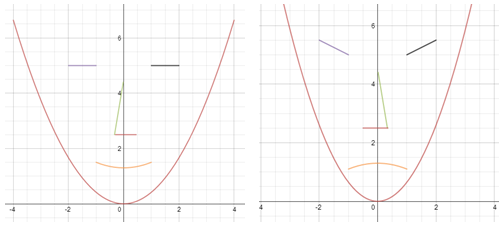
With Function Carnival, we ask students to graph something they see, to draw a graph by clicking with their mouse or tapping with their finger.

We also ask students to make arguments about incorrect graphs.

I’d like to know another online math curriculum that assigns students the tasks of drawing graphs and arguing about them. I’m sure it exists. I’m sure it isn’t common.
2. We can give students more useful feedback than “right/wrong” with structured hints.
Currently, students submit an answer and they’re told if it’s right or wrong. If it’s wrong, they’re given an algorithmically generated hint (the computer recognizes you probably got your answer by multiplying by a fraction instead of by its reciprocal and suggests you check that) or they’re shown one step at a time of a worked example (“Here’s the first step for solving a proportion. Do you want another?”).
This is fine to a certain extent. The answers to many mathematical questions are either right or wrong and worked examples can be helpful. But a lot of math questions have many correct answers with many ways to find those answers and many better ways to help students with wrong answers than by showing them steps from a worked example.
For example, with Function Carnival, when students draw an incorrect graph, we don’t tell them they’re right or wrong, though that’d be pretty simple. Instead, we echo their graph back at them. We bring in a second cannon man that floats along with their graph and they watch the difference between their cannon man and the target cannon man. Echoing. (Or “recursive feedback” to use Okita and Schwartz’s term.)

When I taught with Function Carnival in two San Jose classrooms, the result was students who would iterate and refine their graphs and often experience useful realizations along the way that made future graphs easier to draw.
3. We can give teachers better feedback than columns filled with percentages and colors.
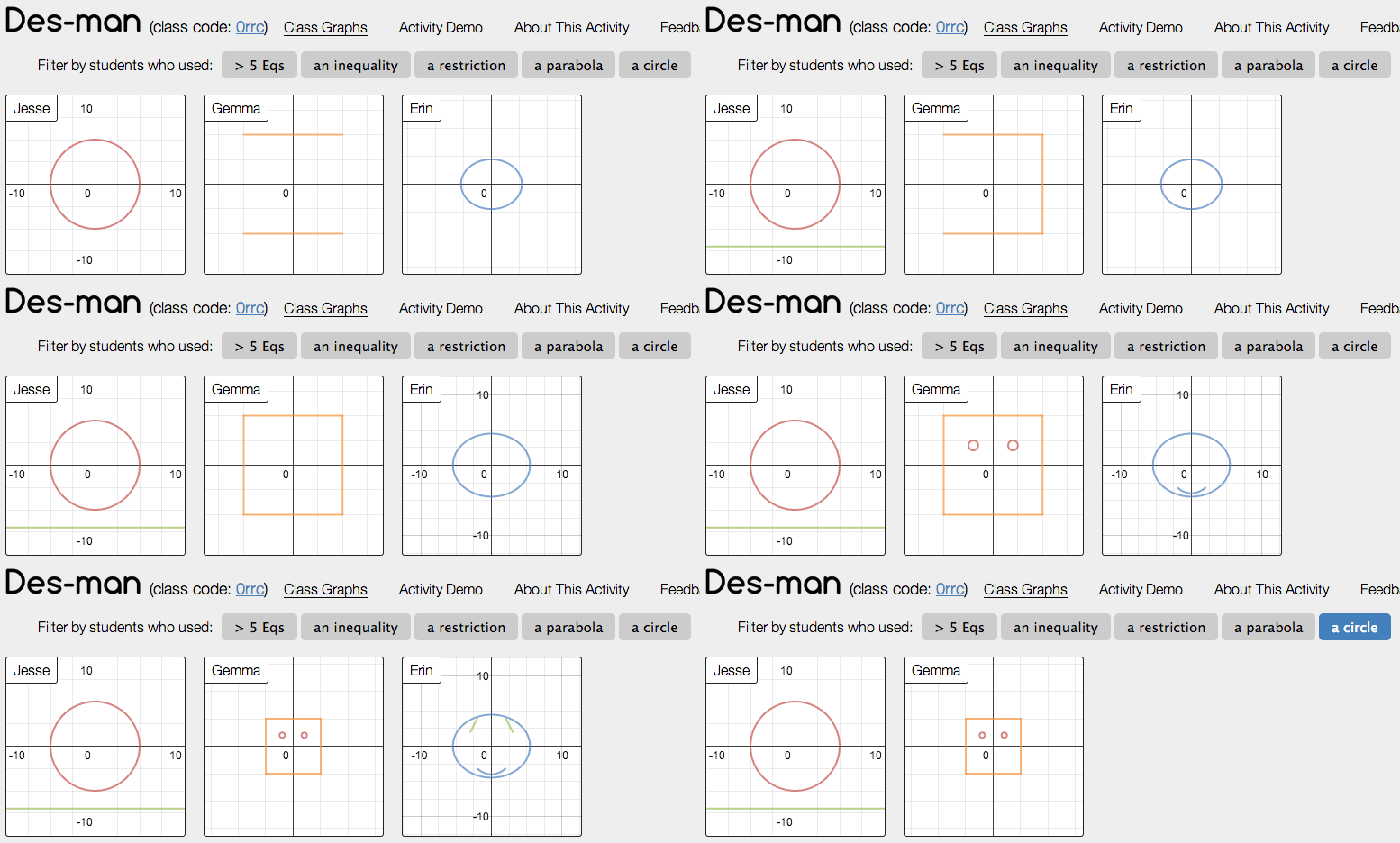
Our goal here isn’t to distill student learning into percentages and colors but to empower teachers with good data that help them remediate student misconceptions during class and orchestrate productive mathematical discussions at the end of class. So we take in all these student graphs and instead of calculating a best-fit score and allowing teachers to sort it, we built filters for common misconceptions. We can quickly show a teacher which students evoke those misconceptions about function graphs and then suggest conversation starters.

A bonus claim to play us out:
4. This stuff is really hard to do well.
Maybe capturing 50% the quality of our best brick-and-mortar classrooms at 25% the cost and offering it to 10,000% more people will win the day. Before we reach that point, though, let’s put together some existence proofs of online math activities that capture more quality, if also at greater cost. Let’s run hard and bury a shoulder in the mushy boundary of what we call online math education, then back up a few feet and explore the territory we just revealed. Function Carnival is our contribution today.