The Task
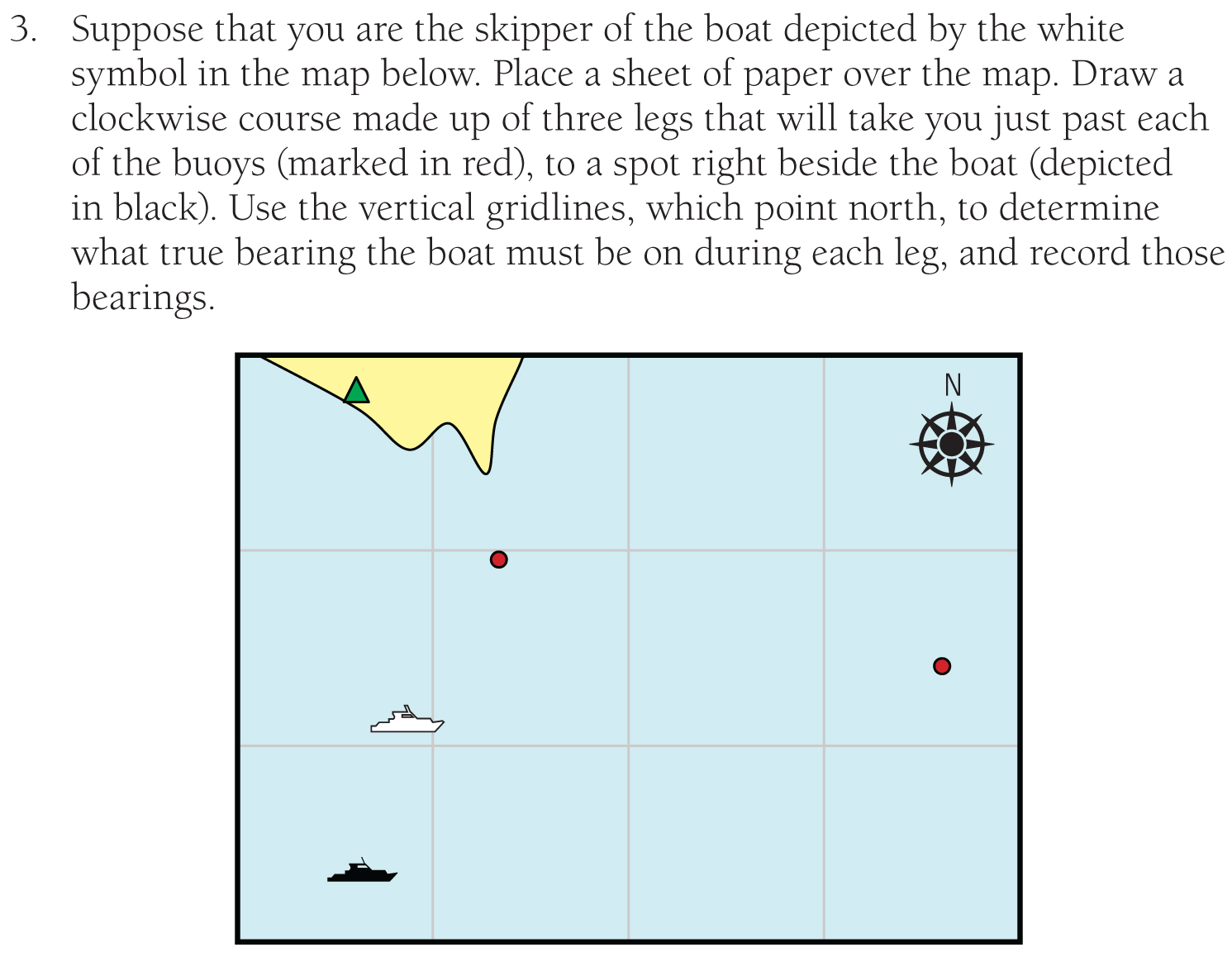
This is another task from MathWorks 10.
What Dave Major And I Did
I don’t have any huge beef with this task. I like that students get to pick their own route. Those kind of self-determined moments are tough to come by in math class. Here, the buoys are pre-determined but students get to make their own path around them. So we get the motivation that comes with self-determination but feedback isn’t the chore it would be if students got to choose the placement of the buoys also.
Establish a need for the bearing format. We’re going to take a cue from the research of Harel, et al. Rather than just introducing the bearing format as the next new thing we’re doing in math class, we’ll put students in a position to see why it’s necessary.
Offer an incentive for more practice. We’re going to make it really easy and enticing for students to try different routes, learning more about degree measure and bearings with each new route they try.
Raise the ceiling on the task. Rather than moving along to another context and another question, let’s stay right here in this one and do more.
Show this image.
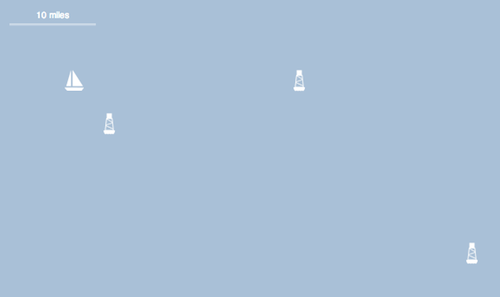
Ask students to write down some instructions that tell the boat’s blind skipper how to navigate around the buoys and return to its original position. Don’t let this go on all that long. Whenever we’d like students to learn new vocabulary or notation, it’s useful for them to experience what it’s like to communicate without that vocabulary and notation, if only briefly.
Write the notation “50 miles at 60° South of East” on the board and ask them what they think it means. After some brief theorizing, send them to this website where they can test out their theories.
Then they can create a series of bearings that carry them around the buoys.
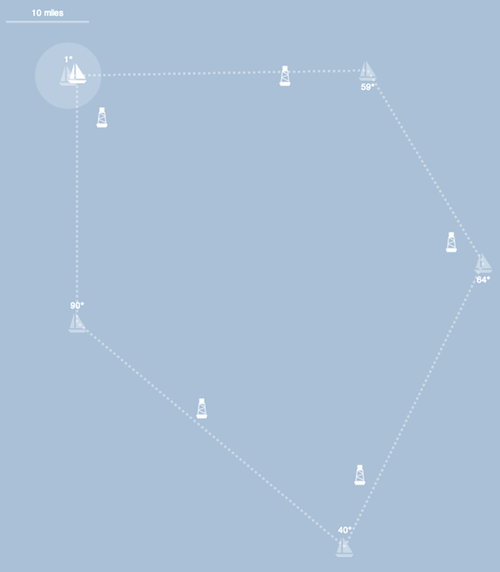
We’ve timed the boat’s path. But this isn’t the kind of timing you find on timed multiplication worksheets that freaks kids out for no discernible benefit. The timer here gives students feedback on their routes. The feedback is also easy to remediate and change. Feel free to try again and do better than your previous time. Or, if you’re feeling competitive, perhaps you want to try for the best time in class. (Or the worst time. That isn’t simple.)
Move on to the next page where we give you a series of bearings and ask you where the boat will come to rest. I find it tough to get inside 10 miles worth of error here.
If we wanted to draw this out even further, we might have:
- featured multiple courses.
- let students create their own courses and challenge their classmates.
What You Did
- Frédéric Ouellet animated the boat in Geogebra. As with the work of a lot of expert Geogebraists, it seems as though the interesting mathematics is in making the animations or the sliders and has been done by the teacher, not the student.
- L Hodge offers another Geogebra applet, one that puts more of the math onto the student.
- Lindsay also asks her students to describe the path of the boat without yet knowing the vocabulary.
2013 Aug 21. It strikes me that some useful questions for provoking an understanding of degree measure would include:
- What do you think “-20° North of East” means? Is there another way to write it?
- What do you think “120° South of West” means? Is there another way to write it?