Category: futuretext

Total 21 Posts

GraphingStories.com Is Open For All Your Graphing Story Needs

Five years ago I released a collection of 10 fifteen-second videos that helped orient my students to abstract and graphical representations.

Kids like them.

Last year I asked you guys to submit your own graphs and stories which I edited together by hand.

Today, in a joint collaboration with the BuzzMath team, we’re releasing 24 of those videos for immediate download and use in your classrooms, all tagged by content and math. (ie. “a step function about ponies”)

You guys were way more creative than I had anticipated:

Call for Submissions (Sort Of)

I’m never gonna do what I did a year ago ever again. Editing all those videos by hand took months of my time and probably a year off my life. But I would like to know what holes you see in this library and what we can do to plug them.

Do we need more videos with periodic functions? Do we need more videos featuring bacon? Suggest them in the comments. If it’s a good idea and you can film the video, I’ll make your graphing story on a case-by-case basis. This thing will grow larger and awesomer.

BTW. Be sure to drop a tweet @BuzzMath thanking them for their killer work here.

Riley Lark’s Red Dot

We know there are important steps [pdf] you can take to ready students for an explanation of key concepts. Riley Lark is helping you do several of them very easily with his open source ActivePrompt project. While Dave Major and I continue to bat around very specific implementations of digital curricula, Riley has created an extremely open framework, useful for all kinds of purposes.

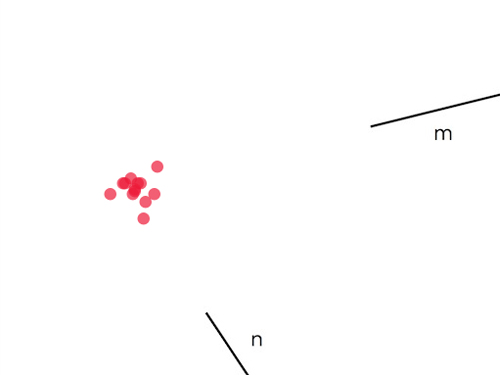
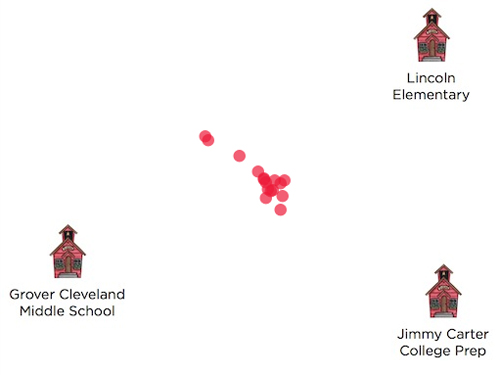
This is everything: the student sees an image and has to place a red dot somewhere on top of it according to instructions given by the teacher. It sounds too simple to be of any use.

Two Uses

Drag the red dot to where you put the cafeteria so that it’s the same distance from each school.

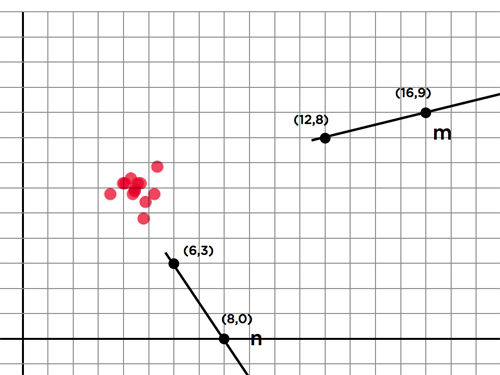
Drag the red dot to where line m will intersect line n.

You see where this goes, right? Even with the second prompt, which isn’t explicitly “real world” in the sense that we usually mean it, students now have experience with the context, which makes it real to them.

Then we start to abstract it and help students work with these concepts:

These brief experiences help immensely to set up and motivate the explanation that follows. It would be great (note to Riley) if the teacher could establish the correct answer at the end of the task (a teacher dot) which would then inform the students how close their guesses came. Also: student names on mouseover, mobile compatibility, vertical lines, and horizontal lines.

You can play with it immediately on Heroku. Be sure to link up your creations in the comments so we can all play along.

BTW. My hope in sharing Dave Major’s work and Riley Lark’s ActivePrompt and my own experiments is that you will become agitated and unhappy with whatever curriculum you are currently using, and that you will express that agitation and unhappiness to the people who publish and sell you that curriculum. None of us are anywhere close to nailing the question, “What do you do on day [x] with concept [y]?” for the entire set of x and y. But before we answer that question, we need to define the modern digital textbook. So here’s my pullquote definition, heavily informed by Dave and Riley’s work:

The modern digital textbook isn’t a collection of content to be consumed. It’s a collection of experiences, of which content consumption is only one part.

Riley Lark’s red dot is one of those experiences.

2012 Nov 29. Riley Lark takes you behind the scenes and shows off several creative ActivePrompts.

2012 Dec 4. Learning Catalytics (a for-profit product) seems to have done a lot of good work in this area already.

Better Online Math

tl;dr version

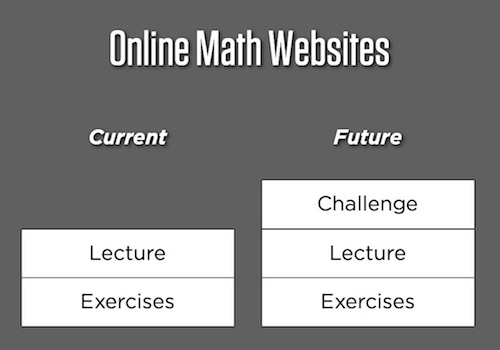
Currently, online math websites comprise video lectures and machine-scored exercises.

For several different reasons, online math websites should add an introductory challenge that activates a student’s intuition and intellectual need. The video lecture should then be directed at satisfying that particular intellectual need.

Here’s an example. Let’s make this happen.

tl version

Online math sites are quickly defining math down to a) watching lecture videos and b) completing machine-scored exercises. I’m not going to re-litigate whether or not that definition of mathematics is as good as what we find in the best classrooms in the highest-performing countries. (It isn’t.) Instead, I’m going to take this online model for granted and ask how we can make it better.

What should we improve? It isn’t the lectures.

For some time there, I was meeting with founders who were pitching their startups as “Khan Academy plus [x]” where x was anything from better graphics, better lesson scripting, a face on the screen, or multiple choice questions embedded in the video. (Here’s basically the entire set of [x] at once.) I don’t believe there’s much value to add there. The Mathalicious lecture videos are beautifully shot. TED-Ed pairs their lecturers with world-class animators. Woodie Flowers wants to see Katy Perry and Morgan Freeman narrate these videos (I think he’s at least half serious) and my suspicion is that we have reached a point of diminishing returns on the efficacy of lecture videos. Once we passed a certain point of coherence and clarity, watching Drake rap over a combinatorics lecture animated by the Pixar team just isn’t adding a helluva lot. If math were only about clear and coherent lectures, we could probably close up shop here in 2012. Thankfully, there’s more interesting work to be done.

So what should we improve? It probably isn’t the exercises either.

The machine learning crowd seems very impressed by the millions of rows in their databases which represent the clickstream of hundreds of thousands of users. That clickstream can tell a teacher how many hints the learner requested, how long she spent on a given problem, whether she’s more apt to score well on machine-scored exercises in the morning or evening. But what the learner and her teacher would really like to know is what don’t I understand here? And machine learning has added very little to our understanding of that question. So there’s certainly value to be added there but I’m pessimistic that machines are in any position right now to evaluate a written mathematical assessment at anywhere near the skill of a trained human.

So what should we improve? We should improve what happens before the lecture.

Currently, the online math experience begins with a lecture. The implicit assumption is that students need to be talked at for awhile before they can do anything meaningful. Not only is that untrue but it results in bored learners and poor learning.

Dan Schwartz, a cognitive psychologist at Stanford University, prefaced student lectures with a particular challenge [pdf]. He asked students to do something (to select the best pitching machine from these four) not just to watch someone else do something. Those students then received a lecture explaining and formalizing what they had just done. Those students scored higher on a posttest than students who were pushed straight into the lecture without the introductory challenge.

I’ll show you an example of how this could work online. Head to this website and play through.

Let me explain what I’m trying to do there. First, any student who knows or can intuit the definition of “midpoint” can attempt that opening activity. It’s an extremely low bar to clear. The lesson will ultimately be about the midpoint formula but we haven’t bothered the student with a coordinate plane, grid lines, coordinate pairs, or auxiliary lines yet. Save it. Keep this low-key for a moment.

Once the student guesses, she sees how her classmates guessed, which queues everyone to wonder, “Who guessed closest?”

We’ve provoked the student’s intellectual need and set her up with the kind of introductory challenge that prepares her for a future lecture.

So we move into the lecture video, which has several goals:

  1. It references the introductory challenge explicitly. The point of the lecture is to bring some resolution to the conflict we posed in the introduction: “Who guessed closest?”
  2. It offers a conceptual explanation of the midpoint formula, not just a recitation of procedures.
  3. It explains very explicitly why we use abstractions like x-y pairs and a coordinate plane. This satisfies John Mason’s recommendation that we become much more explicit about the process of abstraction.

After the lecture, the student sees the original problem, now with x-y pairs and a coordinate plane. No longer does she simply guess, aim, and click. She calculates. There’s are blanks for the answer now. We have formalized the informal.

The student calculates the answer and finds out how close she was. We should also throw some love on the closest guesser who may be a student who doesn’t usually get a lot of love in math class.

After that resolution, we ask students to practice their skills, but not just on automatically generated clones of the same problem template. We give them the midpoint and ask them to work backwards to one of the original points. That’s essential if you want me to have confidence in your assessment of my student as a “master” of the midpoint formula.

That’s it. An intuitive challenge that precedes a lecture video that explains how to resolve the challenge. That’ll result in more engaged learners and better learning.

Other examples?

And on and on and on. There isn’t a recipe for these challenge but I know two things about all of them:

  1. Math teachers have a stronger knack for creating these challenges than people who haven’t spent years fielding the question, “Why am I learning this?” fourteen times a day.
  2. These challenges are more fun when they’re social. It’s one thing to see my own guess at the midpoint. It’s another thing entirely to see all my classmate’s guesses next to mine. We need the Internet to facilitate that quick, cool social interaction. It just isn’t possible with bricks and mortar alone.

Current online math websites have managed to scale up the aspects of decades-old math learning that few of us remember fondly. We can tinker around the edges of those lectures and exercises, adding a constructed response item here or a Morgan Freeman narration track there. Or we can try something transformative, something that draws from the best of math education research, something that takes advantage of the Internet, and makes math social.

BTW:

  1. I made that site for my final project in Patrick Young’s summer Front-end Programming course at Stanford, which, as I mentioned previously, was a pile of fun. If I can make that site in a couple weeks with a thimbleful of programming knowledge, I’m eager to find out what your team can do with its acres of talent and piles of VC funding or non-profit donations.
  2. This isn’t real-world math. I thought initially to pull in some tiles from Google Maps and set up a scenario where the student had to place a helicopter pad exactly between two cities. I don’t think it matters. Students ask “Why am I learning this?” because they feel stupid and small, not because they want you to force a context onto the mathematics. I’m trying to demonstrate that here. Everyone can click on a guess. No one feels stupid and small. Any context would be beside the point.
  3. Cost-benefit analysis. Too often we apply a benefit-benefit analysis to edtech. But there are clear costs to the model I’m suggesting here even apart from the cost of the technology itself. There were at least five different moments over that five-minute lecture where I wanted to stop, pose a question, or have students work for awhile. We lose that here. I acknowledge those costs. We may still come out ahead on benefits if we can scale this up cheaply. “Pretty good” times millions of students may outweigh “great” times thirty.

2012 Nov 7.

A couple of useful tweets.

I’m concerned the competitive vibe appeals only to males, but FWIW this is exactly the kind of reaction I’m trying to provoke.

It isn’t! It’s passively discouraged, which is a huge bummer. I can think of at least two ways a student might think about the midpoint and how to find it. You can take half a side of the right triangle and add it to the point with the smallest value or you can subtract that half from the point with the largest value. Those multiple methods and the discussion about their equivalence are to be prized and they’re lost in the video lecture format. They’re lost. That’s absolutely a cost and not a small one.

2012 Nov 12. Mr. Samson reminds me of the Eyeballing Game, which has been nothing if not an enormous inspiration for the work I’m doing here.

2012 Dec 7. David Lippman does this discussion a favor and creates an environment where the video pauses for student input. Discuss.

Featured Comment

Michael Serra, author of Discovering Geometry:

Curiosity and engagement will always trump “real world” applications. Games, puzzles, being surprised or caught off guard with something new and trying to find out why, these are big tools in our teacher toolbox.
Dave Major Shows You The Future Of Math Textbooks

I’ve been trading e-mails over the last few weeks with Dave Major, a teacher in Dubai who also knows how to use code to make dreams come true.

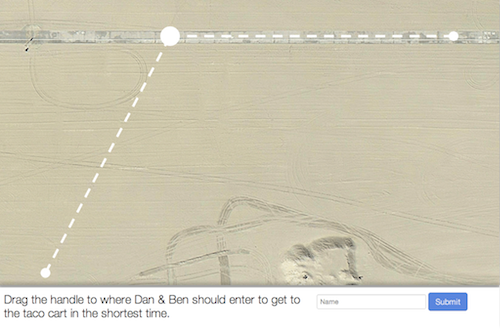
For instance, I wrote a mushy love ode to the Taco Cart task of my dreams. Dave Major made it real.

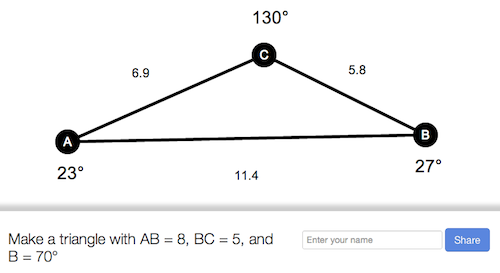
Then I asked him to create an activity I described in this talk at 28:01. We ask students to create a triangle with certain specifications. They submit their triangle and then they see quickly and easily whether or not everyone else created the same triangle from the same specs. If they did, we should prove that it’s impossible to create another triangle. If they didn’t, then we have a counterexample and we can axe the hypothesis.

Dave put it together. You should check it out. He’s giving you a look at the math textbook of the future, several years early.

Featured Comment

Andrew:

I keep thinking of learning a programming language, but didnโ€™t quite have a reason why. I think I have one now.

Building A Better Taco Cart

And by “taco cart” I mean “digital math curriculum.”

I made Taco Cart out of videos and photos. I’m comfortable making math curricula out of videos and photos but I’d rather build them out of code.

Here’s the Taco Cart I wish I had made. Implicitly, here, I’m admitting I’m in over my head. I need a new set of skills or a new set of collaborators.

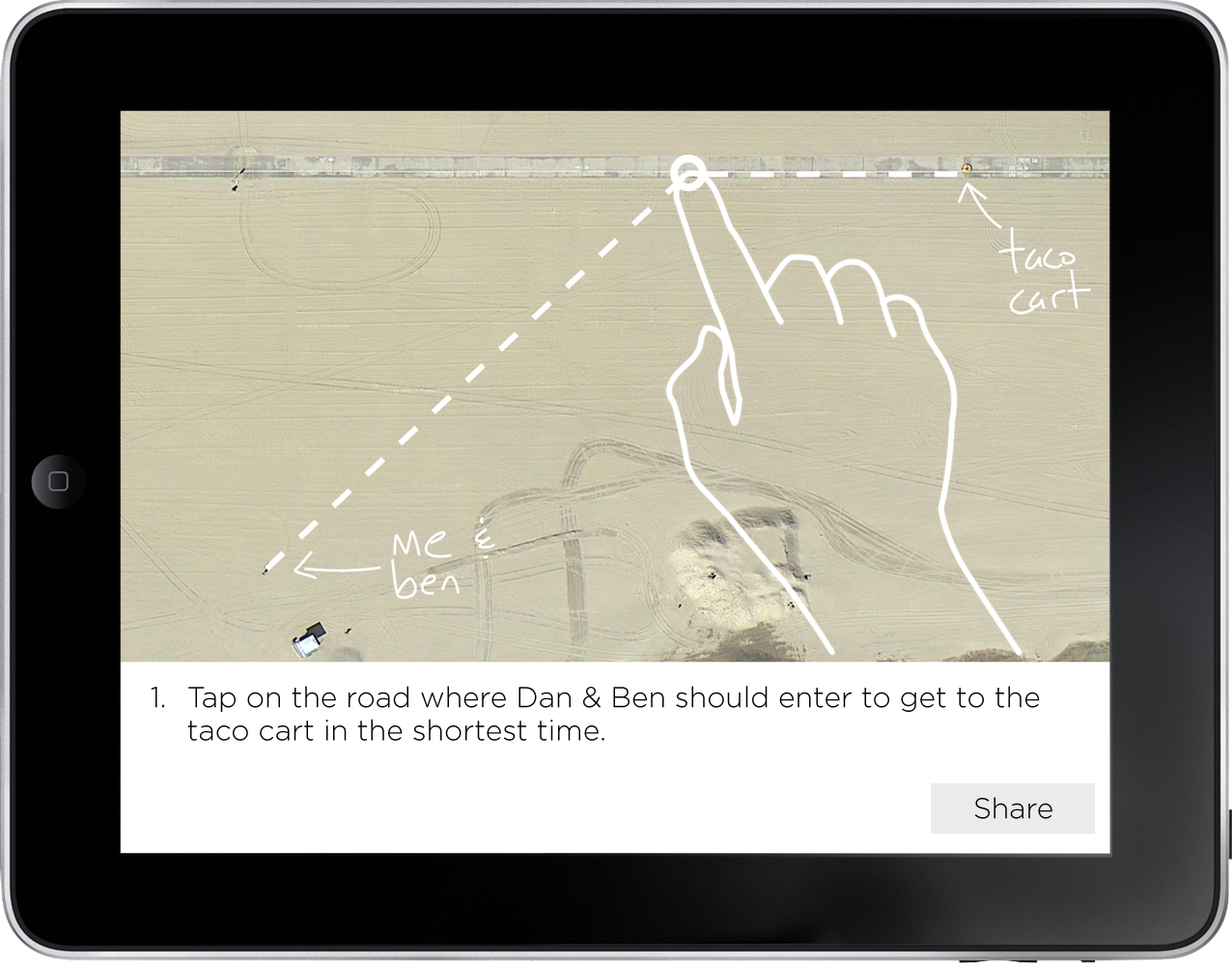
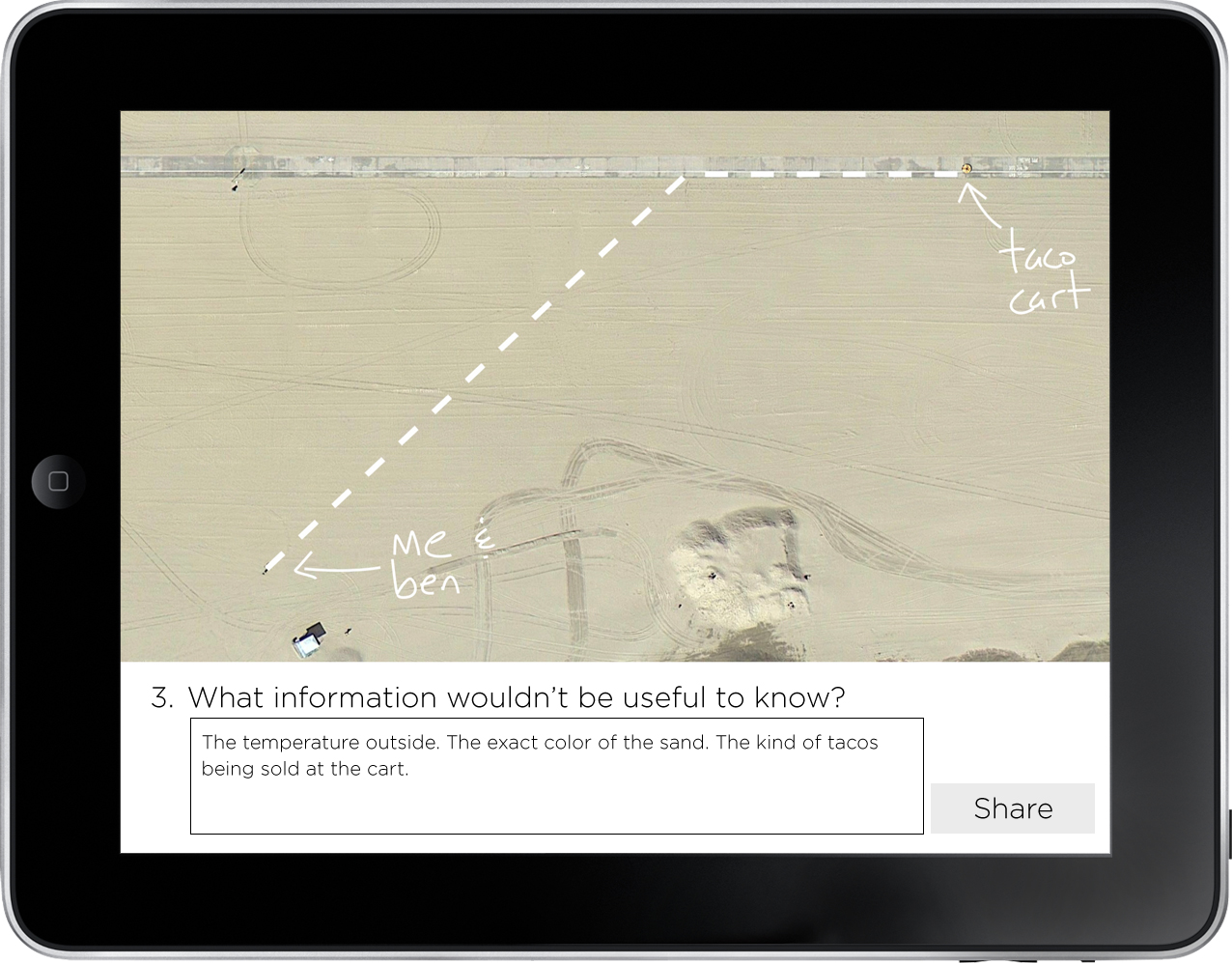
Currently, I’m asking students to guess where Ben and I should enter the roadway to get to the taco cart as fast as possible. But how do they register that guess? Do they point to it? Do they make a mark on a printout of the scene?

Let’s give them tablet computers, instead, and let them slide their fingers down the road until they’re happy with their guess.

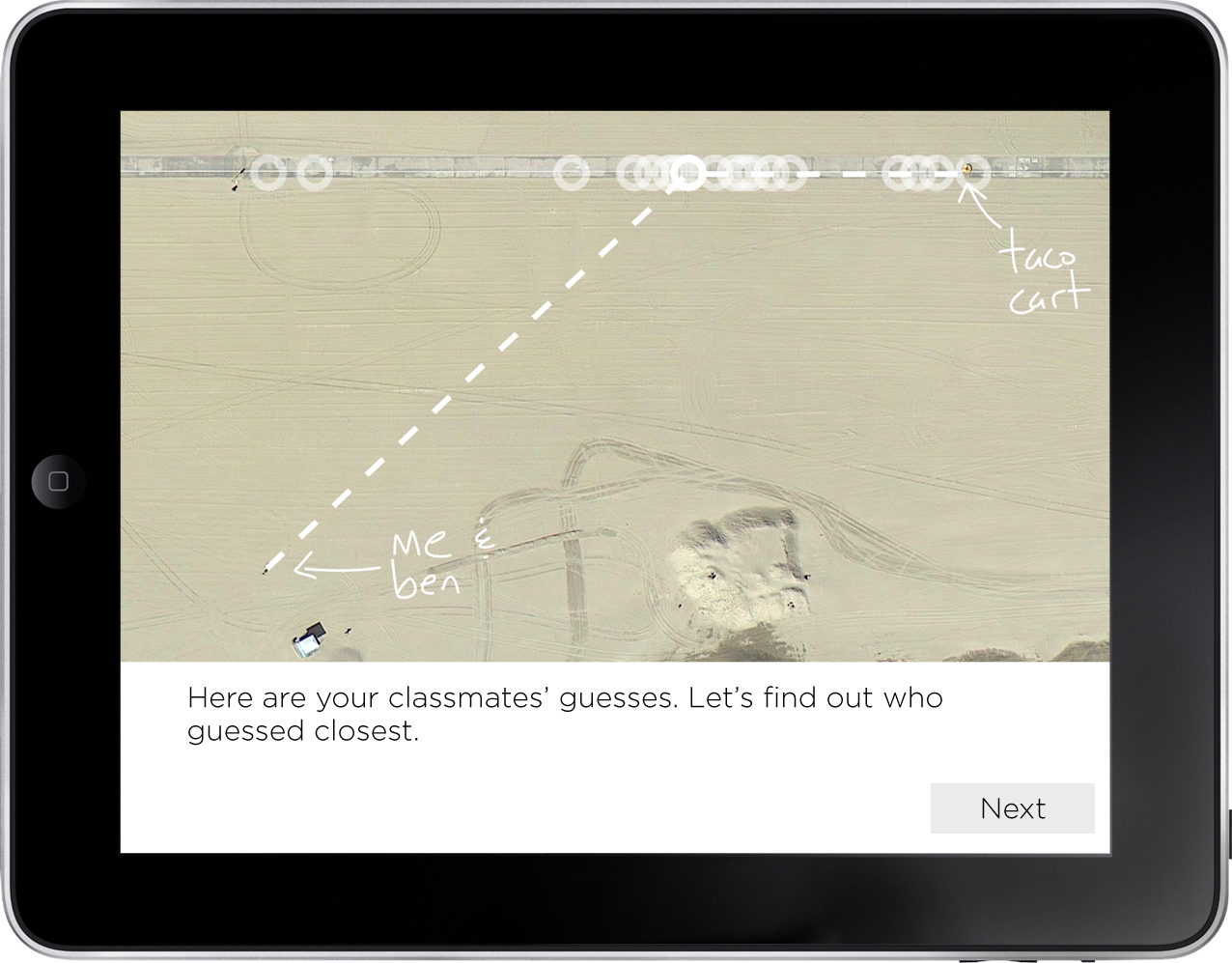
Then they see all their classmates’ guesses. Ideally those guesses are all attached to faces or names somewhere so you can see how your best friend or the girl you have a crush on guessed. This ratchets up their perplexity. Who guessed closest?

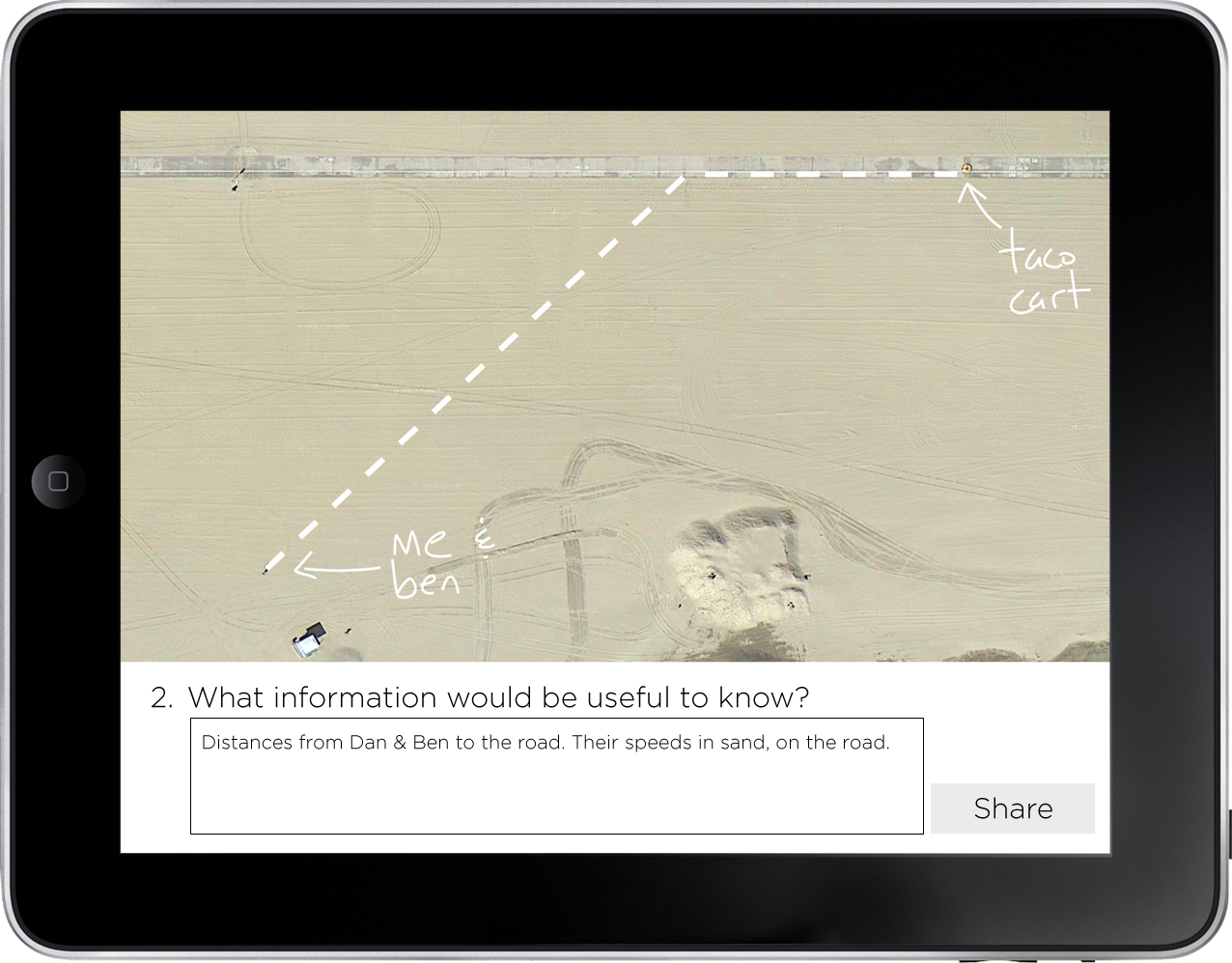
Then we ask them what information would be useful. This is abstraction. We’re giving the students a chance to extract the essential features of the context.

We ask them to discard the inessential features of the context.

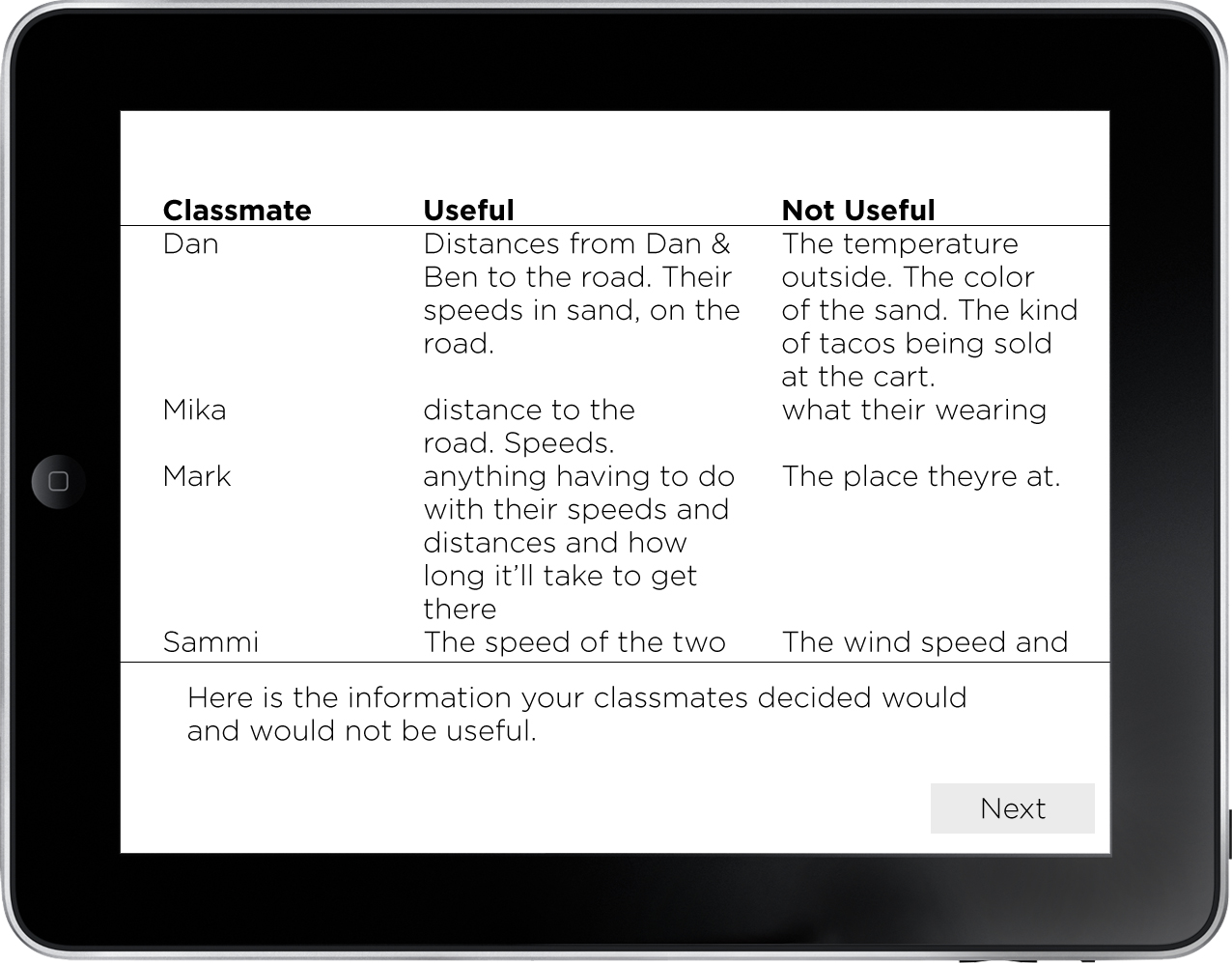
The tablet summarizes the class’ responses. The teacher can use this information to seed a brief discussion.

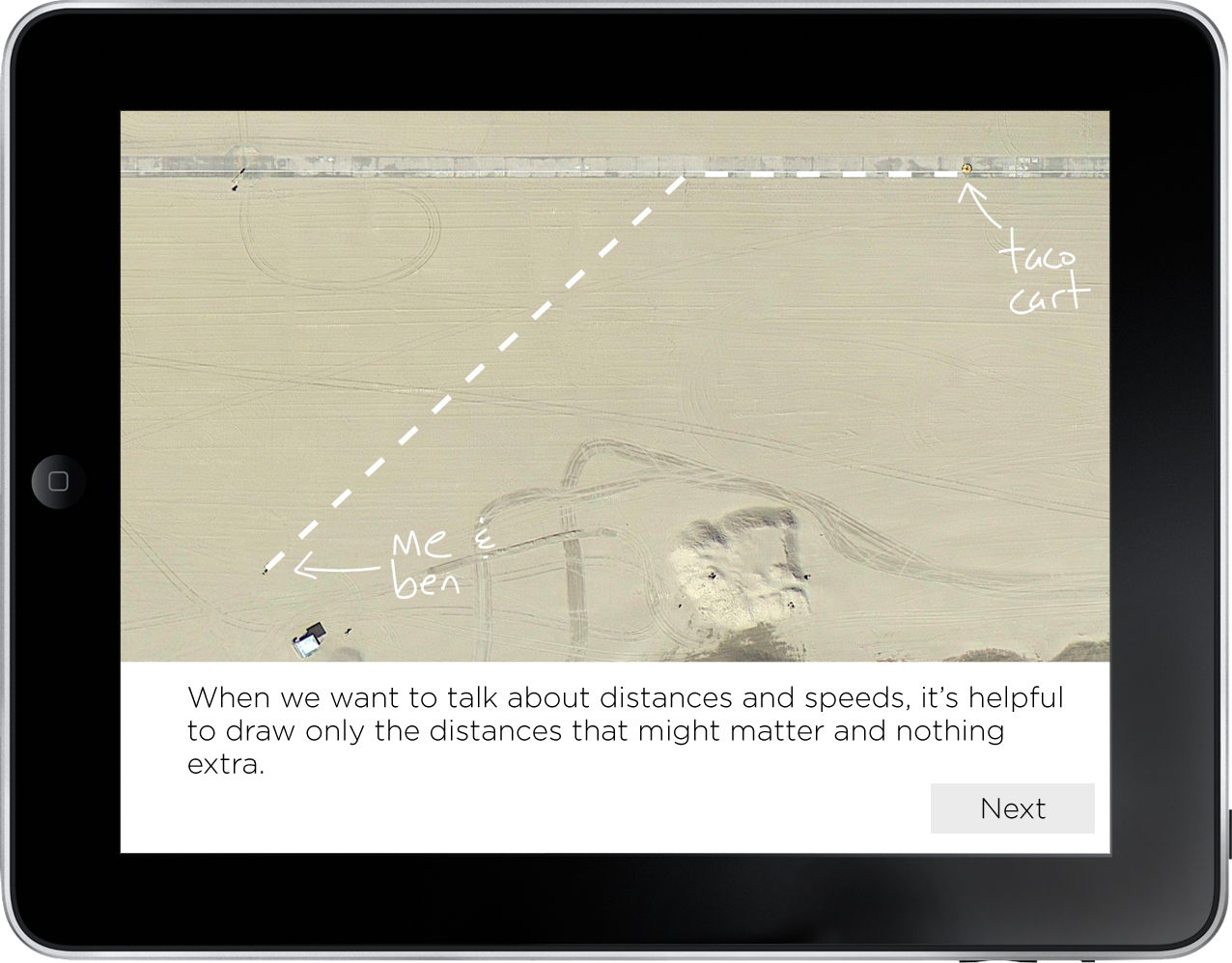
What happens next is violent. We’re going to vaporize the world. We’re going to strip away the sand. We’re going to destroy the buildings. We’re going to wipe Dan and Ben and the taco cart off the map and replace them with points and lines. If you’ve studied math at the university level, it’s possible you’ve lost touch with the violence inherent in mathematical abstraction.

So we scaffold that process briefly. We prepare the student. We say, “We’re going to get rid of a bunch of stuff you said was inessential and represent the rest as neatly as possible.”

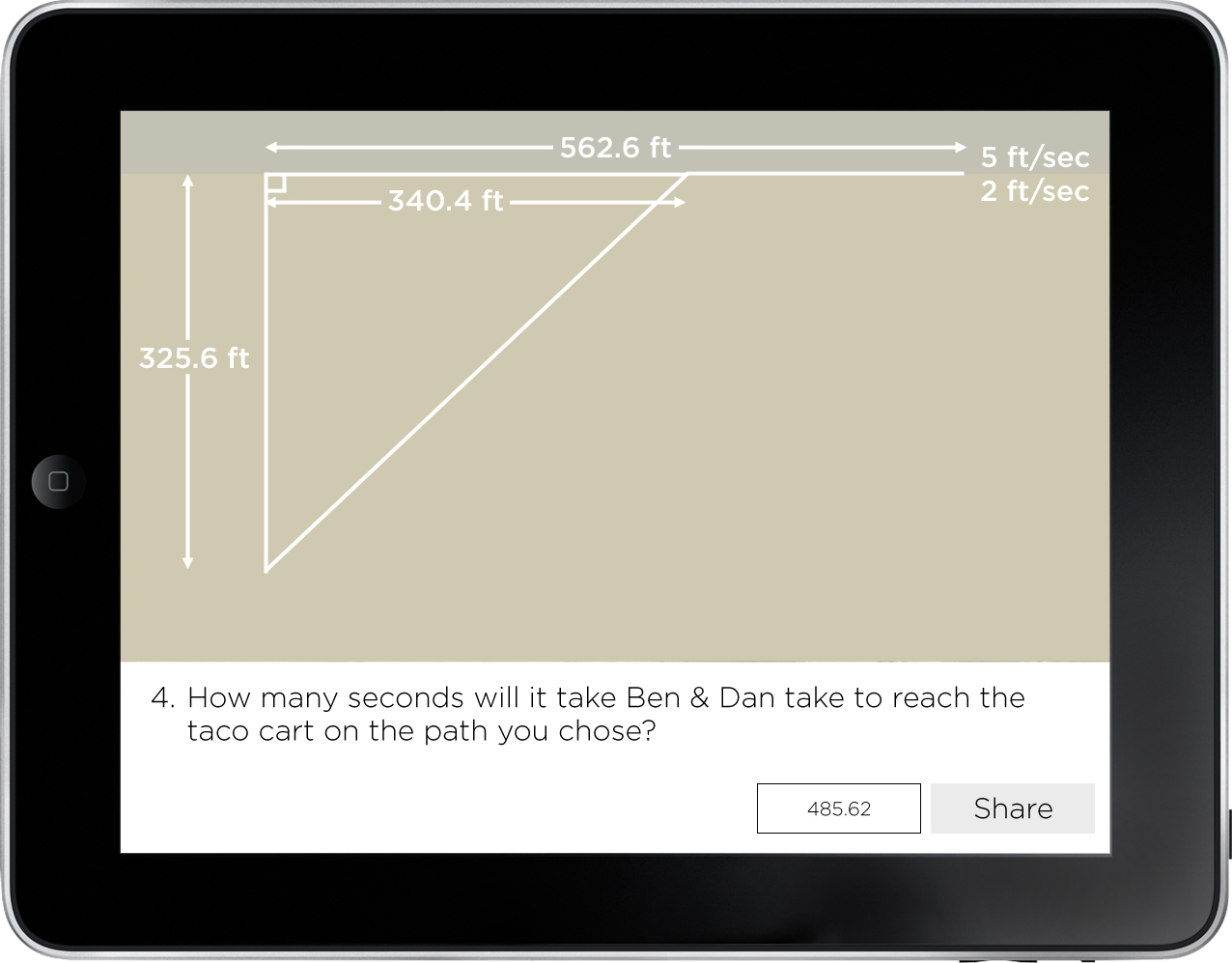
Now this is interesting. Each student is given her own task, a task that she, herself, picked. “You guessed that this would be the fastest path,” we say. “Go ahead and figure out how long your path would take.”

This is more fun than evaluating the duration of a generic path and it’s easier than differentiating the generic path and solving for its minimum. It isn’t all that much more difficult for the teacher to check either because everyone is performing the same calculation, just on a different value.

Everybody enters their results. The tablet checks them for correctness and then displays them.

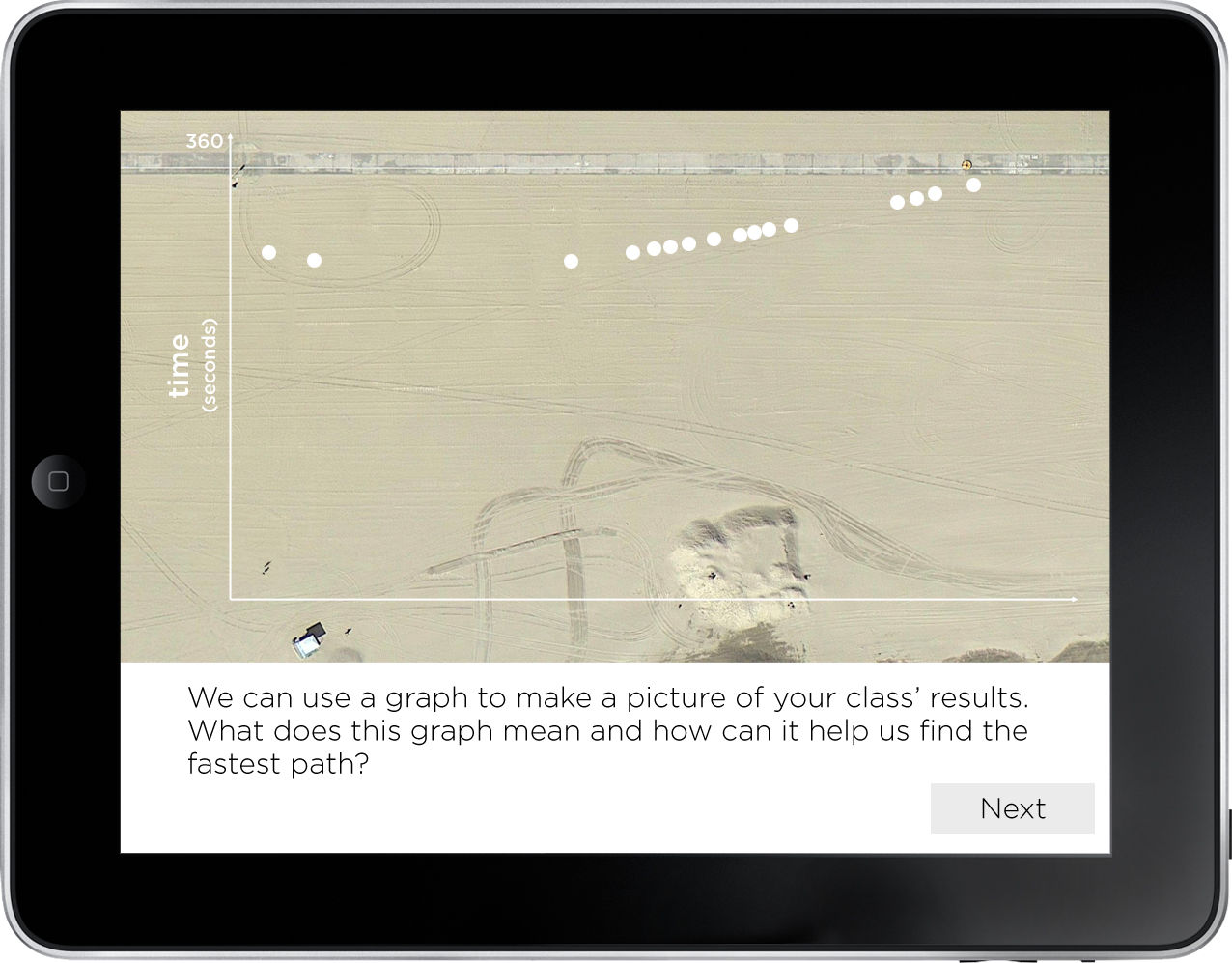
Remember that everybody is doing the same calculation on a different value? [BTW: Christopher Danielson is right that I overstepped myself here.] That means it’s abstraction time again.

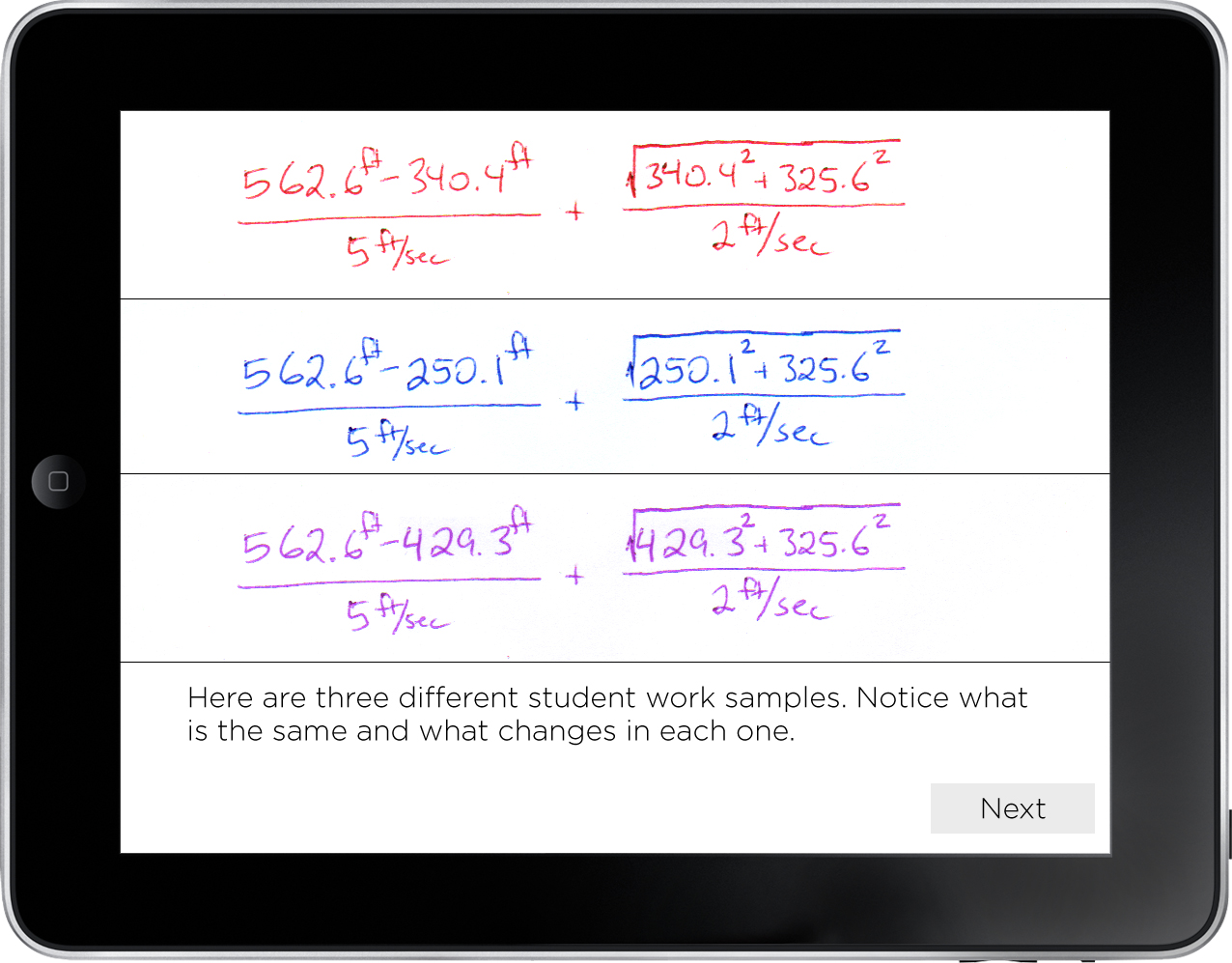
We pull out three student pages (never mind that these are all from the same person) and we ask the students to notice what changes and what doesn’t.

We turn the thing that changes into a variable. But why? Because math teachers need the work? Because math teachers amuse themselves with this notation? No. Because it lets us try any value we want really quickly. What are the highest and lowest values we should try?

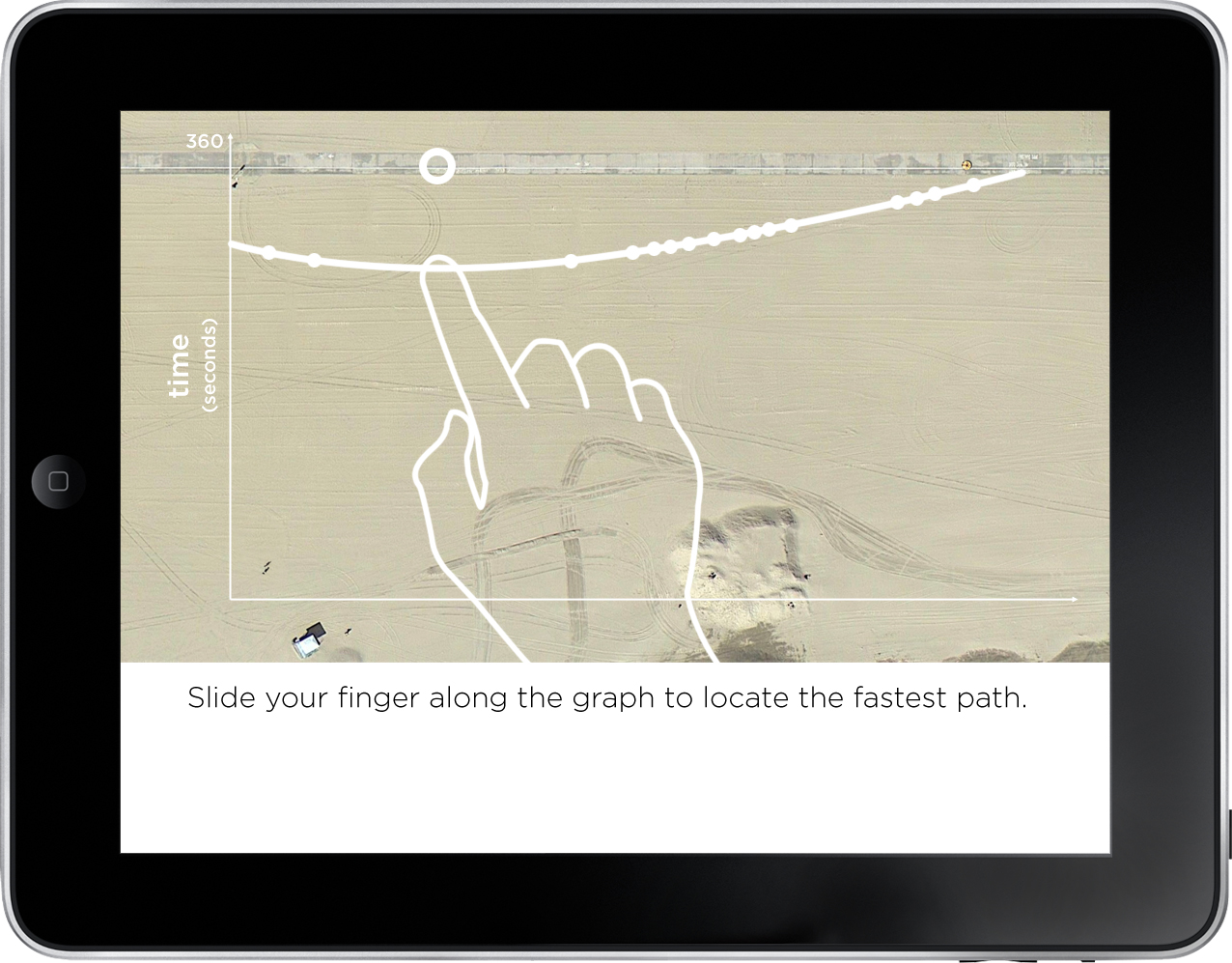
The student slides her finger along the graph and the path adjusts with it. The tablet snaps to points of interest like minima and maxima and displays the value of the graph at those points.

From here we’d play the video that shows that answer. The tablet would find out which student guessed the closest initially and throw some love on her.

A Few Closing Notes Before I Ask Your Opinion About This Kind Of Curriculum

  • On the upside, this task attempts to clarify abstraction for students and make that process participatory. It involves the entire ladder. Students pick their own math problem. Students are guessing. They’re deciding what information is useful and useless. ¶ Look at the original task and imagine how many more students are included in this re-imagining. ¶ The task is also social in a way that’s difficult to achieve without 1:1 technology. The tablet collects and represents the entire class’ guesses in real-time. A teacher can’t do that.
  • On the downside, I’m not sure what the teacher does in this sketch. At different times, I wobble between having the textbook function as the teacher and having the textbook simply maintain a steady course through the problem. If I taught this problem, I know I’d handle a lot of the exposition (ie. “Here’s why we use variables.”) myself, in conversation with students. But what should the textbook do? ¶ Also, we didn’t differentiate the function and solve for the minimum. We formulated the model and solved it graphically. Does that still count as math?

Now you go.

2012 Oct 11. Dave Major went out on spec and put a lot of this into code. It’s exciting.