Category: lessons

Total 93 Posts

Global Darkening

The Daily Show made great work last week out of our tendency to confuse short-term fluctuations with long-term trends, shining a particularly bright spotlight on the it’s-cold-outside-so-global-warming-isn’t-real crowd. I found the clip so effective, I downloaded it, and tucked it safely away in my vault.

Click through to view embedded content.

BTW: xkcd on the same issue.

BTW: Not for nothing, this is exactly how my mind worked. When I was ten.

Score One For The Forces Of Innumeracy

In these exponential times, I admit that even I find it easy to nod my head credulously at a passage like this:

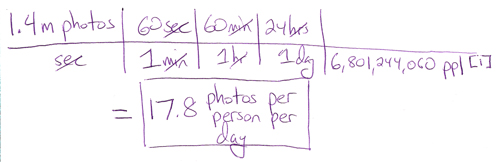
When it comes to [Facebook’s] online chat function, 1.6 billion messages are sent every single day and 1.4 million photos are uploaded a second.

Not so Nat Friedman who crunched some numbers in an utterly classroom-appropriate exercise in unit conversion and calculated that this means everyone on Earth is uploading approximately 20 photos per day.

Which means I had better hurry up and get a Facebook account.

[via daring fireball]

[N.B. The Internet has been pretty generous today, right?]

[1] http://www.census.gov/ipc/www/popclockworld.html

What I Would Do With This: Pocket Change

[following up from here]

Appeal To Their Intuition

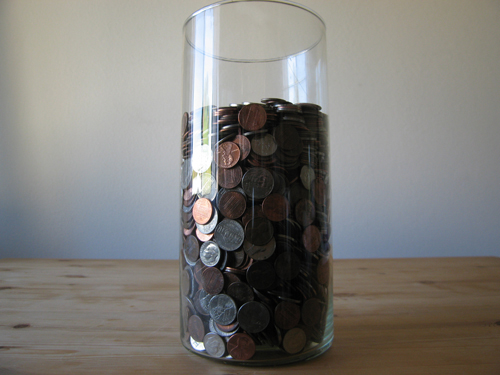
“How much cash is this?” Take guesses. The student risks nothing with a guess but that investment pays off huge for the teacher over the life of the exercise because the student wants to know who guessed the closest.

Build Slowly

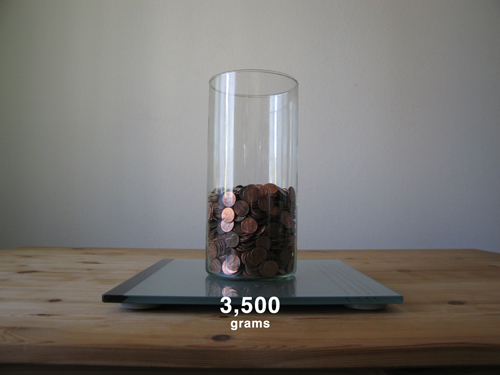
Again, ask “how much cash?” but also ask “how heavy?” Show them the weight. (I zeroed out the jar from every weight measurement you’ll see here. Don’t worry about it.) Spitball some ideas for determining the value of those coins. You’re trying to motivate the idea that the weight of the coins ties directly to how much the coins are worth. Pull up the relevant Treasury website.

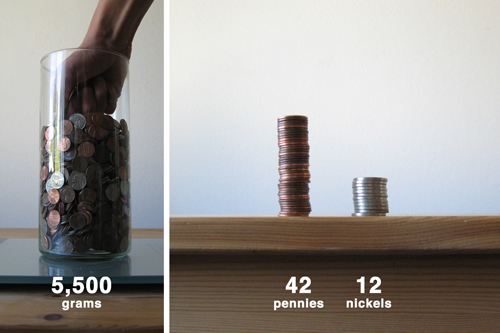
Then mix in some nickels. Scoop out a small sample. Play with that. Set up a proportion between value and weight.

Iterate

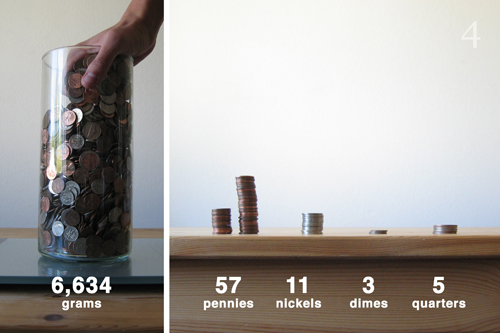
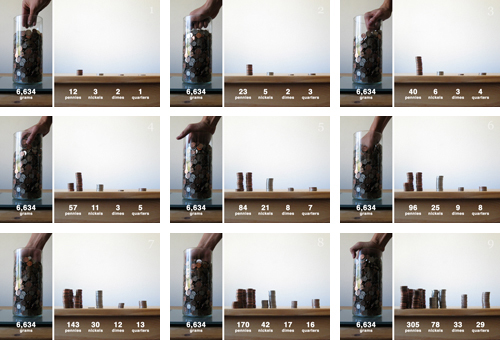
Now you have pennies, dimes, nickels, and quarters. I took nine sample scoops, everything from small to big.

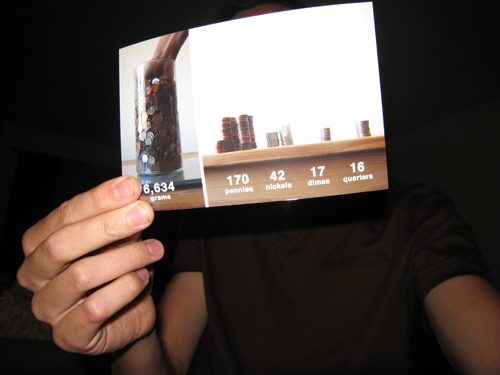
I formatted these at 4×6 so I could print them out at our local one-hour shop for a few bucks and put one in front of every student.

Throw A Curve Ball

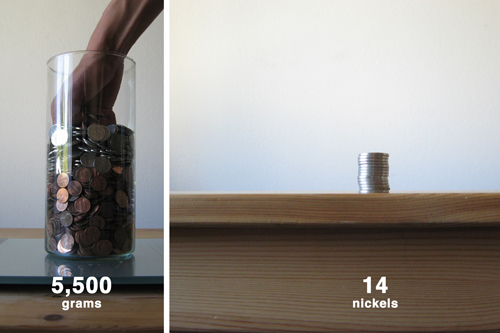
Some will finish quickly. You tell them you have a jar of coins that weighs 5,500 grams. You reach in and pull out 14 nickels. How much is the jar of coins worth?

They’ll run these calculations and come up with an estimate of $55. You tell them it was really $34, which is huge error. Ask for sources of error. Then toss this up and talk about it.

Confirm The Answer

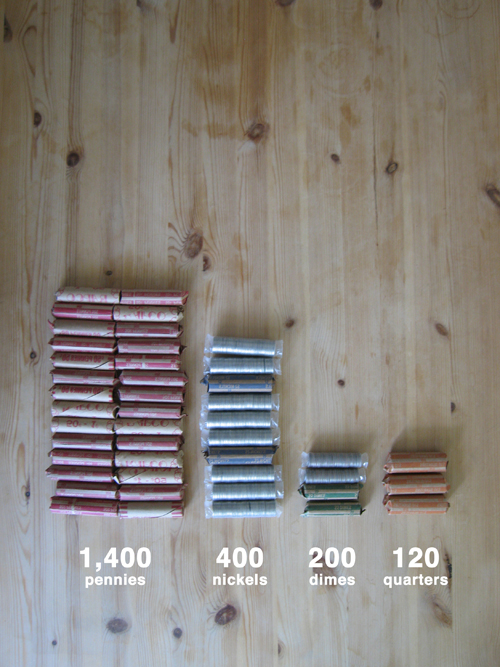
$84.00, if you were curious.

It’s essential to give some kind of visual confirmation of the answer, both so we can give credit to good initial guesses and so we can talk about sources of error. (ie. “who was off by the most? did sample size matter at all?”)

Miscellaneous

  1. Show them CoinCalc, the backend of which does exactly what we’ve done here.
  2. This activity follows-up nicely on the goldfish activity, where we used a small sample of fish to determine the total population of a lake.
  3. We yield the floor to Jason Dyer and anybody else who would like to debate the question, “why are we doing this digitally?”

Download

Here’s the entire learning packet [62MB].
A Second Note On Modern Photography

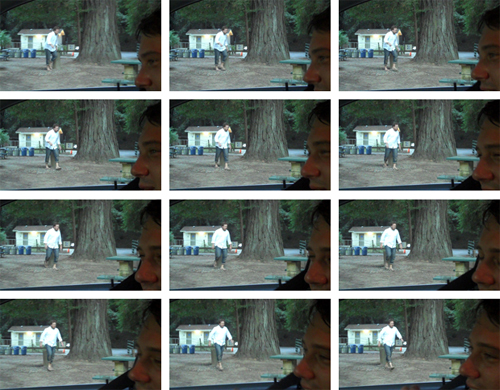
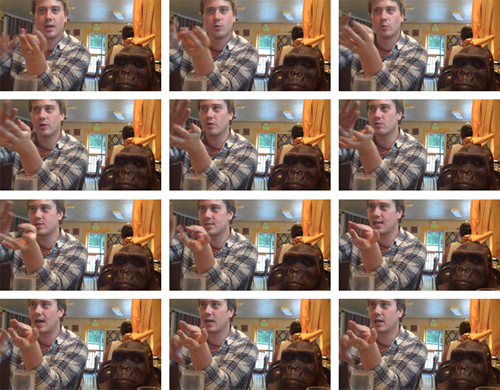
I use my point-and-shoot less and less for still photography and my FlipCam more and more. I realize that with the Flip I’m losing hundreds of thousands of pixels and a much better sensor but I’m also picking up a) portability and, most crucially here, b) a couple dozen more frames per second. Technological advances will eventually close the gap in quality but technological advances are useless to close the gap between the photographer I am and the photographer I want to be.

Check this out. Give a photography student less than a second of video. Twelve frames, maybe.

At what point is the composition balanced?

At what point does the gorilla become the subject?

I have found this kind of deconstruction to be a) essential to my growth as a photographer and b) impossible to achieve using a point-and-shoot camera (or any camera) with a shutter refresh rate of more than a second. That kind of lag has you comparing apples to oranges.