Category: lessons

Total 93 Posts

What Can You Do With This: ELA Edition

I couldn’t sneak this clip past YouTube or Vimeo’s copyright Cylons. Consequently, y’all will have to click a hyperlink to play along.

Download high quality here. See the pilot for instructions.

BTW: Cool stuff in the comments, but I like Mr. H’s suggestions the best, spanning passive voice and inference. (Not that I teach this stuff, of course, so help yourself to that salt lick in the corner.)

How Can We Break This?

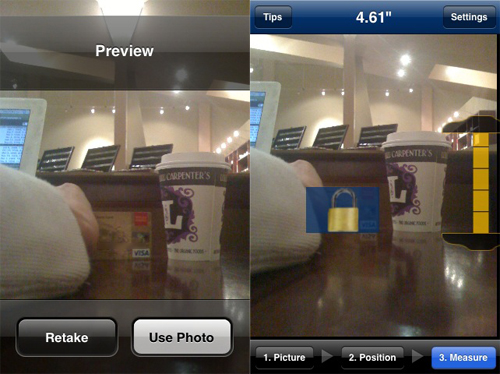
I like this. The iPhone application RulerPhone will measure anything, in any photo, so long as the photo includes a credit card. It’s a great use of proportional reasoning, which, if pressed to name one, would be The Mathematical Skill I’d Most Like My Students To Retain After High School.

I added it to the What Can You Do With This? segment featuring The Bone Collector, which seemed like an obvious pair to me. In trying to find the best classroom entry point for this program, I can only think of the question, “How can we break this thing โ€“ trick it into giving an incorrect measurement?” I imagine someone can do better.

Asilomar #5: Michael Serra

Session Title

Games And Puzzles That Develop Sequential Reasoning

Better Title

OMG MICHAEL SERRA!!1!

Presenter

MICHAEL SERRA!!1!

Narrative

A structure not dissimilar to Megan Taylor’s yesterday, where Serra debuted games and puzzles and gave us time to tease them out.

I sat with two former colleagues in the back โ€“ all of us now at different schools. One teacher enthused over Sudoku puzzles. They challenge kids. Kids like them. It gets them comfortable with numbers. The other enjoys Serra’s games and puzzles, like Lunar Lockout. Both cite improved student disposition toward math and improved deductive reasoning.

I disagreed with them. In general, I find it dangerous to put too much distance between “fun time” and “math time” preferring, instead, to have that cake and eat it too, creating as many challenges as I can that are both fun and mathematically rigorous. (Which Sudoko, to put it plainly, isn’t.) My task is harder, I think, and I know I fail at it more, but I’m more satisfied on balance.

It was a good conversation. Feel free to interrupt us.

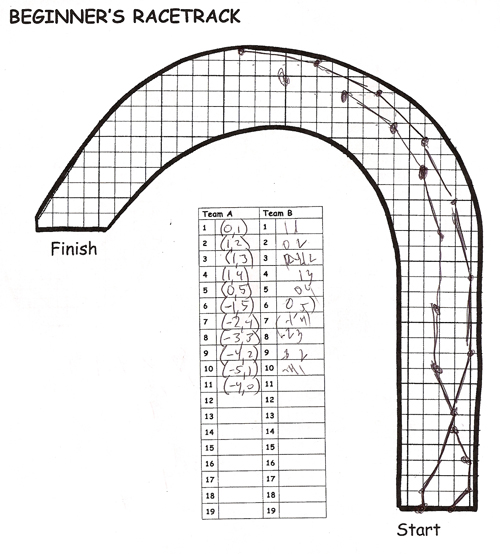
Serra’s best offering for my money was Racetrack Math:

It’s like this:

  1. Draw a racetrack on graph paper, however crude.
  2. You and your opponent start anywhere on the starting line.
  3. You travel along vectors. You may increase or decrease either the x-value, the y-value, or both, but only by one unit per turn.
  4. First person to the finish line wins.
  5. (P.S. No crashing.)

This gets very interesting very quickly. You start out with tiny vectors which lengthen by one unit every turn. If you fail to notice the side of the track off in the distance, though, and fail to slow down in time, you crash. (Which I did in the example above.)

I hereby toss all of my battleship exercises in the recycling bin. This is a much more straightforward introduction to positive/negative coordinates since each new turn is relative to the last turn rather than relative to this strange coordinate axis thing.

Plus, your students can create racetracks of their own, of infinite complexity, within seconds. Serra cited some kids who created a pit lane, which you had to enter on your second lap, and oil slicks, on which you could not adjust your vector at all. I’m impressed.

Visuals

PowerPoint. Which is tough when you’re asking people to solve a puzzle. If someone suggests an alternative route to the one you have programmed into your slide, you have to dodge their answer a bit.

Handouts

Blank puzzles and games to draw on. Again, paper is not dead. How do you do this digitally? Load each picture one at a time into Skitch and pass a stylus back and forth? Moderation, please.

Homeless

  • “There is no research that demonstrates these games improve outcomes in other mathematical procedures like two-column proofs,” Serra admitted reluctantly. “It has to be there. I know it is.
Notes From Homeroom

To recap, this is the first year my school has built a thirty minute advisory period into its weekly schedule. But we’re five weeks into the school year and our advisory binder still has us untangling human knots, breaking ice between students who have known each other longer than I have known my wifeNods at Chris..

So we’re veering wildly off script but the product hasn’t been too ugly. The same kid who called this the most pointless class on her schedule at the start of the year just last week volunteered it as the highlight of her Wednesdays.

What we’ve been about the last few weeks:

  1. We voted on a name for advisory period. The finalists were: a) Purple People Eaters, b) Wombats, and c) Buhemoth, from which Buhemoth was selected somewhat, um, un-democratically. (For the record, my student didn’t intend the misspelling but we all took it with an anti-establishment post-spelling stance like, “Yeah, we know, and we don’t carecf. Wyld Stallyns..”)
  2. We brainstormed a logo/mascot for Buhemoth. The exploratory committee first suggested adjectives that best described (to them) the essence of Buhemoth. We decided on “fierce” and “terrifying” while rejecting “cuddly” and “sensual.” (I swear.) The logo status is “in process.”
  3. We researched designs for our cardboard regatta competitionRelegated to a footnote since I’m positive 99% of this blog’s audience knows what I’m talking about: you are allowed two rolls of duct tape and unlimited cardboard to make a boat that will conduct a student across a school pool. Prizes for fastest time, etc. with a few YouTube queries. Perhaps you’ve heard that Jon Pedersen (not the one you’re thinking about) and I won this competition at Ukiah High School, circa. 2000. This nation would not see the kind of intense, brother-waged-against-brother controversy that surrounded our boat design until Ohio, circa. 2004. Gonna be really difficult, in other words, to keep my mouth shut and let my students take full ownership of the design process.
  4. We ate doughnuts.

Next up:

  1. We will push our logo process along by viewing a montage of contemporary logos and classifying them as “Buhemoth” or “Not Buhemoth.”
  2. We will create a “Buhemoth code”, drawing on the Mafia’s recently revealed ten commandments for inspirationI mean, or not, if that’s a totally stupid idea..
  3. In general, we will stay as far away from the binder as possible.

I Told My Kids I Invented Bingo Yesterday

Brian Cormier:

I played [math basketball] today in class. Class versus the teacher. When I told them I never lose, this was all the motivation they needed.

This kind of hyper-authoritative faux-confidence informs at least 50% of my student-teacher interaction, letting me acknowledge to them that, yeah, I realize this particular lame-duck teacher is real, that I don’t like them any more than my students do, letting me have some cake and eat it too. We get along.