Category: lessons

Total 93 Posts

Saturday PD

a/k/a Homecoming!
a/k/a Mostly Gratuitous Entry!
a/k/a Best To Move Along, Seriously!

6AM

I woke up early on Saturday and drove to Sacramento, CA, to make up some professional development hours which I, uh, accidentally missed last week. This was also my first visit to the area since I unceremoniously evicted myself two years ago so I thought I’d lump in as much nostalgia as eleven hours would allow.

Twitter Interlude

Photo Interlude

Keynote: From Survival To Success

Francisco Reveles came up in the streets of Segundo Barrio, Texas. At the end of his keynote he announced his candidacy for California State Superintendent. His talk, therefore, wandered purposefully along the path from that first sentence to the second.

For my money, he is the only sort who oughtta run a gang-beleaguered school, the sort who pushes past reactionary responses (eg. more enforcement more enforcement more enforcement), who recognizes that gangs fulfill specific psychological needs for their membership (eg. actualization, power, structure, camaraderie), who then deploys school resources to satisfy themDamian’s kinda guy, basically., Make that any kind of school, beleaguered by gangs or otherwise..

His whole keynote served largely to tease his later breakout session but one remark stood alone: “teachers with low expectations for their students are the most frequent victims of assault.”

Twitter Interlude #2

Breakout Session: Pop Art Stencils

Awesome and useless! I can’t believe I scored PD hours for this one.
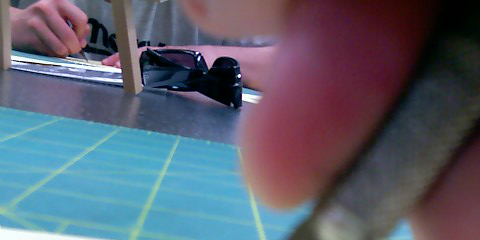
You take a photo and trace out its shadows, midtones, and highlights onto separate sheets of cover stock. You cut them into separate stencils, lay them down one by one, and spray on black, gray, and white. Awesome.

No way this ever figures anywhere into my classroom but

  1. it made for great reflection. This is, after all, exactly how I see teaching: on first blush an overwhelmingly complicated job which anyone can then disintegrate into smaller, more manageable tasks (tasks, which, once upon a regrettable time, I dubbed “slices”), and
  2. whatta mother’s day gift!

Photo Interlude

The Road Mix
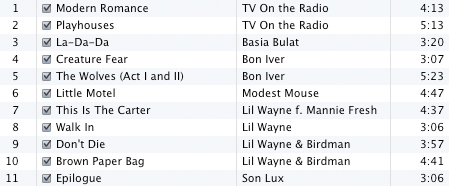
Nostalgic Interlude

I rolled through Davis, CA, past Fountain Circle Apartments, Alvarado Ave., 7st St., Anderson Rd., and anywhere else I ever spent more than twenty minutes in college. I realized I was old enough to have taught some of the undergrads running around and cursed.
I saw my old friend, Josh Yoon, drive by in a Honda and flipped a u-turn as he parked only to realize as he got out of his car that he wasn’t Josh, rather, another Asian guy who looked only somewhat similar. I acknowledged that the nostalgia (and careless racism, let’s be plain) was hitting my head a little hard, cursed again, and moved along.

Twitter Interlude #3

5PM
On my way out, I stopped by my old mentor’s office, looking to share news of the largest return on his investment, the most recent, most curious development in his protégé’s short career. But he wasn’t around, so I beat a path out of my past and returned home.
Help Me Get Away With This

Mean, median, and mode are each important, each easily mistaken for the others, and, depending on context, misleading or completely meaningless.

I came across a scenario yesterday which highlighted their differences and limitations a little too perfectly:

  1. Consider every human being in the world.
  2. List each person’s total testicles.
  3. What is the mean, median, and mode of that list, and what do they mean?

Is this even worth the trouble? If you aren’t trying to shock or pander to or titillate your students, are testicles fair game? ‘Cause the implications and extensions are really awesome here.

Like: the average human being has one testicle.

Or: the median number of testicles is either zero or two depending on gender majority.

And: the median and the mode will be the same number except under a few (also awesome) conditions.

How do I avoid panicking my principal here?

[via Jim Ray’s cool tumblog]

Dodging My Tech Coordinator

a/k/a Linear Fun #4: Hit ‘Em

She wants her laptop cart back so I’m ducking her calls, trashing her e-mails, employing idle freshmen to shield me as she walks past.

I don’t know how this happened. I reached for those laptops to show my tech detractors I could, to inoculate myself against charges of Ludditism the next time we went to the mattresses, debating the relevance of the read/write web to math education.

“But Some Of My Best Friends Are Laptops.”

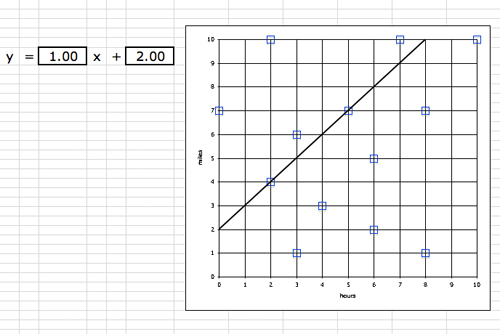
But then, after our first investigation into the flight data, after they selected their own data sets for regression analysis, after we investigated the data from the Department of Motor Vehicles (which y’all positively killed in the comments, thanks) I roughed up an interactive activity in Microsoft Excel:

Punch in a slope and y-intercept. Do your best to hit a set of targets. Get ready to give me several sentences explaining both.

There were positive, zero, negative, rational, and impossible slopes.

This was, like, the fifteenth extension on the mobile lab return deadline I begged off my tech coordinator and I realized this laptop thing was no longer an affectation. I wasn’t posing. It was real, more or less.

The Lonely Criterion

If you’re a tech proponent, coordinator, evangelist, or whatever, I’d like to break my complicated, conflicted, highly emotional experience (seriously: who am I anymore?) into small pieces for you.

  1. I had to accomplish a specific instructional objectiveWe can debate the merits of my state’s content standards, fine, but you can’t ask me to defy my employers, simultaneously setting my students up to fail in their next class, all so BJ Nesbitt won’t think I’m a lousy teacher. I mean, if that’s integral to the master plan, we have some work to do.. My students would a) model some part of their world with a linear equation, and b) explain the significance of the equation’s parameters.
  2. Microsoft Excel (coupled with a web browser) was the best tool to accomplish those objectives. And by “best” I’m balancing more factors than I have time or eloquence to describe but a) student engagement (are their brains working hard?), b) student enjoyment (are they having fun?), c) seat-hours expended (could I use our in-class time better?), d) planning hours expended (could I use my out-of-class time better?), and e) assessment scores (how well can they demonstrate mastery of the objective?) certainly round out the top five.

That is my uncomplicated flowchart, my lonely criterion for working technology into my classroom or not. I can’t imagine it is uniquely mine.

Your Job, Simplified

See, this is great. You don’t have to email your entire faculty a link to Mike Wesch’s latest call to educational actionFor serious: if I never saw another stony-faced child staring grimly at the camera, holding a hand-scrawled sign denouncing her out-of-touch, digital-immigrant teacher for not letting her SMS her iPod playlist to her Facebook group (or whatever) during class it would be too soon.. You don’t have to throw statistics at me. You’ve convinced me that my students need different instruction this century than they did in the last โ€“ check. got that. โ€“ yet you’ve satisfied only one-tenth your job description.

See this is the bummer. Now you have to immerse yourself in my content standards and use tech to help me satisfy the same instructional objectives in some way that’s a) more engaging, b) more fun, c) less time-intensive for my students in-class, d) less time-intensive for me out-of-class, or e) sturdier upon assessmentReally, if you can show me gains along any of those vectors without losing the others, you’ll be my valentine..

But this is also a bummer because, assuming your background wasn’t in every content area your school offers, you have to build a robust network of prolific educators pushing every content area in every direction but down.

And that’s the final bummer for y’all School 2.0 sectarians I’ve hectored these last fifteen months: unless I’m missing several platoons of math teacher bloggers, we’re stuck with each other.

‘Cause I’m starting to enjoy these Internets of yours, and finding a place for them in my classes.

2015 Nov 9. This might be the most belated update ever on this blog. Ms. Mac asks why there isn’t a Desmos Activity Builder-enabled version of this task yet. (Note to my past-self: you now work for an edtech company. Take the day off while you process that turn.) There should be. She made one.

Who Does Florida Think It Is?

a/k/a Linear Fun #3: Driving Across America

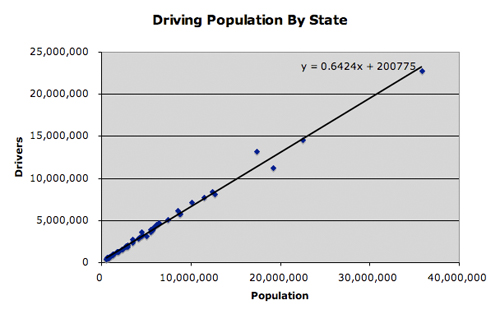
Plot total drivers vs. total population (using this table) for every state in the US and you get this graph:

Okay, that dot that’s below the line? That’s New York. That one’s easy. Fewer licensed drivers than you’d expect for the population ’cause only cabbies drive there or something.

But that dot that’s above the line? That’s Florida, and me and my classes will be damned if we can figure out why they’ve got more than their fair share of drivers.

Anybody got anything for us on that?

Linear Fun #2: Stacking Cups

My favorite lessons build an hour of complicated, engaging mathematics from a simple picture, question, or anecdote. This is one of those lessons.

  1. The Question

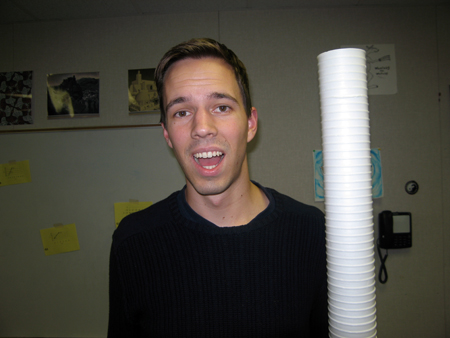
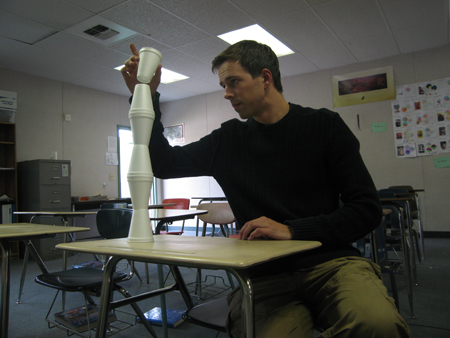
    How many Styrofoam cups would you have to stack to reach the top of your math teacher’s head?

  2. Mess With Your Students

    Tell them you’re 200 centimeters tall (if you’re me). Measure a cup in front of them and tell ’em it’s around 10 centimeters tall.

    Act like you blew it and overestimated the question’s difficulty. Ask them for a fast answer.

    Someone will divide quickly and tell you “twenty cups,” at which point you hold up a stack of 20 cups and let them wonder how they underestimated so grossly.

    Let them figure out which math problem they actually solved:

  3. Offer Them Materials

    Ask them what they need from you. Some will ask for hundreds of cups. Offer them ten.

    They’ll want a ruler. Offer that.

    Some will chase you around the room, running after your feet with their stack of cups, asking you to hold still so they can eyeball the answer. Don’t offer them that.

  4. Let It Go

    The rest largely runs itself. Just walk around, ask good questions, and correct faulty assumptions.

  5. Good Questions
    1. How many parts of the cup are there? Two.
    2. Which part of the cup matters most over the long run? The lip. The base only counts once but you count the lip every time.
    3. If I asked you to tell me how tall a stack of sixty cups would be, what would you do? Add the height of sixty lips to the height of the base.
    4. If I asked you to go backwards and tell me how many cups are in a 200-centimeter-tall stack, what would you do? Subtract the height of the base and then divide by the height of the lip.
    5. Does it matter if you round to the nearest centimeter? It definitely does.
  6. Get A Graph And An Equation

    Kids will solve this pretty well without either โ€“ two groups socked the answer right on the nose โ€“ but this is pretty meaningful context for graphs and equations. The lip-height is the slope and the base-height is the y-intercept.

  7. Actually Stack Them

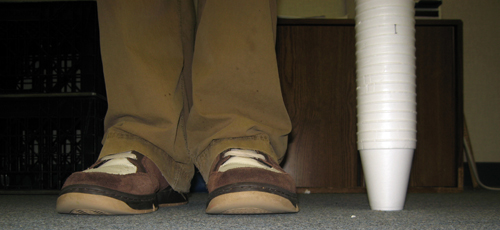
    After you’ve a) taken secret-ballot estimates from each group, and b) written them down on the board in descending order, have one member from each group i) count her cups, ii) stack them by your feet, and iii) call out the quantity for the rest of the class to tally up.

    If, just for instance, you’re twice as tall as some of your students, have one student stand on a chair to eyeball the answer. (“One more. Okay, one more. Nope, too much.”)

    The winning team receives fabulous cash and prizes.

  8. Extend It

    This project has legs. My kids ran outta interest at different points after we announced the winnersNote to self: postpone that announcement until after the extensions. *smacks forehead* but these extensions are all gold.

    1. Ask them the same question with a different cup. A red Solo cupDon’t pretend like you don’t know the ones I’m talking about., plastic, a thin lip, and tall base.
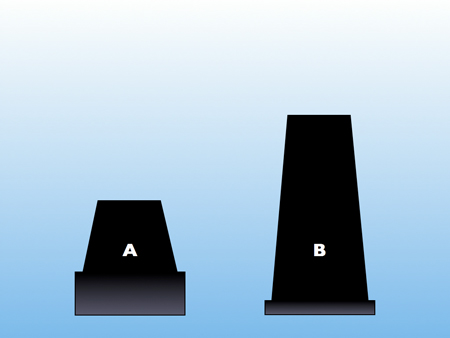
    2. Toss up this graphic.

      Have them measure the lip and base of each.

      Ask them, “Which will be taller after three cups?” (A: Cup B.)

      Ask them, “Which will be taller after one hundred cups?” (A: Cup A.)

      And then โ€“ respect, if you see what’s coming โ€“ ask them, “How many cups does it take stack A to rise above stack B?” Wham. You’re solving three-step equations.

These are my favorite projectsOne, again, to which I can only claim certain flourishes. The rest comes out of ed-school at UC Davis.: easily scaffolded, easily differentiated, easily assessed, and arising completely from a simple question, a simple prop, and a single image.

More, please.