Category: pseudocontextsaturday

Total 40 Posts

[PS] Midterm

Will Richardson:

I keep wondering what a “Basketball Math” curriculum might look like for Tucker, one that would combine his serious interest in the sport with his growing interest in math.

Choose one:

  1. Which of Will’s commenters has suggested a pseudocontextual problem?
  2. Create a math problem in response to Will that would be pseudocontextual.

Justify your answer. I’ll post a solution key next week.

[PS] Sandbags & Hot Air Balloons

[BTW: My opinion is that this isn’t pseudocontext for reasons I elaborate on in this comment.]

Calculus: Early Transcendental Functions. Larson Hostetler, Edwards. 2003. Houghton Mifflin.

Pseudocontext

Greg Hitt (a/k/a Sarcasymptote):

Et tu, Calculus?

Seriously, you are when I started to love math. Up until I met you, I trudged through year after year of pseudocontext, merely completing tasks only because they needed to be done and not out of some enjoyment or aching desire to do it. Then, you came along, and blew my freaking mind with your applicability. You were the math that worked.

And now look at you. Really, Calculus? Answer me this:

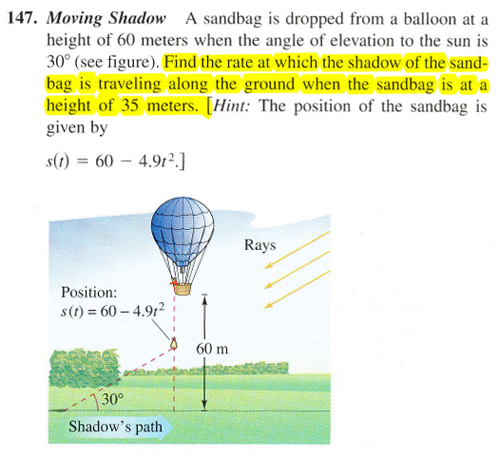
  1. What in the hell are you talking about? This is one of the most poorly worded questions I’ve ever seen. And is it common practice for someone to be so cavalier as to heave sandbags over the side from almost 200 feet in the air, all while carefully measuring both the height above the ground and the angle of elevation to the sun? I don’t know, because I don’t care about hot air balloons. I don’t know anyone who does.
  2. Why are we worried about the rate of the movement of the shadow? Is the rate that a shadow moves across the ground useful for any situation? Is there some arbitrary race between the shadow of a sandbag and a log floating down a river? Seriously, related rates should be much more applicable than this.
  3. This is textbook, er… textbook. We could pretend to think about how to model the height, but instead, let’s just skip the thinking and go right to a formula.

Transcription:

Moving Shadow. A sandbag is dropped from a balloon at a height of 60 meters when the angle of elevation to the sun is 30° (see figure). Find the rate at which the shadow of the sandbag is traveling along the ground when the sandbag is at a height of 35 meters. [Hint: The position of the sandbag is given by s(t) = 60 – 4.9t2.]

Assignment:

  1. Scan an example of pseudocontext.
  2. Email it to dan@mrmeyer.com
  3. List the textbook title, edition, and publisher.
  4. Give me your interpretation of the term “pseudocontext.”
  5. Let me know if you’d like credit (name, blog or twitter) or if you’d prefer anonymity.
It’s Everywhere

Santa Cruz Sentinel, today:

The City Council will consider a proposal today to establish a citywide pay-by-cell phone system that would allow motorists to start, finish and extend time for meters or fee-based parking spots. [..] Consumers would pay a fee of 35 cents per transaction, or 25 cents for frequent users if they are willing also to pay a monthly access fee of $1.75.

Is pseudocontext a failure of imagination or is it a symptom of laziness? Because this sort of thing just isn’t hard to find.

[PS] The Piano Lid

Geometry, Prentice Hall (Pearson), 2007, pg. 151

Pseudocontext

Kate Nowak gets out the knives and goes in:

I think Pearson knows that angles are hard to motivate. You would hope that the multi-jillion dollar conglomerate we paid multi-thousand dollars for books and associated peripherals would use all that money to help me. But they clearly punted on motivating angle measure. The lessons are dry and contextless and the exercises include this monstrosity.

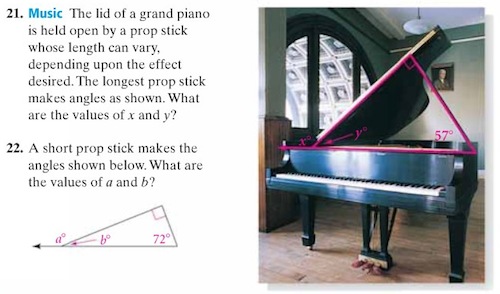
  1. Yes people have to prop piano lids with sticks, but what could possibly happen that we would give a flip about the measures of those angles?
  2. The photo is not taken head-on. I bet that given angle isn’t even really 57 degrees.
  3. Superimposing a diagram of a triangle on a photo does not make it a real world application.
  4. Do “prop sticks” on all pianos intersect the lid at 90 degrees? Why? Is the prop-stick length and angle determined by the width of the piano? Yes, if the right angle is required, by hypotenuse-leg, and no, if it’s not, because it’s side-side-angle. I still don’t really care, but it’s at least a teeny bit more interesting.

Transcription:

The lid of a grand piano is held open by a prop stick whose length can vary, depending upon the effect desired. The longest prop stick makes angles as shown. What are the values of x and y?

A short prop stick makes the angles shown below. What are the values of a and b?

Assignment:

  1. Scan an example of pseudocontext.
  2. Email it to dan@mrmeyer.com
  3. List the textbook title, edition, and publisher.
  4. Give me your interpretation of the term “pseudocontext.”
  5. Let me know if you’d like credit (name, blog or twitter) or if you’d prefer anonymity.
[PS] Guitar Hero

Algebra I (Illinois Edition), Prentice Hall, a Pearson subsidiary.

Pseudocontext

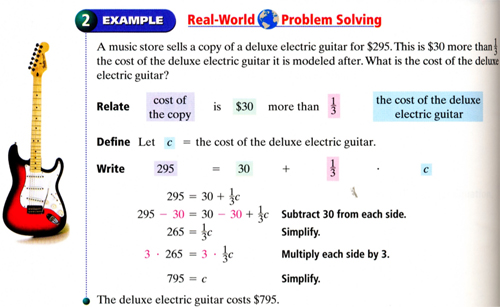
Is there anything inherent to buying an electric guitar that would lead to that equation ever?

[via Ryan Buck]

Transcription:

A music store sells a copy of a deluxe electric guitar for $295. This is $30 more than 1/3 the cost of the deluxe electric guitar it is modeled after. What is the cost of the deluxe electric guitar?

Assignment:

  1. Scan an example of pseudocontext.
  2. Email it to dan@mrmeyer.com
  3. List the textbook title, edition, and publisher.
  4. Give me your interpretation of the term “pseudocontext.”
  5. Let me know if you’d like credit (name, blog or twitter) or if you’d prefer anonymity.