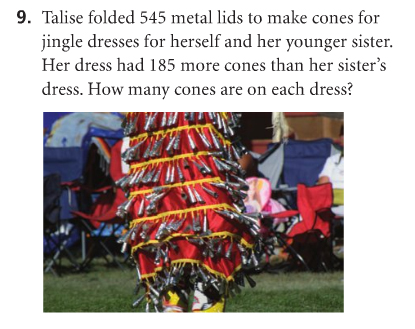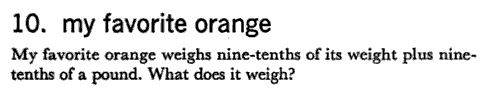
Geometry, McDougal-Littell.
Pseudocontext
Brian Miller:
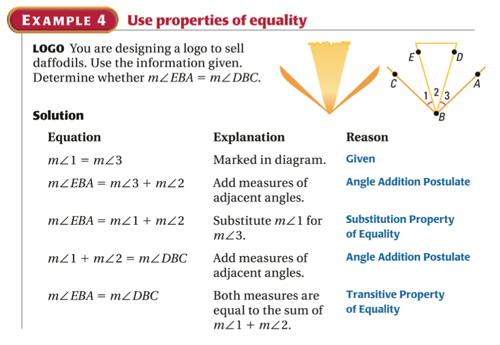
Context should add something to the problem, whether it be intrigue, interest, or a way for students to pull from their intuition, and prior knowledge. It is the absence of reaching these measures, that makes me characterize this problem as pseudocontext. No student is going to read about the daffodil logo, and then feel compelled in anyway to prove the leaves to be at congruent angles.
This particular problem became more interesting after I took away the context. That could become another measure of how we judge context v. pseudocontext. Is the problem more interesting after the context has been stripped away? If so, then the context was actually pseudocontext.
Transcription:
You are designing a logo to sell daffodils. Use the information given. Determine whether the measure of angle EBA is equal to the measure of angle DBC.
Assignment:
- Scan an example of pseudocontext.
- Email it to dan@mrmeyer.com
- List the textbook title, edition, and publisher.
- Give me your interpretation of the term “pseudocontext.”
- Let me know if you’d like credit (name, blog or twitter) or if you’d prefer anonymity.