Turn this infographic by Sean Kearney into an opportunity for critical thinking, data analysis, and mathematical computation for your students.

EC: Extend the activity to the population of Earth.
Turn this infographic by Sean Kearney into an opportunity for critical thinking, data analysis, and mathematical computation for your students.
EC: Extend the activity to the population of Earth.
Teaser
If you’re the sort who likes to figure this WCYDWT thing out for yourself, here’s the clip I’ll be discussing after the jump. Also: my readers outside of Burma, Liberia, and the United States can safely skip this one.
Spoiler
Whenever a student asks me how tall I am, I always answer “79 inches.” (It’s a math teacher thing.) The student’s first reaction is, inevitably, “Seven foot nine?!” The student’s second reaction, after dividing 79 by 12 and seeing “6.6” on her calculator is, “Oh. Six foot six.”
This drives me nuts. Once a student has the idea that decimals are inches, it’s nearly impossible to convince her otherwise.
Apparently, high school freshmen wrote the 2003 remake of The Italian Job. Halfway through the opening heist, Seth Green tells Edward Norton to mark “14 feet 8 inches from that west wall” but Norton measures out 14.8 feet on his distance sensor. Decimals aren’t inches, Ed! You’ve gone 1.6 inches too far!
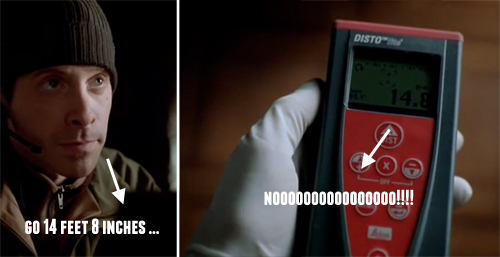
I don’t know the extent to which that error should scuttle the entire plan but Mos Def makes the same mistake on the floor below so the whole thing looks pretty grim.
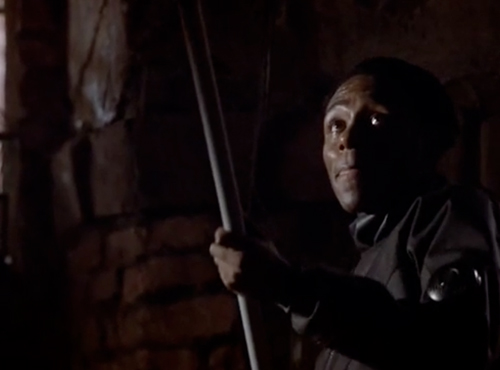
This is a clear application of entries #7 and #43 from the WCYDWT taxonomy.
#7: Put the student in the same mental frame as a character from a TV show or movie. Have the student solve the character’s problem.
#43: Allow overconfident learners to pursue incorrect answers.
So you put them in the same room as Edward Norton by giving them a piece of grid paper. You tell them every minor line represents an inch. You’ve really stacked the deck with this one, having drawn major grid marks every 10 lines, instead of every 12. You’re inviting the likely error.
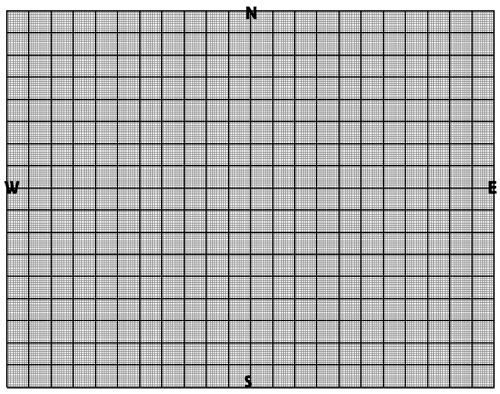
You play the clip as many times as they want. Encourage solo work on this one. (Edward Norton was alone in the room, after all.) After a given time, you invite a confident student up to the board to draw a safe you know in advance to be incorrectly placed. At that point, most students have decided this activity is really easy and way beneath them. This overconfidence is gasoline. As students discover differing answers to the same totally easy problem, they’ll argue and debate. These frissons around the room are the little sparks in the combustion engine of learning.
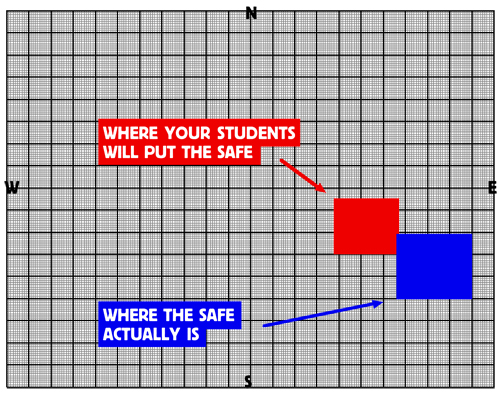
If a student miscalculates my height by an inch, it’s no big deal to her. The stakes are too low and the percent error too insignificant. But if a student blows up the wrong part of a floor and loses millions of dollars in gold bricks she thought was a sure thing, that’s productive frustration, even though the stakes are imaginary. We can work with that.
BTW: Delise Andrews offers a handout that is much better than mine. Thanks, Delise.
Dan, I’m totally with you on this line of thinking but only up until a point. I’d add a further layer to your line of questioning: who cares? Who cares how fast you can fill it up? Ultimately, the motivation to learn needs to be intrinsic from the student. Just making something more flashy (as much as I think technology can help here) isn’t enough. We need to also make it relevant.
Maybe someone can help me find some sense in Joe’s objection.
As a starting point for a rebuttal, WCYDWT has less to do with “flashy technology” than it does with a template for talking about math. Some technologies enable that conversation better than others. That’s all.
And then there’s this: “who cares?”
If we’re planning on paring math curriculum down to the material about which students instinctively care, Joe needs to prepare himself to trim Algebra 1 down to somewhere near the size of a Scientology tract, the stuff that explicitly involves video games and cell phones. On the upside, we’d finish the school year somewhere in October. On the downside, you’d lose the entirety of pure math.
There’s a lot packed into Joe’s question concerning the role of the teacher, concerning the purpose of school, that I don’t have the energy or time to unpack. I’ll let it suffice to say that I find Joe’s question uncomfortably proximate to “who’s entertained?”
A closing anecdote and then a wager.
The Anecdote

I posted a video series not long ago where I walked down two flights of stairs. Nothing more than that. It’s hard to say why anyone should care about a guy walking down stairs. It’s a totally mundane scene. It’s harder still to say why anyone would care about a graph of that scene. Mundane + Math = More Mundane. Right?
The Wager
My career leads me to this prediction, upon which I’ll stake my credibility and whatever else you want:
Play the water tank video clip in front of a class of students of any age between 12- and 30-years-old. The video is best served cold. No music. No text. No introduction.
Your students will start to inventory their surroundings. They’ll identify the crucial elements of the scene. Again, you shouldn’t say anything.
Twenty seconds into watching the hose dribble water into the tank, ask “how long do you think this is gonna take?” Ask for guesses. Just guesses. Write them on the board next to the guessers’ names. Whenever anyone raises the maximum or lowers the minimum, point it out.
Then turn the clip off. Turn off the projector and proceed to whatever else you had planned for the period.
At least one student will ask what 90% of the class will be thinking:
“Well … who was right?!”
BTW: a blogger took up my wager. The entire post is well-written classroom anecdote but here’s the relevant excerpt:
One day I introduced a lesson based on a challenge presented by Dan Meyer (The Wager from “Who Cares?”). I played about 20 seconds of a video clip created by Dan Meyer of a transparent tank filling up with water at the beginning of class. I asked each group of students to predict how long it would take to fill the tank. Their guesses ranged from ten minutes to a few hours. The fill/drain a water tank problem is a pretty easy, if unexciting, application of linear equations to a real-world situation. Yet, by allowing the students to actually see the tank and having them make a prediction, the plan was to engage the students in the process of discovering the answer. After the students made their predictions, I abandoned the water tank problem and moved on to something completely different. In each one of my classes, eventually a few of the students made a comment along the lines of “you never told us how long it took to fill the tank.” Sometimes the comment came only a few minutes after we had moved on. Other times, it came much later. More convincing evidence of the students’ level of engagement in the exercise came at the end of the lesson when I played the rest of the video. With their focus on the screen, you would have thought they were watching a summer blockbuster at the movie theater, not a tank filling with water in a classroom.
I used the engagement of the students to invest them in solving a problem that involved some critical thinking. When we revisited the problem, I avoided the temptation to hold the students’ hands through writing a linear equation to represent the situation. Instead, I simply asked them to come up with a justified answer to the question of how long it would take to fill up the tank. Some students’ answers included a rate of change and/or linear equation. Most of the answers didn’t. All of them experienced the struggle, including failure, that it takes to solve a real problem, and the first group was able to make a connection between the content covered earlier in the year and a problem they had not seen before.
a/k/a A Rubric For Applied Math Curriculum
Worst
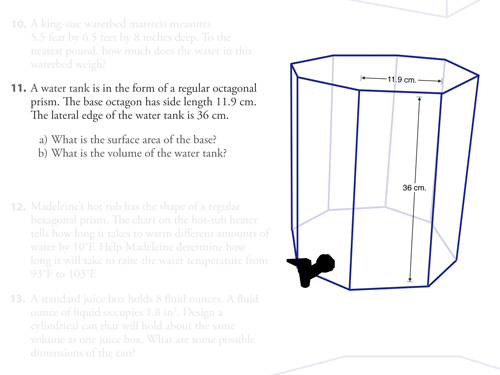
Bad
The same as worst except:
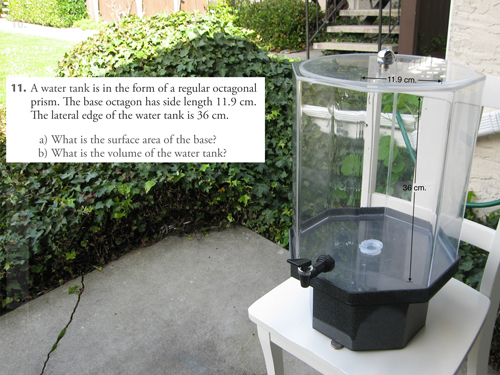
Good
The same as bad except:
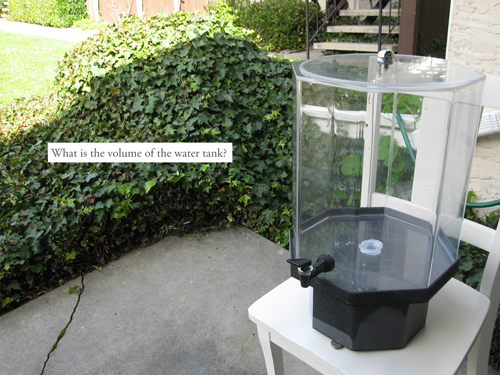
Best
The same as good except:
For Instance:
The question: how long will it take to fill up the tank?
WCYDWT: Water Tank from Dan Meyer on Vimeo.
The answer:
WCYDWT: Water Tank + Timer from Dan Meyer on Vimeo.
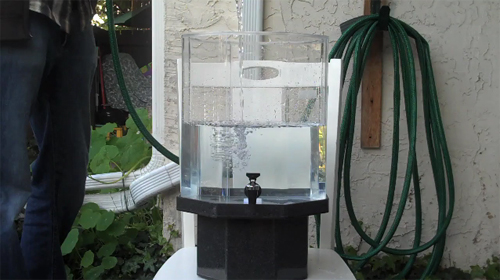
There’s some dynamite material in the comments of the previous post, particularly from Alex, Andrew, Frank Noschese, and Steve Peters.
For anyone interested in curriculum design, please consider: which of these is the better question to ask a class?
Your answers and their justifications are due in the comments. Use a #2 pencil.
BTW: My answer below.