This one isn’t terribly ambiguous. As usual, I’ll welcome you to describe the kind of activity you’d build around this clip, including the kind of supplementary materials that would be useful.
But really, I’m only posting this as a preamble to the kind of rubric suggested by monika hardy several posts back. Assuming we’re after curriculum that provokes students to apply mathematical reasoning to the world around them, that teaches students to construct their own problems:
Nick Hershman is running laps with this one. Check the blog post or the screencast, in which he explains how he built a Python script around an algorithm from the comments.
I’m very impressed by the commentary in the kick-off post. The default WCYDWT stance has the eager math teacher stroking his chin and musing that “we should really tie this into gas prices somehow … ” while studiously avoiding the essential, practical details of constructing a framework for that learning. Instead, at freaking last, our commenters are starting to attack those logistics with a certain thrilling mania, developing full-bodied worksheets, manipulatives, and Geogebra appletsHats off to: Steve Phelps, Jack Bishop, Josh Giesbrecht, Dan Schellenberg, Nick Hershman, and Justin Lanier. Great work..
I’m not exactly sure of the best route through this problem. In fact, the one that interests me most is one I don’t know how to solve. I hope you can help me with that. I only know one thing:
We can’t learn much from an obscure background element of a video clip unless we drag it into the foreground. We need our own copy of that bouncing DVD screensaver. So I made one in AfterEffects. [download clip]
Your goal with these intro clips should be to infect your students with as much of PB&J’s anticipation as you can:
Take bets: will it hit a corner with five minutes? Ten minutes? Put a few students on record.
Now ask your students, “what matters here?” There are nearly ten variables you can define together. Ask, “what are good ways to measure what matters?” Pixels, angles, speed, time, etc.
The formulation of a problem is far more often essential than its solution, which may be merely a matter of mathematical or experimental skill.
Back To Our Show
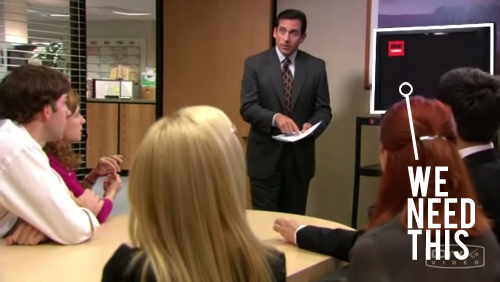
Play this clip. It features information that should, ideally, surprise no one. Your students have abstracted all this information already. You’re just taking their hard wor and pressing play. [download clip]
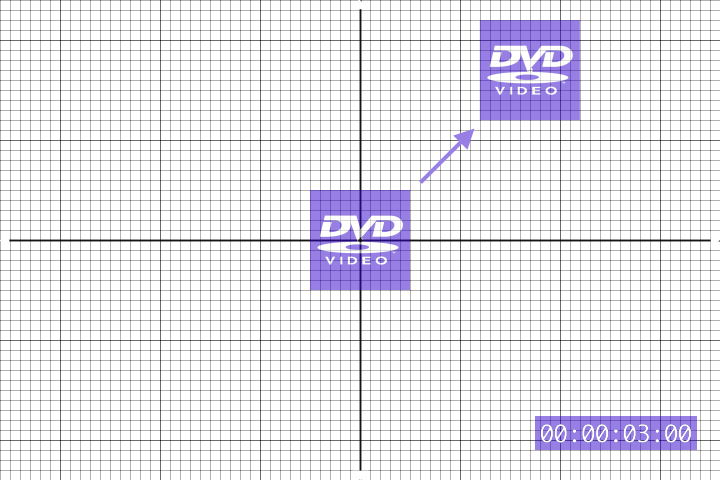
From there, take your pick. You could give them something fairly explicit like this [download image]:
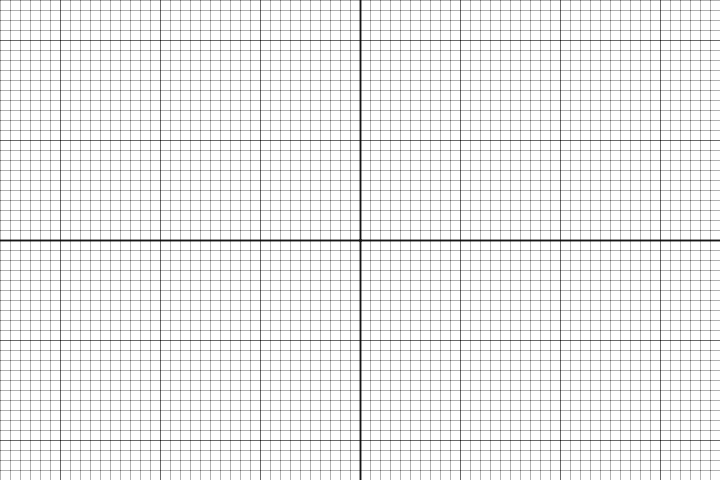
Or you could just give them this grid, 720 by 480 with ten-pixel increments, go frame-by-frame through the movie, and pick out some data points together. [download image]
The awesome observation they should make, regardless of what route they take, is that, once that icon starts moving, the rest of its natural life is foretold. It’s totally predictable in this frictionless environment.
By my count, we’re still missing a clip.
We need video of the solution. It’s one thing for you to consult your answer key (the full measure of your authority) and confirm a student’s answer. (A: lower-left corner at 1:34.) It’s another thing entirely to say, “It doesn’t matter what I think. Let’s check the tape.”
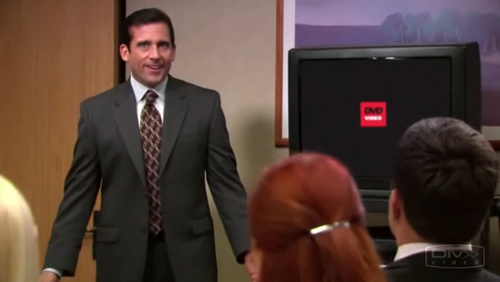
So here’s one where no one gets any credit for guessing the question. The question is obvious. The question is scattered throughout this entire clip (from the fourth season of The Office). I made the question explicit in the post title.
Will the DVD icon ever ricochet into a corner?
But what are the supplementary materials? How do you make this experience real to your students? What do they have in front of them? How are they getting their hands dirty with the math?
It doesn’t matter if you don’t know how to make the supplementary materials. Just name them. This is a big-hearted community. We’ll find someone who does.
Here’s what basically has to happen to make a successful WCYDWT lesson:
Lighting strikes (you observe something).
You recognize that lightning has struck (you say “holy *&^%”).
You investigate by building layers of abstraction on your observation.
You realize that that particular abstraction fits in your curriculum.
You strip away all those layers to a core question interesting to a 15 year old, who (I’m sorry and draw whatever conclusions you will about me or my school system) are the least interested people on the planet.
You rebuild the abstraction in a way that will support the questions you successfully predict they will ask.
You make attractive keynote slides out of it.
You extend your original abstraction to questions that they will want to pursue to enhance their understanding.
there seem to be two corners of necessary student experience here. first, engaging with the instructor in “recreating mathematical reasoning”…using cooperative examples to learn how to ask useful questions, and making visible the math already there to find solutions. but those presented scenarios, in turn giving birth to the useful questions, are still coming from the heart/experience of the teacher, even if covertly. the most valuable part of WCYDWT to me is giving students the confidence and skills to recognize within their own spherespassionsinterestsloves specific places where those useful questions can be posed.