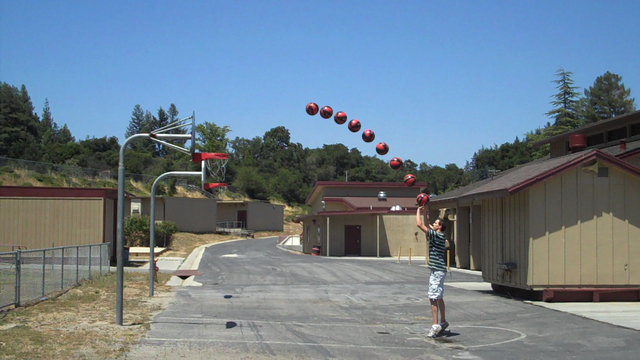
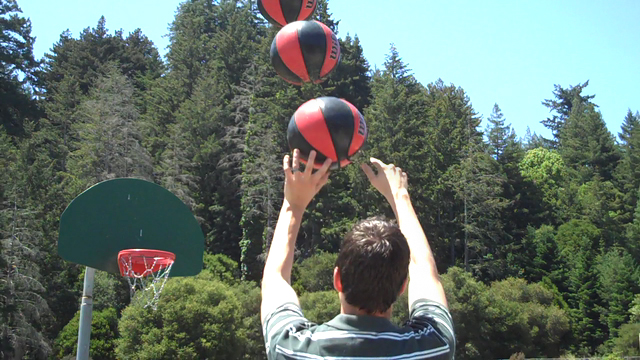
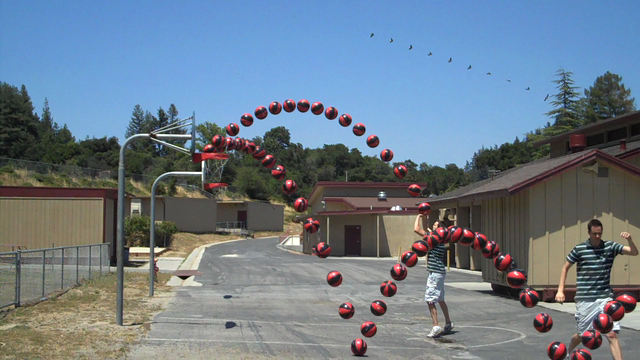
Category: series

Total 134 Posts

Redesigned: Kyle Webb

Kyle Webb drops a WCYDWT video on circle area and perimeter:

Academic Green Circumference and Area Problem from Kyle Webb on Vimeo.

First, let’s pay respect to how fast the video moves, how it sets a scene and establishes a problem in just 14 slides and 57 seconds. Webb knows his audience and its attention span. Also, none of this is stock photography. Every photo selected is of high bandwidth and relates directly to the problem. After 12 seconds, we have three different views of the lawn. After 15 seconds, a panoramic shot. I’ll begin my redesign 23 seconds in, when he mentions the lawn is 75 steps across.
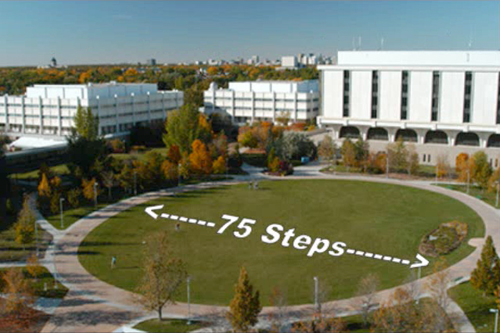
This is really, really close to my textbook’s own installation of the problem. The text would ask a question like “how far is it around?” or something with a real-world spin like “how large would the ice rink be?” (standing in for “what is the area?”) and then it would explicitly define the only variable we need: 75 steps. My students would identify the formula and then solve.

This kind of instructional design puts students in a strong position to resolve problems the textbook draws from the real world but in no position to draw up those problems for themselves. This kind of instructional design also yields predictably lopsided conversation between a teacher and his students.

The fix is simple but difficult: be less helpful.

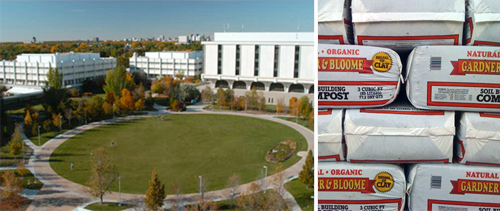
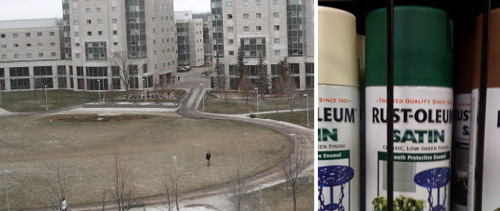
Let’s start here: is circle area just something math teachers talk about to amuse themselves or do other people care? If they care, why do they care? How do we convey that care to our students? Maybe someone needs to fertilize the lawn. Maybe someone wants to spray paint the dead lawn green in the winter. Without this component, the answer to the question “how far is it around?” is little more than mathematical trivia to many students.

So put them in a position to make a choice, a tough choice that’s true to the context of the problem, a choice that math will eventually simplify.

For instance: “how many bags of fertilizer should I buy to cover the entire lawn?”
Or, a little weirder: “how many cans of spray paint should I buy to cover the entire lawn?”
In both cases, we’re putting every student on, more or less, a level playing field. They are guessing at discrete numbers (ie. “fifty bags โ€“ no โ€“ sixty bags.”) and drawing on their intuition, which, from my experience, is a stronger base coat of for mathematical reasoning than the usual lacquer of calculations, figures, and formula.

This approach also forces students to reconcile the fact that the problem is impossible to solve as written. This is an essential moment. They need more information, but what? What defines a circle? Would it be easier to walk across the lawn’s diameter or around the lawn’s circumference? Which would be more accurate? Why is the radius difficult to measure? Did Kyle really walk through the center of the lawn or does he just think he did?

When you write “75 steps” on a photo, that conversation never happens.

My thanks to Kyle for jogging my thoughts here.

What I Would Do With This: Pocket Change

[following up from here]

Appeal To Their Intuition

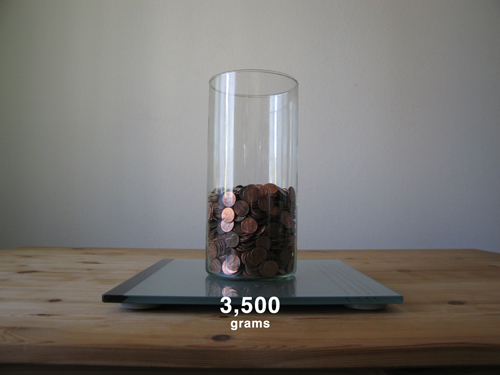
“How much cash is this?” Take guesses. The student risks nothing with a guess but that investment pays off huge for the teacher over the life of the exercise because the student wants to know who guessed the closest.

Build Slowly

Again, ask “how much cash?” but also ask “how heavy?” Show them the weight. (I zeroed out the jar from every weight measurement you’ll see here. Don’t worry about it.) Spitball some ideas for determining the value of those coins. You’re trying to motivate the idea that the weight of the coins ties directly to how much the coins are worth. Pull up the relevant Treasury website.

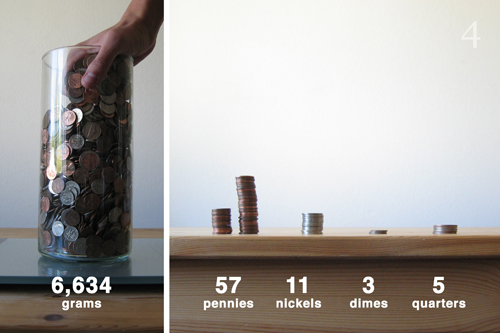
Then mix in some nickels. Scoop out a small sample. Play with that. Set up a proportion between value and weight.

Iterate

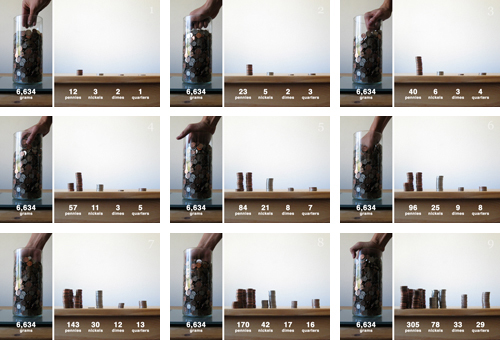
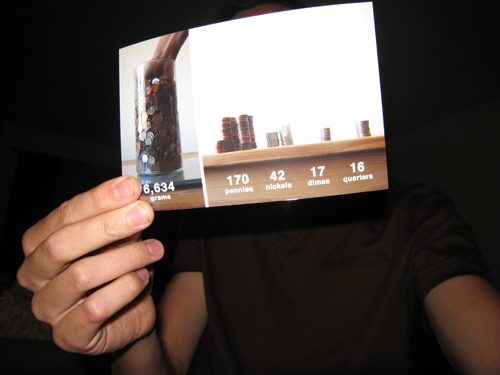
Now you have pennies, dimes, nickels, and quarters. I took nine sample scoops, everything from small to big.

I formatted these at 4×6 so I could print them out at our local one-hour shop for a few bucks and put one in front of every student.

Throw A Curve Ball

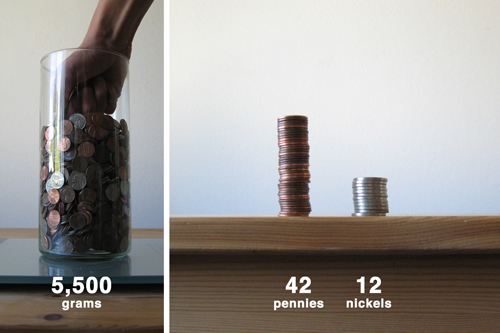
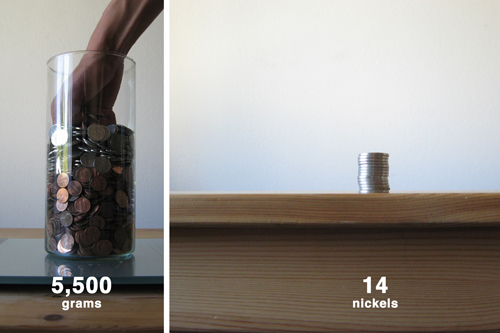
Some will finish quickly. You tell them you have a jar of coins that weighs 5,500 grams. You reach in and pull out 14 nickels. How much is the jar of coins worth?

They’ll run these calculations and come up with an estimate of $55. You tell them it was really $34, which is huge error. Ask for sources of error. Then toss this up and talk about it.

Confirm The Answer

$84.00, if you were curious.

It’s essential to give some kind of visual confirmation of the answer, both so we can give credit to good initial guesses and so we can talk about sources of error. (ie. “who was off by the most? did sample size matter at all?”)

Miscellaneous

  1. Show them CoinCalc, the backend of which does exactly what we’ve done here.
  2. This activity follows-up nicely on the goldfish activity, where we used a small sample of fish to determine the total population of a lake.
  3. We yield the floor to Jason Dyer and anybody else who would like to debate the question, “why are we doing this digitally?”

Download

Here’s the entire learning packet [62MB].

What Can You Do With This: Pocket Change

[followed up here]

Let’s push this forward. The question is “how much cash?” The reference point is CoinCalc.

Your challenge is to outline the supporting materials so that this activity will a) scale from easy to hard, b) throw a few curveballs at the students who figure out its mechanics quickly, and c) offer visual confirmation of the answer to provoke a discussion of sources of error.

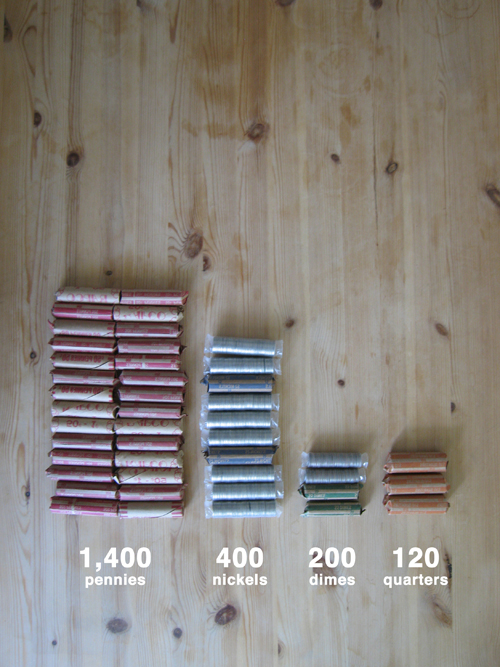
If you then consider the fact that a) it’s easier to mix coins than unmix them and b) it’s easier to tally the value of a roll of coins than a pile of loose change, you’ll understand why producing this unit took a week of detailed planning and an afternoon of careful shooting.

[click for high-res]

What I’m Trying To Say:

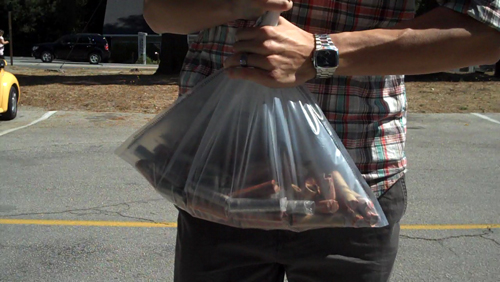
I withdrew $100 in pennies, nickels, dimes, and quarters from my bank account last week. I walked out of the bank holding a plastic sack full of change, feeling like some kind of underachieving bank robber.

I did this because I live in mortal terror that if I ignore the WCYDWT fairy even one time, she will leave me for another math teacher and whisper interesting ideas in his ear. For this reason, I put her ideas into some kind of play as fast as I possibly can.

I was just thrilled she didn’t tell me to literally rob the bank. I mean, it’s conceivable.