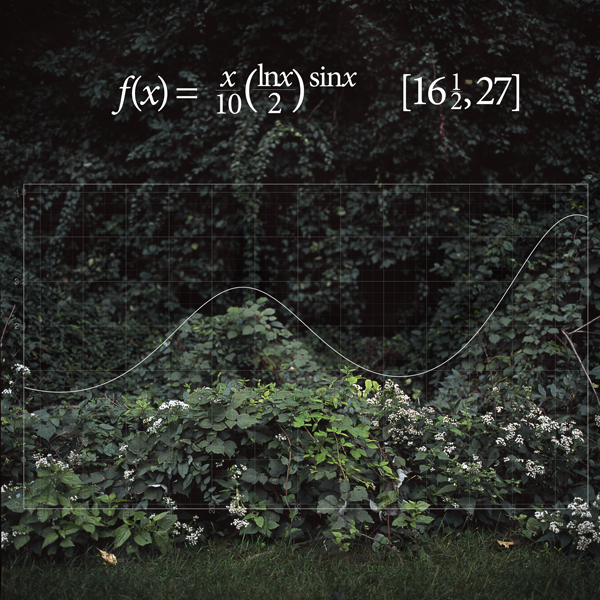
Let me be clear, first, that Nikki Graziano’s Found Functions are beautiful, subtle invocations of math and nature. They make me happy.
But two people have forwarded Graziano’s work my way in the last 12 hours under the heading “WCYDWT?” so I’d like to point out, for whatever it’s worth, that this is significantly narrower in scope than what I’ve been proposing for the last few years. The same goes for most tweets tagged #WCYDWT, which typically link to:
recreate mathematical reasoning for my students as I find it in the world around me.
involve students in both the solution to and the formulation of meaningful questions.
exploit my students’ intuition and prior knowledge in the solution of those questions.
I don’t have any problem using Graziano as a classroom conversation piece, but there isn’t a question here. I don’t know how to turn this interesting thing into a challenging thing.
Yes, I could go out and take a few photographs and have students model different equations also. But in the service of what higher-order question? It’s like asking “what shapes do you see here?” It isn’t worthless but it isn’t far from the bottom of Bloom’s taxonomy either.
I’m trying to get this blog feature to a place where teachers ask themselves, “what extra resources do I need to create to make this question accessible and challenging for students?” but, for the most part, teachers aren’t even asking themselves “what is the question here?” They’re applying this #WCYDWT tag to an exhilarating feeling of connection between math and the real world. Which is great, but it’s an entirely different (and entirely more difficult) task to translate that exhilaration into something a student can discover and experience for herself.
I’m frustrated. I have no idea how to make this any clearer.
I read stuff like this, and the first thought that goes through my mind is, “Man, I suck at teaching math.”
#2
I’m with Steve. I realize how far I am from where I should be.
#3
I’m with Steve and Craig- I can’t teach this way yet because my brain isn’t aware/smart/intuitive/mathematical enough to first notice these things, then develop a lesson, and actually deliver and make sense of it.
#4
I’ll echo Steve’s comment, I read this site and I feel like a fraud. I don’t know anything about teaching math.
I don’t teach to disempower students and I don’t blog to disempower teachers.
My largest point with these WCYDWT features, way above any other, has been that compelling, interesting math is everywhere. That you can capture it, mount it, and bring it into your class in such a way that students will also find math interesting and compelling and, in the process, become a little less intimidated by their own imaginations.
But I really suck at teaching that to teachers. Both off comments like those quoted above and off a recent, gruesome experience teaching online, it’s clear that I’m missing some key piece(s) of scaffolding.
Course Prerequisites
I’m trying to determine the prerequisites for this kind of coursework and – correct me here – I’m pretty sure there are only two:
You like math. You weren’t forced into this job.
You use math. You’re high on your own product. This isn’t a game to you. Math has made your personal life richer, easier, or more meaningful in the last week.
From there it’s a simpler matter of teaching:
process – how to flip an interesting thing around into a challenging thing, detailed somewhat in my last post.
technique – how to (i) capture photos / video, (ii) copy and paste images from the web, (iii) rip DVDs, (iv) download TV shows, (v) layer measurements on top of photos/videos, and (vi) post all of the above online.
Once the process becomes intuitive and once any three of those skills become easy, I think you fall quickly into this virtuous cycle of seeing interesting things > teaching interesting things > seeing more interesting things. The coefficient of friction falls to zero. It’s like skating on ice.
Case In Point
Kate Nowak, on the bite-sized opener clip I ripped from Parks and Recreation and posted two weeks ago:
This is cute, and totally slipped by me even though I watch this show.
I see little daylight between me and Kate as educators, which makes her comment all the more illustrative of the skills I’m talking about, skills which I use often enough that my antenna is on auto-scan for these passing mathematical moments. If I had to guess, Kate has never (iv) used BitTorrent to download a digital copy of a TV show and excerpt a clip in QuickTime, which means there is a certain degree of interference between her antenna and those moments.
Does That Make Sense?
If I allow myself any charity here it’s to acknowledge that this process is as much lifestyle as it is technique, and blogging – or any kind of asynchronous forum where dialogue plays out slowly – may be the wrong forum for teaching it. The right forum has proven pretty well elusive, though.
[Correction: an oil barrel contains 158,987.295 ml.]
Nat Torkington writes the Four Short Links column for O’Reilly’s Radar, highlighting interesting articles around the web on a daily (or near-daily) basis. Recently, he’s pitched me a few links via e-mail under the heading “WCYDWT?” which, due to my fallen nature, I have taken as a challenge to my sacred honor.
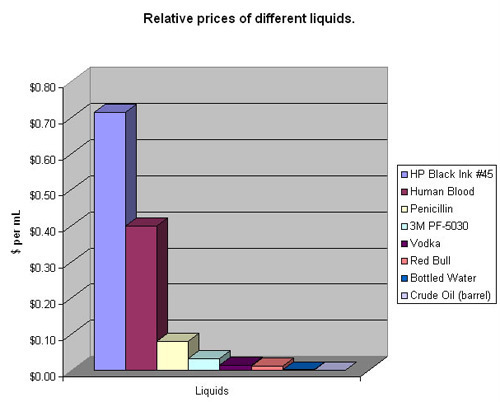
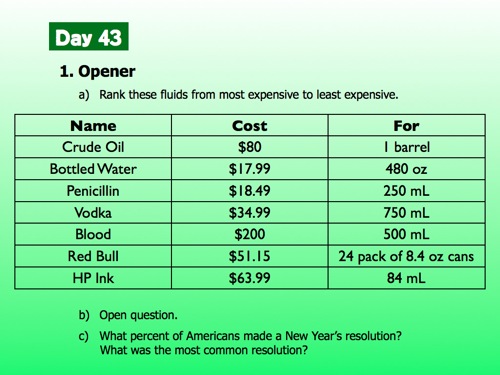
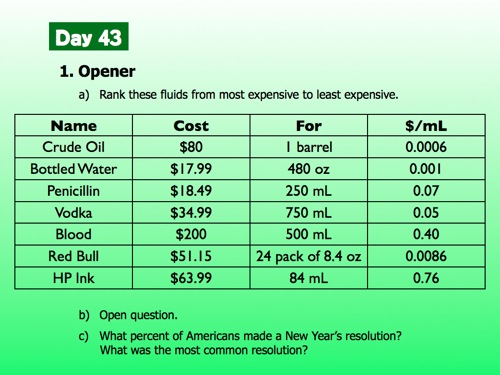
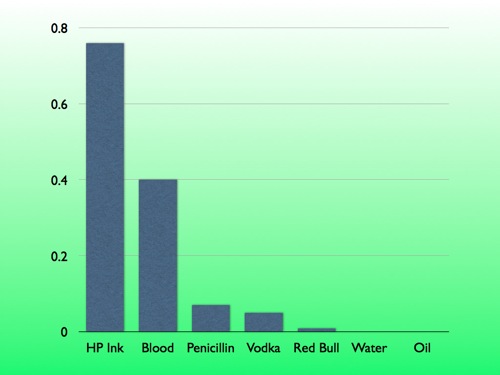
Here’s one: the relative price of different liquids which illustrates the disturbing fact that HP printer ink is several orders of magnitude more expensive than crude oil.
So I opened our first day back from winter break with a learning moment built around Nat’s link and then recorded video of the moment which you’ll find below. My apologies in advance for the pitiful production value. Initially, I was going to forward this only to Nat as some kind of retort but I found the experience so difficult, messy, and exhilarating, I had to debrief myself here. Notwithstanding the video quality, you’re welcome to pummel me for anything you see.
Synonymous with “What Can You Do With This?” is “How Do You Turn Something Interesting Into Something Challenging?” I have asked educators that question on this blog, in online classes, and in several conference presentations over several years. Here is – by far – the most common answer:
“I’d put it on the wall and we’d talk about it.”
Which is a weak start. A certain kind of student inevitably dominates these pseudo-Socratic discussions and then invites another kind of student to disengage. But Nat has dealt us a strong hand. If we play those cards right, we can retain and empower a lot of those (mathematically and conversationally) reticent students.
1. Calm down with the math for a moment. Invite their intuition.
At one point in my career, I would have led this off by giving them all the data and asking them to compute the ratio of cost to volume. but my blue students are poorly-served by that approach. So many of them have been burned so badly by math that if I open the conversation with terms like “ratio” and “volume,” pushing numbers and structure right at them, I’ll lose the students I want to keep. Moreover, this confuses master with slave. We use math to make sense of the world around us more often than the reverse.
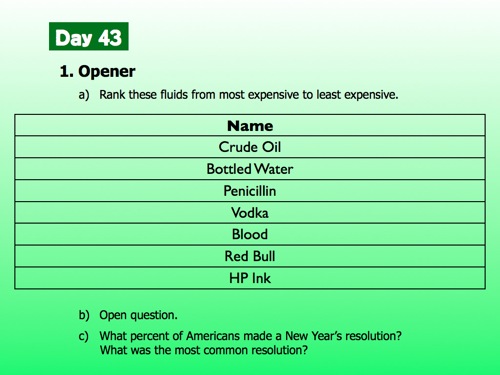
So I put seven liquids on the wall and asked them to rank them from most expensive to least. Simple speculation. Nothing more mathematical than that. Please imagine, here, how much more fun it is to walk around and talk about the question, “Which do you think is the most expensive?” rather than the lead balloon “Which has the highest ratio of cost to volume?”
Ask a student to come up and share her ranking with the class. Argue a bit. Entertain opposing opinions. Ask a student if he’d trade a can of Red Bull for a can of his own blood. Student investment at this point is very nearly 100%. It’s mine to lose.
2. Slowly lower mathematical structure onto their intuition.
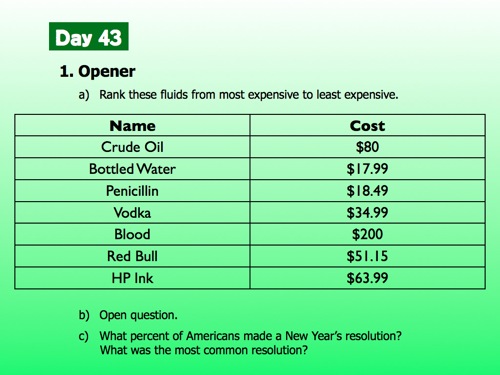
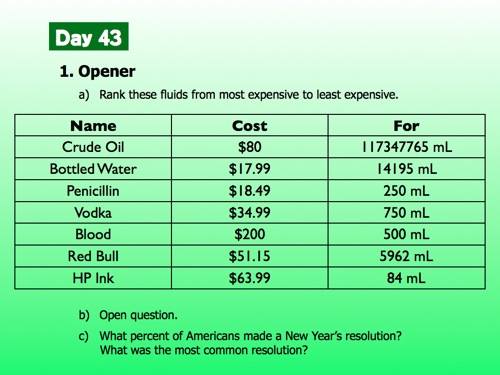
“Here’s the answer,” I told them, but students know at this point to triple-check me. Several went straight for Red Bull, which totes does not cost $51.15.
“So you’re saying that how much you get matters as much as how much it costs.”
Fine.
We used cell phones to text Google and ask for unit conversion. This always strikes my students as magical and suspicious.
And here, finally, we talked about the ratio of the cost of blood to how much blood you get. I asked them to visualize one milliliter of blood. “What does .40 mean?” We talked about the cost of one milliliter and how it’s useful to compare that cost across liquids.
The rest (hopefully) writes itself, though, for the record, I kind of hate how explain-y I get in the last third of the video.
The Virtuous Cycle Specific To Our Line Of Work
Find an interesting thingIt’s sad how often the conversation with other teachers ends here, after it becomes obvious that they just aren’t interested in all that much..
Transform that interesting thing into a classroom challenge.
Help your students develop tools to resolve that interesting challenge.
[Optional] Blog about it.
Repeat.
The feeds in your reader then spiral upwards and out of your control. WCYDWT ideas begin to pile up faster than you can capture them. It’ll freak you out and you’ll wish you could turn it off for just a few hours while you’re watching TV but you realize this a rare ancillary benefit in an occasionally tortuous job and you accept it gratefully.
I’m not claiming any kind of rigorous activity here. This is just a cute clip from Parks and Recreation, the best American comedy on TV right now, that begs one, maybe two good questions. I’ll throw this on an opener.
The last few weeks have been pretty profoundly discouraging on all three of my professional fronts. I’m sure it’s just the ebb tide of education but it’s worth mentioning that I’m specifically losing my mind over this WCYDWT thing, which is just a thing and may be much less than that, some form of digital wankery, I don’t know.
It’s like when you were a kid and you whispered the word “football” over and over again until the compound word separated and both parts seemed weird and meaningless all at once, that’s something like giving three conference sessions on the same process of curriculum design in four months. I can’t convince my fellow curriculum specialists at Google nor the teaching cohort I mentor online nor my high school colleagues of its value, which makes convincing myself of its value suddenly a real trick.
I’ll say this much for certain: if there’s value here it isn’t in the comment, “Rates! We could talk about rates!” The response to these media too often breaks down into a checklist of mathematical conversation starters and if you’re going to offer them any more than two minutes of class time then they absolutely have to be more than that. They have to earn their keep.
What do the students do with the photo? What questions will they ask? What measurements will they need? Once they’ve resolved the first question and feel like they have a stronger grip on the concept than they really do, how will you twist the scenario around to challenge them? How will you create that crisis?
Maybe it’d be better if I showed all of my cards up front, rather than this coy unveiling process which seems like a non-starter. If the exercise interests you, help me construct a narrative, an activity around these photos. Extra credit if you feel like contrasting it against Sean Sweeney’s pass at the same material some months ago.
I only know I shot this because I felt like I needed it, because the alternative is a problem involving savings accounts with different principals and different monthly deposits and none of my kids have savings accounts.