Category: what can you do with this?

Total 99 Posts

What I Would Do With This: Pocket Change

[following up from here]

Appeal To Their Intuition
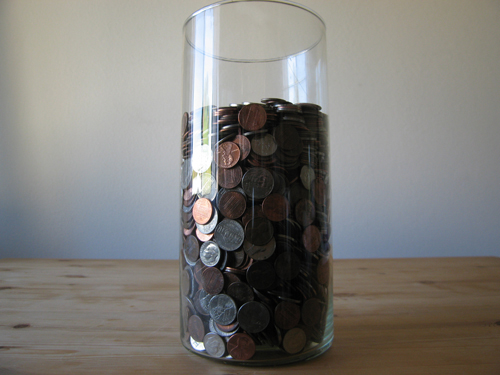
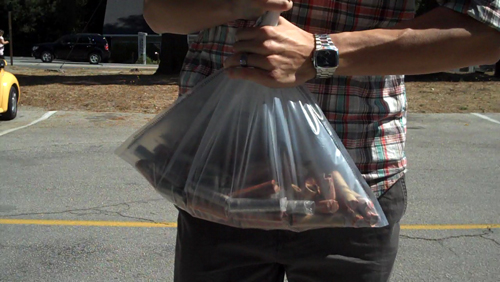
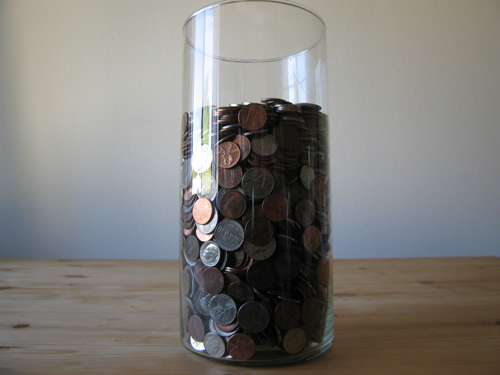
“How much cash is this?” Take guesses. The student risks nothing with a guess but that investment pays off huge for the teacher over the life of the exercise because the student wants to know who guessed the closest.

Build Slowly
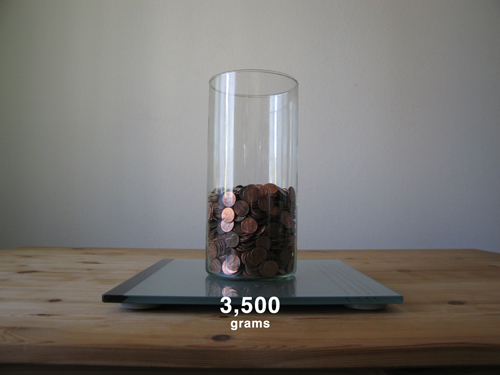
Again, ask “how much cash?” but also ask “how heavy?” Show them the weight. (I zeroed out the jar from every weight measurement you’ll see here. Don’t worry about it.) Spitball some ideas for determining the value of those coins. You’re trying to motivate the idea that the weight of the coins ties directly to how much the coins are worth. Pull up the relevant Treasury website.
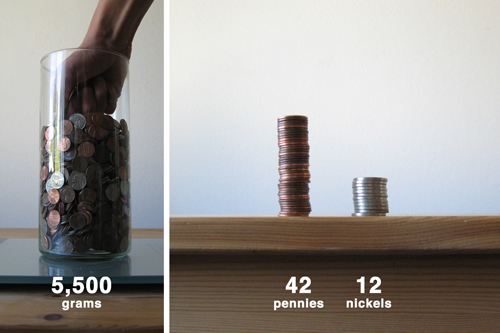
Then mix in some nickels. Scoop out a small sample. Play with that. Set up a proportion between value and weight.

Iterate
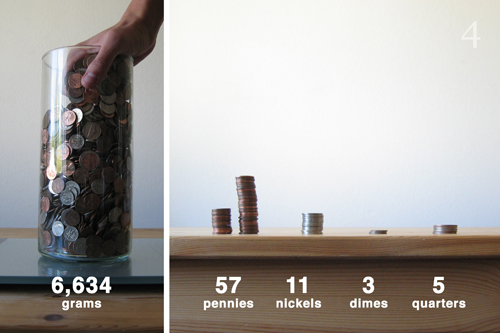
Now you have pennies, dimes, nickels, and quarters. I took nine sample scoops, everything from small to big.
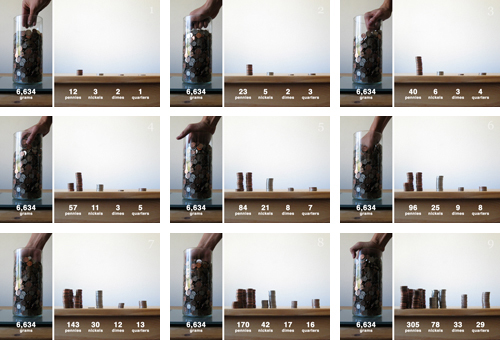
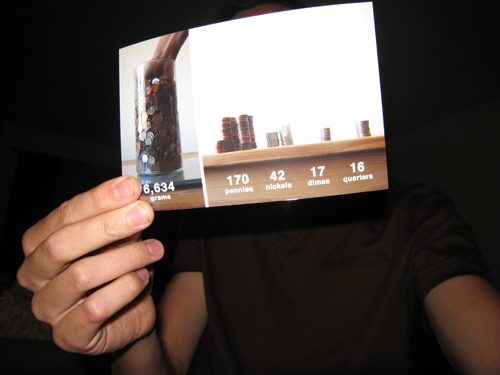
I formatted these at 4×6 so I could print them out at our local one-hour shop for a few bucks and put one in front of every student.
Throw A Curve Ball

Some will finish quickly. You tell them you have a jar of coins that weighs 5,500 grams. You reach in and pull out 14 nickels. How much is the jar of coins worth?

They’ll run these calculations and come up with an estimate of $55. You tell them it was really $34, which is huge error. Ask for sources of error. Then toss this up and talk about it.
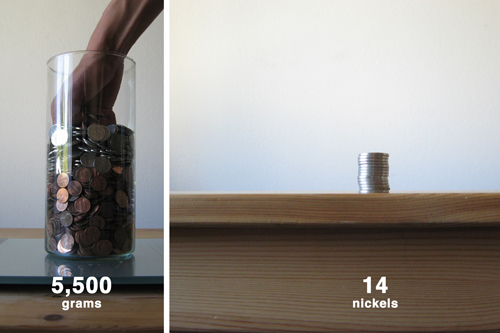
Confirm The Answer

$84.00, if you were curious.
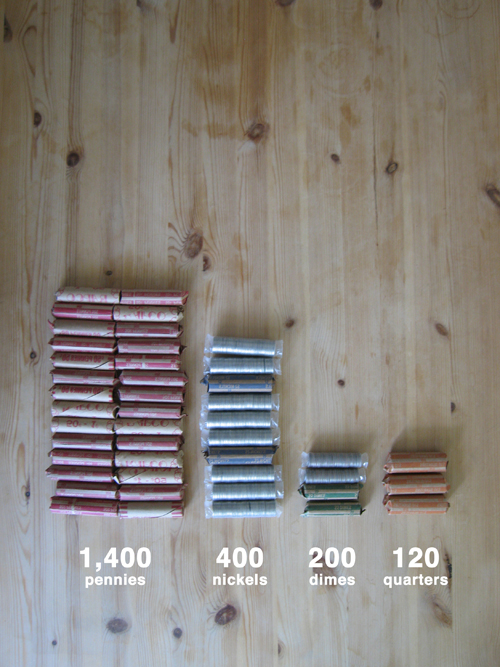
It’s essential to give some kind of visual confirmation of the answer, both so we can give credit to good initial guesses and so we can talk about sources of error. (ie. “who was off by the most? did sample size matter at all?”)

Miscellaneous

  1. Show them CoinCalc, the backend of which does exactly what we’ve done here.
  2. This activity follows-up nicely on the goldfish activity, where we used a small sample of fish to determine the total population of a lake.
  3. We yield the floor to Jason Dyer and anybody else who would like to debate the question, “why are we doing this digitally?”

Download

Here’s the entire learning packet [62MB].
What Can You Do With This: Pocket Change

[followed up here]

Let’s push this forward. The question is “how much cash?” The reference point is CoinCalc.

Your challenge is to outline the supporting materials so that this activity will a) scale from easy to hard, b) throw a few curveballs at the students who figure out its mechanics quickly, and c) offer visual confirmation of the answer to provoke a discussion of sources of error.

If you then consider the fact that a) it’s easier to mix coins than unmix them and b) it’s easier to tally the value of a roll of coins than a pile of loose change, you’ll understand why producing this unit took a week of detailed planning and an afternoon of careful shooting.

[click for high-res]

What I’m Trying To Say:

I withdrew $100 in pennies, nickels, dimes, and quarters from my bank account last week. I walked out of the bank holding a plastic sack full of change, feeling like some kind of underachieving bank robber.

I did this because I live in mortal terror that if I ignore the WCYDWT fairy even one time, she will leave me for another math teacher and whisper interesting ideas in his ear. For this reason, I put her ideas into some kind of play as fast as I possibly can.

I was just thrilled she didn’t tell me to literally rob the bank. I mean, it’s conceivable.

Excellent Math Blogging

These two are fresh. If you subscribe now, you can say you were into them before they got big.

1.

Tony Alteparmakian is a 2009 Leader in Learning enacting Chris Lehmann’s vision of classroom inversion (though I don’t doubt they came to the idea separately). Their idea is that we should send our students home with what used to constitute classroom time โ€“ the lecture โ€“ and spend classroom time on labs and teacher-led enrichment of that material.

Obviously, that vision comes fully loaded with complications but Tony is resolving them one-by-one in a how-to series that has only just started.

Also, I dig his redesigns. It’s hard to argue with slide transformations like these.

Before:

After:

2.

Sean Sweeney is an extra-value meal. In one corner of the edublogosphere you have the edtechnologists, the district IT staff, the ICT professionals, the policy wonks, etc., all asking huge, important questions about merit pay, technology integration, assessment, online schooling, etc., and posing reckless hypotheticals about limitless resources with nothing less than the future of education at stake, and all of it makes me grateful for guys like Sean who are driving 90MPH up the right lane, offering educators something they can use in the classroom right. now.

I’m talking about his quadratic catapult project. Or his Graphing Stories remix. Or his exercise in grocery store estimation. And that’s his output over two weeks.

This is math-instruction-as-artistic-expression and it’s cool as hell to watch.