Category: what can you do with this?

Total 99 Posts

WCYDWT: Burning Man

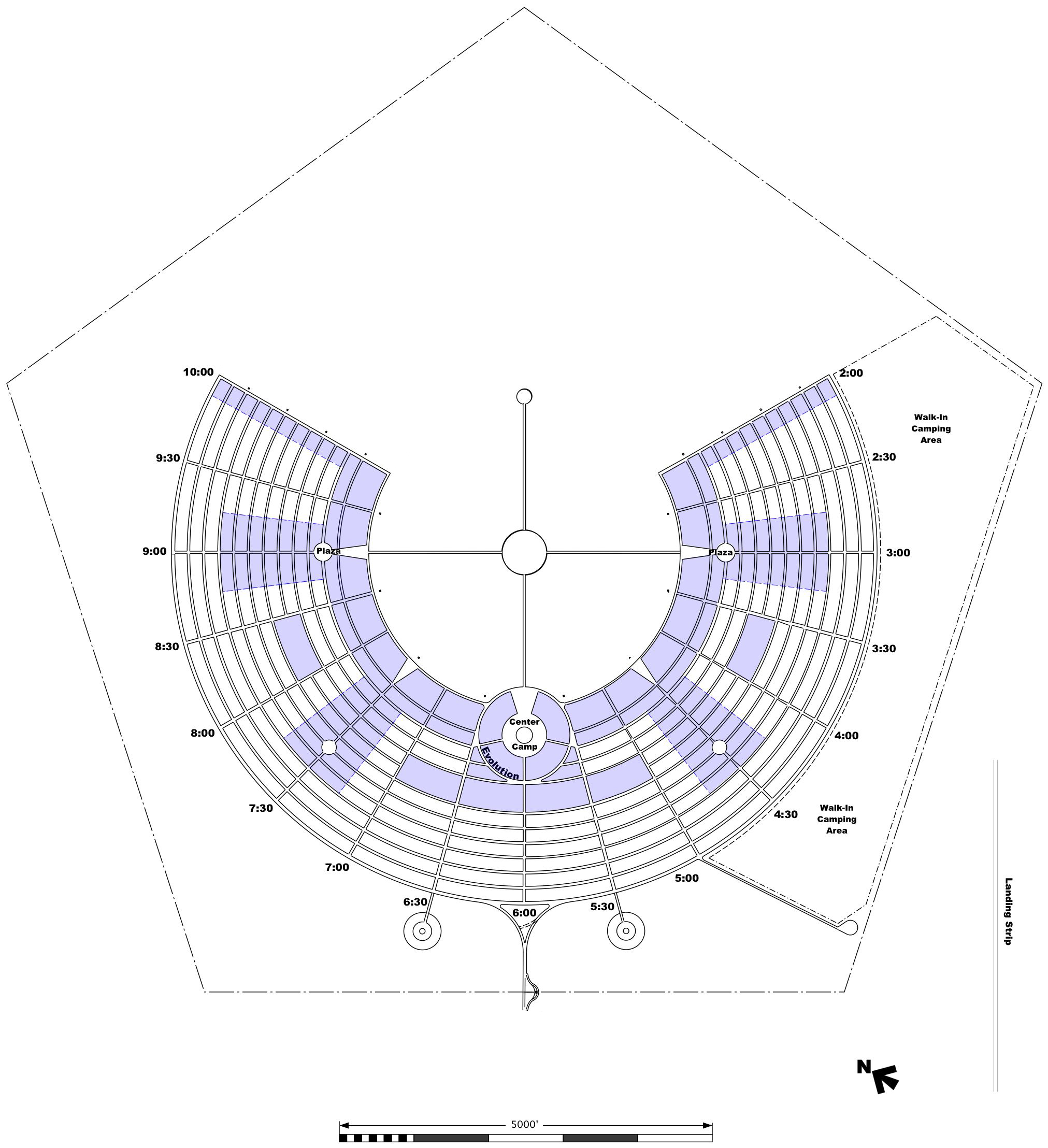
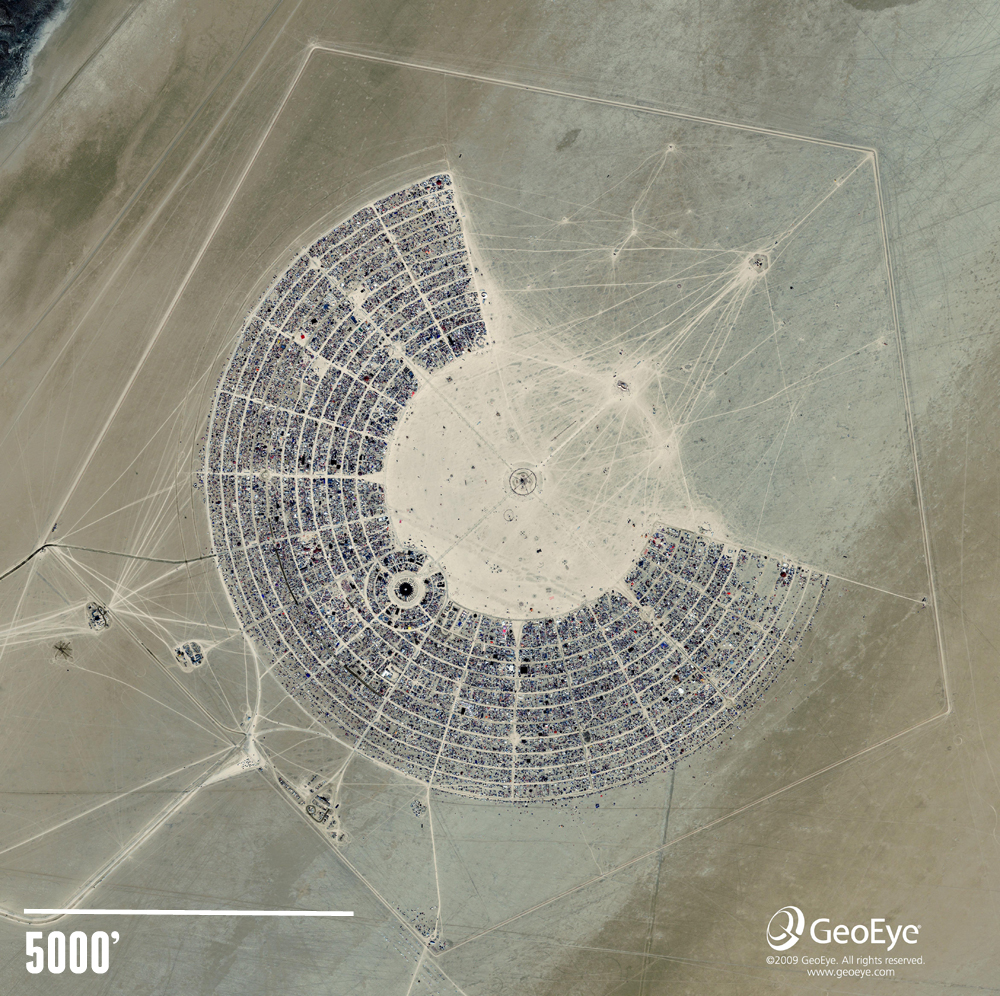
Click the image for full size. You have to see it full size.

1. What questions perplex you about this photo?

What’s the perplexity score here?

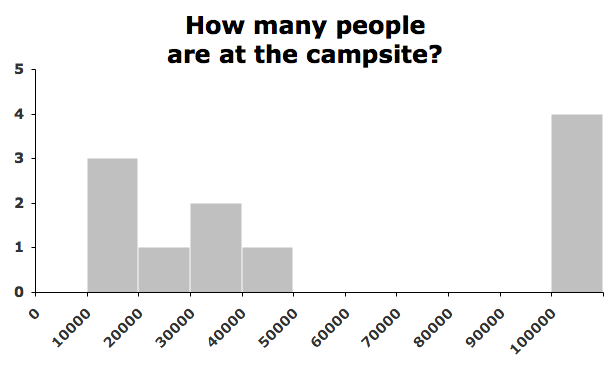
davidwees: How many people there?
Peter: how many people are there?
Roz: How many people?
schwartz: is it bad that i want to know the area of the shaded regoin?
JG: How many rows can be added until the circle touches the pentagon?
Colin (@ColinTGraham): How was it built and measured out?
Sam Critchlow: what/why is the gap between the pentagon and the circle
JG: How much area is added on with each additional concentric circle?
Sam Critchlow: or what is the total open space area
Chris: how many more people to complete the circle?
Colin (@ColinTGraham): what’s the significance of the pentagon
Nick Hussain: how many more people/dwellings (?) could be added if the circle was completed?
JSR: what’s at the center?
Colin (@ColinTGraham): how many sectors if the circle was complete

We went with:

davidwees: How many people are there?

2. What is your guess? What is a number you know is too high / too low?

3. What information would you need to answer the question?

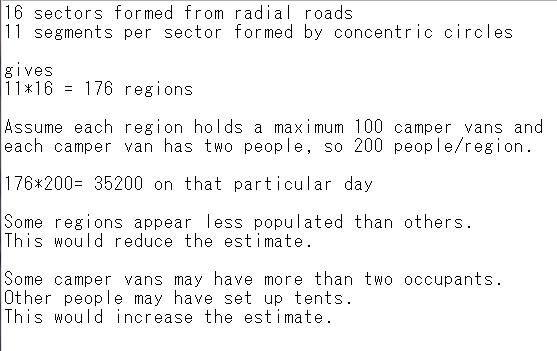
JG: Average number of people in each rectangular region
schwartz: people per square something
davidwees: I think we can estimate people per square
schwartz: radius of part circle?
Barb: Was admission charged? If so, who sold the tickets? They could give a ballpark figure
Colin (@ColinTGraham): is each sector evenly divided and how many sit in each of the eleven concentric rings?
davidwees: and get the scale from the size of the tracks shown
Roz: we definitely need scale

David’s response is right on point:

davidwees: so I think we could get a pretty good estimate without much more information

You don’t need anything more here. (I wonder what it takes to get students comfortable with imaginary units, as in “the radius of the circle is 500 burningmans,” etc.)

Nevertheless, here are two images that are interesting, if not useful also:

4. Submit your work.

I knew we wouldn’t have time for this. Here’s the Evernote page, though, where Colin Graham posted his work:

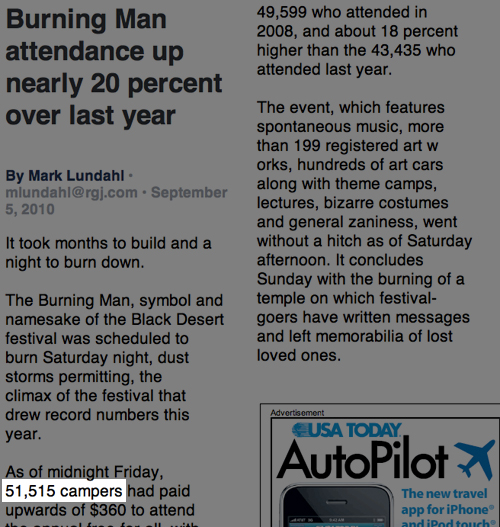
5. Show the answer.

[BTW: Though the photo is clearly timestamped 2009, various commenters have outed themselves as serious Burning Man attendees to tell me that this is 2010’s photo. I have adjusted the news clipping accordingly.]

Download High Quality

WCYDWT: Book Of Eli

Huge spoilers for the movie Book of Eli. You were warned.

Click through to view embedded content.

1. What questions perplex you about this video?

If we were assigning a score for perplexity, can we agree that this would receive a much higher score than Big Baby?

Jazo: how long will it take for him to recite the whole bible?
Sam Critchlow: how long is this movie going to be if he speaks this slowly for the whole bible?
Peter: how long would it take to dictate the entire bible
Roz: How long would it take to transcribe the bible
Matt: how long to recite?
Chris: Given that the Bible was being recalled from memory and transcribed at the same time, how long might it take?

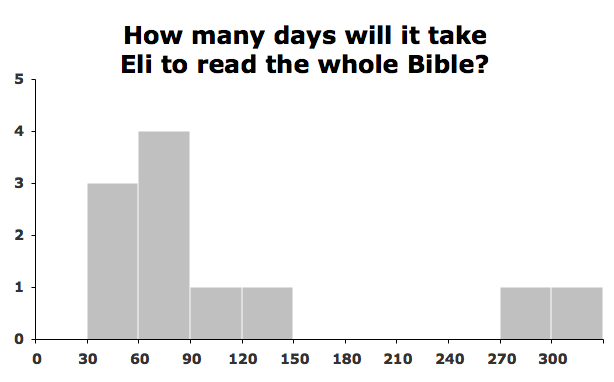
I set the units to “days” โ€“ I wouldn’t have done this in class โ€“ which led to:

2. What is your guess? What is a number you know is too high / too low?

3. What information do you need to answer that question?

Sam Critchlow: # words in bible
Chris: How many verses? Time per verse?
Peter: how many words per minute is he speaking? how many words in the bible
Roz: Are they taking breaks?
Jazo: how many words does he speak in a day at that speed?
schwartz: How fast a reader is he? How much time a day does he spend reading?
Matt: how many verses in the bible and average word length of each verse
Barb: I need to know if he reads 24 hours a day or takes breaks
Barb: Which version of the Bible
schwartz: How long is the bible in pages or words?

Three things about this conversation.

  1. It’s fun.
  2. It’s challenging.
  3. It doesn’t happen when you assign problems one through thirty odd.

I laid a timer over the relevant part of the video and linked it up, but you don’t even really need that. You’re counting. You’re Googling. (It’s the English Standard Version translation.) You’re calculating.

4. Submit your work.

Technical innovation: a public Evernote notebook.

Participants e-mailed my Evernote address with “@BookOfEli” in the subject. They attached a scan or a photo of their work and then everyone could see everybody else’s work.

5. Show the answer.

Technical demerits.

Download High Quality

WCYDWT: Big Baby

via Joshua Sloat, who offers up what is (I believe) our site’s first WCYDWT for upper elementary math students.

1. What questions perplex you about this photo?

Almost nothing went well here, which is what makes this particular moment so valuable for me. The image didn’t urge the question I thought it did, especially when I couldn’t easily clarify its meaning.

Sam Critchlow: how many players on a football team, are football babies bigger?
Chris: How many babies?
Matt: What do the yards and pounds represent?
Peter: what is 24,414 pounds? what is 7908 inches?

The intended question was:

Jazo: how many players?

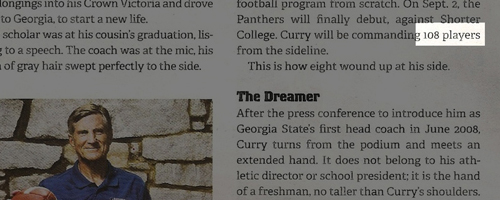
I have no problem, in these situations, just asking the intended question, but I remind myself to tune my WCYDWT antenna to scan for a better provocation than this one.

2. What is your guess? What is a number you know is too high / too low?

Technical innovation: Google Forms to submit a) the guess and b) the upper / lower bound.

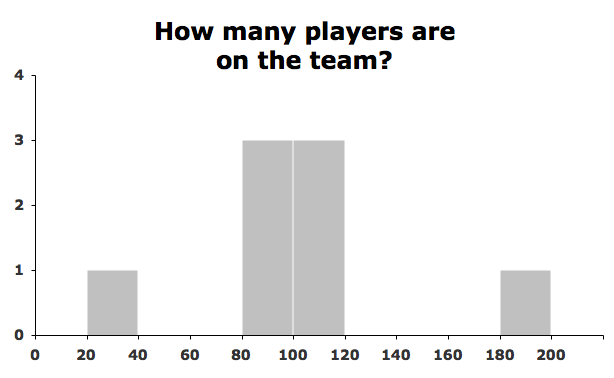
However you handle this, you’d rather not have one student’s developing number sense stunted by another student’s guess. Seriously. When I do this in class, everyone tracks within a standard deviation or two from the first guess, no matter how insane that first guess is. When JB says “the Eiffel Tower is 7 miles tall,” the next guess from AJ is “5 miles.”

3. How can you use math to tell if you’re right or not?

Peter: to know if your guess is right, divide total pounds by your guess

4. Play around. Decide if your guess was too high or too low.

We divided the total pounds (24,214) by one guess of 200 players.

Jazo: 121 pounds? sounds like a weak team
schwartz: less people!

5. Show the answer.

Download High Quality

WCYDWT: Dirt

Click through to view embedded content.

This clip is from the movie Holes, which is inexplicably billed as a movie for kids. (Sue Van Hattum kindly brought it to my attention.) The grim premise is a penal colony of children, each digging one hole per day in the desert for the duration of their sentences. On our hero Stanley Yelnats’ first day, he accidentally takes another kid’s shovel which is slightly shorter than the rest. Drama!

[High-Quality Download]

Step One:

  • Play the video.
  • Ask the students for questions that perplex them.

Aaron: “does the shorter shovel really matter?” +4 others
Peter: “how long does it take to dig a standard hole?” +2 others
Other questions. +5

This data is invaluable to my curriculum development. Invaluable. Consider last week’s responses to the boat in the river video.

Steve: “How long will it take Dan to go up the down escalator?” +15 others
Other questions. +2

It’s obvious to me which problem has the stronger current. Maybe I can do something about that; maybe I can’t. Regardless, I had to make a more authoritative call on the problem than I prefer. I said, “Okay, let’s talk about the first question. ‘Does it really matter that X-Ray’s shovel is a couple inches shorter?’

“How many pounds of extra dirt is Stanley going to dig at the end of a full year?”

Step Two:

  • Ask the students to guess at the answer to our question.
  • Ask the students to set an upper bound on an acceptable answer.
  • Ask the students to set a lower bound on an acceptable answer.

Our median [lower bound, guess, upper bound] was [100 pounds, 1,000 pounds, 10,000 pounds]

Step Three:

  • Ask the students to define the information they’ll need to solve our question.

VoijaRisa: Weight of dirt and extra length of shovel
Frank: how many days/ week?
Mr_K: Density of dirt
Steve G.: Density of dirt, dimensions
Aaron: mass of dirt, “shorter” shovel length

The movie doesn’t define the shorter shovel’s length, which leads to an awesome moment where the students and the teacher can basically make something up, some number that has no material effect whatsoever on the mathematics they’re practicing but which gives everyone the sense that “this is our problem.” Big win.

Director Andrew Davis didn’t think it fit the narrative of his film to mention the weight of a cubic foot of desert dirt so we faced a similar dilemma w/r/t density.

Step Four:

  • Give them a pile of information to use as they see fit.

Step Five:

  • Give them time to work.

I put twenty minutes on the clock and asked everyone to email me either a scan or a camera photo of their work when they finished.

Example #1
Example #2
Example #3
Example #4

Step Six:

  • After they compute their final answer, ask them to compare it to their error bounds from step two.
  • Play the answer video.
  • Compare the answer to our guesses from step two. Determine who guessed closest.
  • Discuss sources of error.
  • Discuss follow-up questions.

Stacy: I love this problem, but we still don’t have a good way to check our answer.

So this problem receives a certain demerit for not allowing us to observe the answer. I accept that demerit.

These problems require some kind of plan for challenging students who finish early. The attendees offered two approaches I want to highlight here:

Aaron: change the size of the original shovel.
Justin & Anna: how much shorter would the next shovel have to be for the difference to be the same?

Aaron has changed the input quantities and asked his students to find another output. His students will use the same operations on different numbers. From my experience, this leaves the teacher vulnerable to charges of assigning busy work.

Justin and Anna, by contrast, have made the old output quantity the new input. Before, their students were solving for the total quantity of dirt. Now, Justin and Anna have given their students the quantity of dirt and asked them to work backwards to new inputs. This is a great, versatile way to quickly create a new problem for students who finish early.

Open Questions

  • ft3 or pounds? In a workshop recently, we ended this problem by calling a local composting company and asking them how many cubic feet of compost they brought in on each dumptruck. The units on our final answer, then, were “dumptrucks.” There are different, subtle ways to frame the same question. Do you ask for mass, weight, volume, or dumptrucks? Mr. K and I went back and forth over the difference between these two questions. “How many extra pounds of dirt will Stanley dig after a year?” vs. “How many extra cubic feet of dirt will Stanley dig after a year?” What are their advantages and disadvantages? I’m still going over this in my head but my sense is that our students’ early estimates will be more accurate in ft3, but the answer will be more tangible to them in pounds. (See also: How Big Really?.)
  • I’m curious, if you were in that session, what does it do for your engagement with the problem to see your classmates’ guesses? (I welcome any other comments from the participants, of course.)
  • What app will let people email files to a public folder? I planned to use Dropbox but, last minute, I realized it didn’t support that function so I had participants email me their files, which I uploaded to my domain after updating an HTML file, and the whole thing was ridiculous. How do I cut out the middleman (me) here?

Miscellaneous:

  • Here is the session transcript.
  • I had DimDim’s whiteboard up at the start of the workshop, which turned out to be accidentally awesome. Participants started doodling as they waited for the session to start. One participant drew a map of the US and asked everyone to identify their location with a star.
  • I need to type questions after I speak them so the responses in the transcript make a little more sense to me afterwards.
  • I’m crazy enough to look up the shooting locations for Holes. It remains to be seen if I’m crazy enough to drive down to the Mojave Desert with a scale and weigh a cubic foot of dirt, which is clearly what needs to happen here.