2011 May 12: I gave this post another pass a year later.
The job of the dramatist is to make the audience wonder what happens next. Not to explain to them what just happened, or to suggest to them what happens next.
– David Mamet
Once you’ve learned something, my experience is that if you do something with that learning, if you turn your learning into something else for somebody else, it starts a flywheel spinning awfully quickly where you start learning more and then doing more with that learning and then you’re on CNN.
A recommendation: turn your learning into a story for somebody else.
Why a story rather than a persuasive essay or a pillow sampler? For one, the story is a medium that runs on greased rails between very different people. It’s an efficient transaction, even between me and my grandpa. For another, it’s hard for me to ignore how many elements of good teaching have their predicates in the three acts of a good story.
The First Act
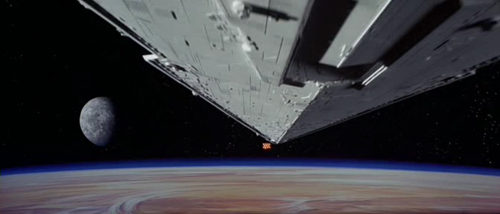
Consider the opening shot of Star Wars, a movie which is nothing if not a story well told.
The moons. The tiny ship pummeled by the huge ship. The chase. The symbolism of the green and red lasers. The camera rolling just inches from the huge ship’s underside so it (the huge ship) appears to go on forever.
I’m not saying every lesson needs to (or can) open this way. I am saying there are obvious advantages to opening a learning moment with a series of clear, intriguing constraints (again: the tiny ship, the huge ship, the chase) that invite speculation and curiosity.
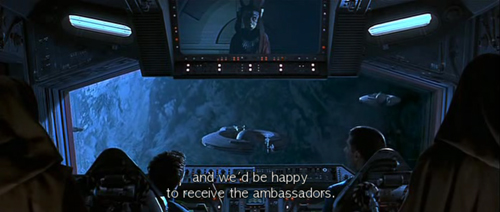
I’ll leave the injection of poor teaching onto the opening sequence of the first Star Wars prequel as an exercise for the reader. Hint:
The Second Act
During the second act of a story, your protagonist encounters allies and antagonists and uses the former to help resolve problems created by the latter.
During the second act of our lesson, students seek out the limits of the problem and try to determine valuable information and skills for resolving it.
The storyteller / teacher needs to assist the viewer / student just enough to make the viewer / student wonder what’s coming next and enable her to put that answer together on her own. It’s almost easier in these instances to help too much, to nudge a viewer or a student too forcefully, than it is to help too little.
Here’s an example from television where that goes right and wrong. These two shows both feature armed standoffs between criminals and cops. One show asks you to work hard to determine the motives and capabilities of the characters, the tone and possible outcomes of the scene. It’s a satisfying, tense experience. The other show signals all those answers awkwardly, and loudly, elbowing the viewer in the ribs with some ominous strings on the soundtrack.
You should be able to determine one from the other.
Click through to view embedded content.
Obviously, I need a better illustration with fewer adult themes here. Perhaps think about those sloppy literary adaptations where the writer couldn’t describe the source text visually so she has the main character narrate all those thoughts on the soundtrack.
The mandate for filmmakers is show, don’t tell.
Question, don’t tell is far from the worst mandate you could choose for the second act of your lesson.
The Third Act
Consider, now, a) great movie endings alongside b) Ben Blum-Smith’s Pattern Breaking series. If we allow the relationship between storytelling and teaching, Blum-Smith’s broken patterns represent the third-act twist: Rosebud is a sled; Bruce Willis is really dead; Darth Vader is Luke Skywalker’s father; 2, 4, 8, 16, 31. These patterns lull you into a false sense of certainty before yanking the rug out from under you, leaving you scratching your head, wondering what you missed, sending you back through the narrative again, scouring the story for other clues, conjuring up new theories.
Other movies choose to set up a sequel in their final minutes, like Batman Begins positioned the Joker as The Dark Knight’s next villain. Do you see how neatly that fits into Avery Pickford’s definition of great problems:
The problem should be deep. It should be rich enough to spend hours, days, weeks, months, or years working on variations, generalizations, and extensions.
Great problems and stories lead to more great problems and stories.
Questions
“Perplex them,” one of my old high school math teachers advised me when I told him I was going into teaching. Perplexity isn’t the same as confusion; rather, it’s a very, very productive form of confusion. My favorite teachers and storytellers perplex me repeatedly throughout a lesson or movie.
How do you teach people to tell perplexing stories? Even harder question: how do you teach people to tell perplexing stories about math?
My fear is that this skill, more than most others in my practice, reduces to character traits that can’t be taught. Storytelling requires empathy, an understanding of an audience’s expectations, their current knowledge, and their prior experience. I don’t know how you teach empathy. Perhaps it can only be modeled.
Certainly, here are fair pre- and post-assessments of storytelling:
-
Tell me about something you learned recently that exhilarated you. Tell me about it in such a way that I understand your exhilaration. ie. “Holy cow. ‘Oman’ is the only country in the entire world that starts with an ‘O!'”
-
Tell me about something you learned recently that exhilarated you. Tell me about it in such a way that I experience that exhilaration for myself. ie. “What is the only country in the entire world that starts with an ‘O?'”
It’s the assessments in between that mess me up.