Category: tech contrarianism

Total 133 Posts

What We Want Isn’t Out There

Todd Seal, the best ELA blogger you don’t subscribe to, responds to Scott McLeod’s recent provocation (paraphrased), “Can you identify 10 excellent web sites for your grade / subject area, and if not what’s wrong with you?”

Todd: What we want isnโ€™t out there. My typical search finds me cobbling lots of different pieces together with an idea Iโ€™ve had for the last two years along with a little something I got from watching SNL this weekend attached to the core of an idea I got from a discussion with some friends last month. I rarely find resources online that fit right into what Iโ€™m doing or that hit on what I want to address. I wish they were out there, but not even Discovery Education or any of the lesson plan warehouse sites cut it. Lots of chaff to sort through there and I worry about my return on time invested.

If I had to compile a list of sites essential to my day-to-day practice, you’d find Google Search, Google Reader, Google Images, and not a whole heckuva lot else. I spend much of my planning time lately curating media of the kind Todd lists in his awesome run-on sentence there: TV shows, photos I find, photos I take, video I capture, iPhone applications, current events, commercials, and, if I must, my assigned textbook.

I curate this media. I arrange it sensibly and structure questions and activities around it. It’s time-consuming and it’s challenging and the only way I can remotely justify the expense is by posting those lesson packs here, for others to download, deploy, and improve upon, thereby propping up an initially weak return on my investment.

As magical as these Internets are, I haven’t been able to outsource that curation to one website, or ten.

Picking Up The Gauntlet

If you read nothing else, my summary judgment on stock photography closes the post.

Tom Woodard

Ten minutes after I threw down the gauntlet Tom Woodward picked it back up and whacked me with it:

Once again, help me make this better. That goes for images, argument, facts – whatever.

My response.

John Pederson

John Pederson, apropos of nothing I wrote, has developed a sudden, sloppy crush on typography, one of the artistic disciplines that hasn’t changed in several centuries, so that’s great. Because if you don’t know how to work with type, Prezi and CoolIris won’t save you.

Darren Draper

Darren Draper posted two variations on the same theme, asking would I really prefer a white background to a stock fast-food worker.


vs.

My answer is no, I prefer the stock photo, though I am glad there are a few other options besides those two. If those were your only options then go with stock photography. But carefully. The trappings of stock photos are a) exaggerated lighting, b) exaggerated framing, and c) exaggerated content, all of which give the content of your slide a lot of competition for attention.

I saw recently, for one example, a frightened kid shot under harsh lights with Scrabble tiles spelling out F-E-A-R censoring his mouth. The accompanying quote concerned Internet filtering or something. The quote was interesting and provocative but completely overwhelmed by the stock photo.

Dean Shareski

Dean perplexes me, saying I’m “stirring up trouble” with my last post. I realize this is just Dean’s usual Canadian bonhomie but, come on. Here is Dean’s commenter, Mark Kowalski. Take it away, Mark:

Even as a teacher, public critique of a personโ€™s work is an odd experience. Maybe our social norms on feedback and politeness have gone too far one way?

If that “one way” is toward norms equating “criticism” with “insensitivity,” then I agree.

Angela Maiers

Angela has linked up a Slideshare presentation and asked for feedback.

Credit where credit is due. Y’all have taken Garr Reynold’s style and run with it for quite some distance. I have two concerns.

First, there are instances when the stock photography is so exaggerated or stylized that it distracts from the purpose of the presentation. In this example, I promise you I am not pondering the consequences of Angela’s quotation. I am scared to death of that toddler. Someone sign that kid to the Lakers but get him away from me.

Second, there are instances when the stock photography Angela has selected a) interprets the quotation for me or b) tips me to Angela’s interpretation when she’d probably rather I develop my own interpretation and add it to the discussion or presentation wiki or whateverTo cite my recent obsession, stock photography can easily be too helpful..

I didn’t mind this next one at all, an understated image that doesn’t constrain audience interpretation. The fact that I’m reduced to judging stock photography on how little it hurts a presentation oughtta concern us, however.

Alice Mercer

Alice has linked up her presentation files and asked for feedback. Take it away, people.

Summary Judgment On Stock Photography

Ditch it. Show me something real, not artificial. Serve the quotation up on a simple background with good typography and then show me some video or a photo or some audio captured naturally, in the wild, that hints at but doesn’t clonk me over the head with your point. And then let’s talk about it.

In Darren’s case, I would look for video of high school dropouts interviewed about their career paths since they left school, including, for the sake of intellectual honesty, some success stories. Find that. Or make that. Embed that. Let’s talk about that. Not about some Google Image or FlickrCC search I could have performed myself.

I realize this is several hundred times harder than typing keywords into a search engine but, as with personal hygiene, you get out of it what you put inMaybe y’all think I’m some sort of crank in these posts. But when someone uses their digital projector to curate and build conversations around interesting media they captured or aggregated themselves you really can’t imagine my enthusiasm..
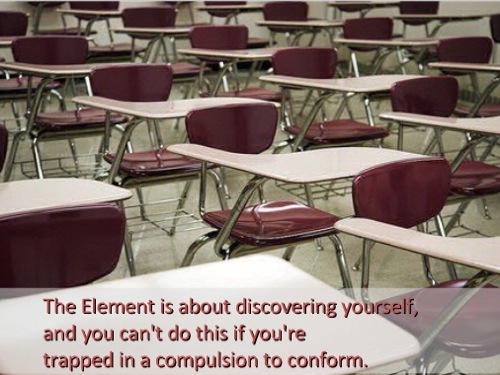
Just One Example: Stock Photography

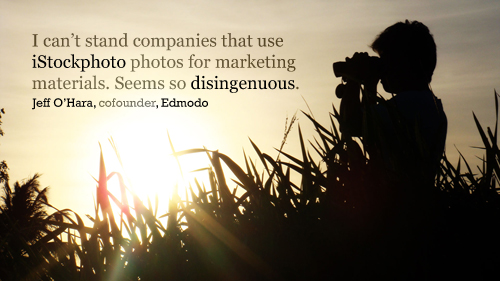
It would be interesting to open the floor up for discussion of one of the hottest memes in education presentation: the stock photo / quote combo. They’re inspirational. They’re ominous. They’re ironic. You can find them from the highest-trafficked level of edublogging to the lowest.

We collectively obsess over the tools to create these imagesPhoto source. Quote source. And, incidentally, yes, stock photography adds extra artifice to your image and, consequently, weakens your thesis. (Unless, for example, your thesis is that stock photography adds distracting artifice to a thesis.). We obsess over the technology that lets us publish them globally. Yet, if someone has asked the essential question, “Do these images distract from or enhance our theses,” I haven’t seen it.

I realize that, in the stadium of Essential Skills For Educators, visual literacy sits somewhere up in the mezzanine. There are many more important things to discuss than how best to use an image in the service of a thesis. But it sits much, much closer to the field than any of the publishing tools which depend on and amplify your existing visual literacy.

I’m trying to convey my frustration that you’re somewhere on the order of ten times more likely to find a post in the edublogosphere celebrating SlideRocket or Prezi than you are a post soliciting feedback on your pre-existing visual literacy condition which these presentation apps utterly depend upon.

Want to shut me up? Let me see you not just post the slidedeck of your last education presentation, but the audio also. Next, don’t just tell yourself that you’re open to visual literacy instruction but tell that to your readership explicitly. Ask for feedback. Describe your thesis โ€“ what were you aiming for with those slides? โ€“ and ask for criticism. Ask people to post alternative visual approaches to your own thesis. And then โ€“ because a lot of people equate “criticism” with “hurting someone’s feelings” โ€“ reward their criticism. Thank them.

And then hype whatever new tool lets you publish your slides through Twitter’s API (or whatever) with my blessing.

But first things first.

[photo credit: Francis Yannick De Ocampo]

The Latest Web 2.0 App For Education

Charles Eames:

Choose your corner, pick away at it carefully, intensely and to the best of your ability and that way you might change the world.

I receive comments occasionally asking me if I have ever heard of SMART boards. I attended a district-wide SMART sales pitch earlier this school year before we became very broke. And I thought to myself the entire time, please, please, someone just help me get a grip on how to use pictures โ€“ moving and static โ€“ in a math classroom. Maybe then I’ll move along to something else that doesn’t change and after I have done everything I can for my classes with each of those, maybe then I’ll have need of a SMART board, which can play clapping sounds on command.

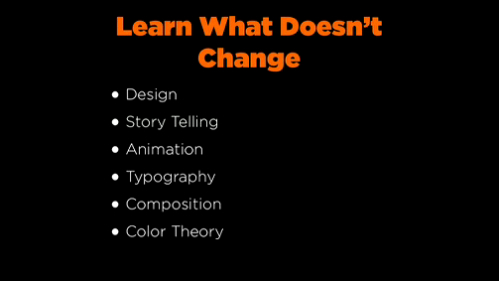
Learn What Doesn’t Change

Two minutes into his MGFest 2009 presentation How To Be Creative And Get Paid, Nick Campbell summarizes my concerns about cigotie’s technically proficient mimicry.

Campbell tells the crowd to learn what doesn’t change.

design, storytelling, animation, typography, composition, color theory

We are awash in shiny cheap tools, a reality which is both wonderful and maddening. These creative disciplines have changed very little in the last several centuries and yet when edubloggers talk about creativity in 21st-century schools they talk overwhelmingly of the tools and, occasionally, of who found the tool first.

I paint with a broad brush here but for every 100 posts celebrating the easy-bake aesthetic of Wordle and Animoto you’d think I could find one celebrating the use of color toward easier, more satisfying communication.

Just gotta make it look new maybe. Like maybe we lose some vowels, rename it colrthry or something. We’ll give it a logo with a gradient, add some social networking functionality, and if our district IT guy blocks it maybe then we’ll start talking about what’s more important to art than the tools we use to make it.