Category: tech contrarianism

Total 133 Posts

I Can’t Do This

In an astonishingly wise appropriation of tech funds, my district is paying its own teachers to conduct tech seminars for other teachers. I signed up for a block of three tutorials on maximizing digital projector use in the classroom. I have way too much material for this workshop.

But my district’s curriculum coordinator assigned me a workshop called “Web 2.0 for Mathematics Instruction” unaware that my c.v. here is positively larded with skepticism about this place where your Internets and my Maths coincide, a place which you have sworn exists. I have no material for this workshop.

Neither, apparently, do the ed-tech institutions. Vicki Davis retweeted this from Dianne Krause the other day:

Leigh Ann Sudol’s response, that this blog represents some kind of coincidence of Web 2.0 and math, is even more disconcerting:

Far from representing the read-write web’s effect on math instruction, this blog remains perpetually befuddled by it.

So before I cancel this workshop (for which I never volunteered in the first place) I’ll put Vicki and Dianne’s question out here: does anybody have any examples of Web 2.0 technology transforming math instruction?

I’m particularly interested in methods specific to math. Tell me my students can collaborate over a conceptual wiki, or Skype with another country over project-based learning, or blog their class notes, and you’ll find my attention wandering. These techniques could enhance a class on auto repair, I realize, but the farther you wander away from the liberal arts towards my room, the more their returns diminish.

Postscript:

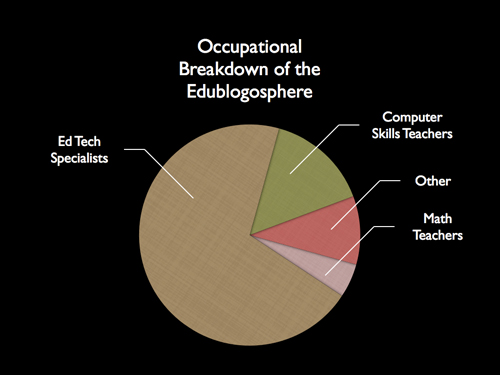
Though Scott has yet to release his 2008 survey of the edublogosphere (which *cough* will only be a year outdated this January) I have seen some of the early infographs and they confirm that the loudest voices on the matter of ed-tech don’t teach and, furthermore, don’t teach math:
Time was, I’d recommend Darren Kuropatwa as the go-to guy for math instruction using read-write technology but I pay my taxes more often than he blogs.

So where are the Web 2.0-enabled math teacher bloggers?
Correct Me If I’m Wrong

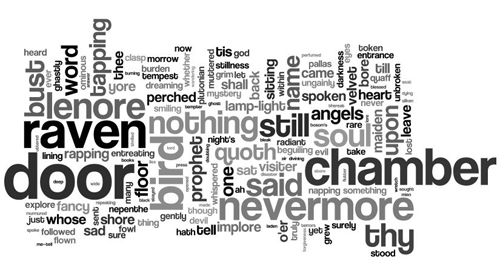
Wordle’s classroom use โ€“ no matter where I find it โ€“ seems predicated on the false assumption that word frequency has anything to do with meaning.

What โ€“ if anything โ€“ does this Wordle say about The Raven? Very little about subtext, certainly, but its creator enthuses:

… will they notice that the word soul is used more frequently than tapping and rapping? As I looked at the cloud for โ€œThe Raven,โ€ I couldnโ€™t help feeling that I had created a piece 21st century text in its own right.

How are otherwise competent lit instructors so seduced by low-level lit analysis?

Web 2.0: Education’s Accidental Friend

Wes Fryer glows over Animoto, the debits of which I addressed some time ago, and a lot of my hesitance to embrace [your pet Web 2.0 tool] crystallized in my response there:

Animoto is wrong for education in every way that itโ€™s right for consumers โ€“ and the befuddlement of its creators at its educational market share affirms this directly. Consumers want something that takes the difficulty out of an engaging slideshow but difficulty is essential to learning.

These are businesses, after all, and some businesses (though not all) attract customers by making difficult processes easier. Sometimes (but not every time) those difficult processes are the same ones which impel learning. So while Blogger, for example, makes the right processes easier for students (the mechanics of online publishing) so that they can focus on the difficult one (writing), Animoto simplifies the wrong processes (editing a slideshow with rhythm, music, visual panache) leaving behind only the most menial (select an order for your images, select a track, press go)Again, because I have enormous respect for the skill of Animoto’s editors and of Animoto, itself, as a consumer tool, this screed is only to urge its judicious use among educators..

Many have come to this conclusion before me, I realize, but I am only now fully struck by the fact that the goals of profit-driven Web 2.0 applications and the goals of educators only align accidentally.

Hackwork

I’m now filing Wordle alongside Animoto in my drawer labeled “Cool Technology The Classroom Value Of Which The Edtechnoblogosphere Grossly Overestimates.”

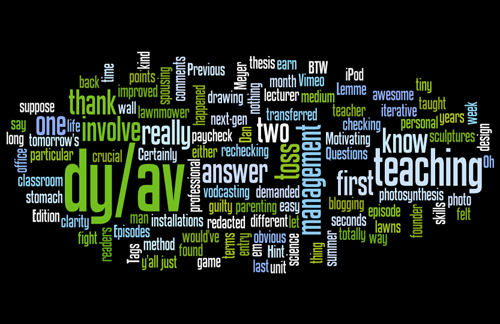
The output of each is interesting โ€“ jittery, rhythmic slideshows in Animoto; neatly formatted word clouds in Wordle โ€“ but for classroom purposes we need to stop judging these tools on the quality of their output rather on the rigor of their input and the interpretation of their output.

Each requires input which would hardly challenge a toddlerBetter Wordle Activity: Have the students develop the frequency distribution chart for a small text themselves and then create the cloud from rules like “between nine and twelve instances receives a thirty point font.” Even then, I’m not sure what this thing does, though I’m sure it has little to do with “theme.”.

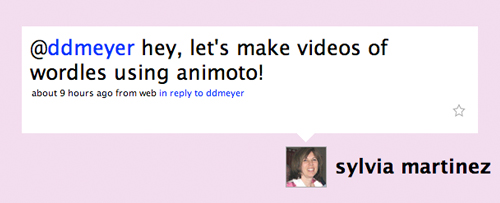
Taking up Sylvia’s reductio ad absurdum here:

Maybe I’ll keep mashing these tools up in real-time as y’all fawn over them, hoping that if I exaggerate the cookie-cutter enough it’ll persuade someone to jump ship.

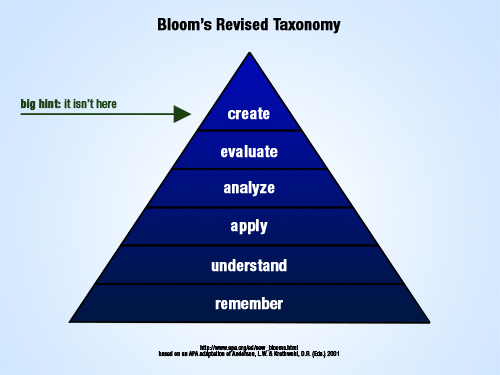
Anybody want to elect a shelf for these tools in Bloom’s (Revised) Taxonomy?

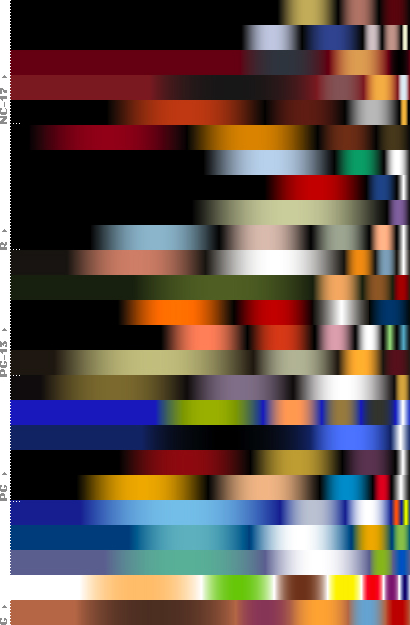
It’s only a matter of time before y’all find Thumber, which only asks you to select a movie file and press “Go” before it does all the heavy lifting for youBetter Thumber Activity: Have the students select fifteen posters from high-grossing movies from child rating though restricted. Use IMDB. Build a color distribution (ie. what colors do you see and in approximately what percents?) and compile something like this, which shows children’s movies consistently employing bright blues and restricted movies employing blacks and reds. Awesome..

Let’s call it what it is.

Related:

  1. This Thing I Just Realized