Stop the assumption that reading and writing and math are the most important things everyone needs to learn. Anyone who suggests reading is more important than art scares me.
Comments like these, pitched along the Ken Robinson wavelength, do nothing to rid me of (what I’m positive is) my wrongheaded presupposition that the ed-tech evangelists, writ large in the blogosphere, have a very loose grip on the challenges facing low-achieving populations and their teachers, though that prevents none of them from adopting an authoritative stance. My bias, which I have never explicitly disclosed in two years blogging but which I suspect has been evident from the start, is that none of them has any idea how difficult it is to do what I do. I’m certain this bias is false, unmitigated self-absorption, but the comments section at Ideas and Thoughts does little to disabuse me.
or: Finally Understanding The Appeal Of These Student Response Systems
Aaron Pallas (nee Skoolboy) has been skeptical of the impact of reduced class size on student achievement for some time. This never made sense to me until last week.
I’m observing other classes on my prep period. It started out once a week, reluctantly. Now I’m in a new class every prep – half hour at a time – and really enjoying the experience. My note-taking has evolved as I’ve noticed trends and I have customized an observation form. I take photos and record audio (on my iPhone, natch) and keep all the media in GoogleDocs.
After I observe every class at my school, I’ll inevitably work all of my field notes into some kind of comprehensive post-mortem (the results are too interesting to simply file in a drawer and forget) but I have to point something out right now.
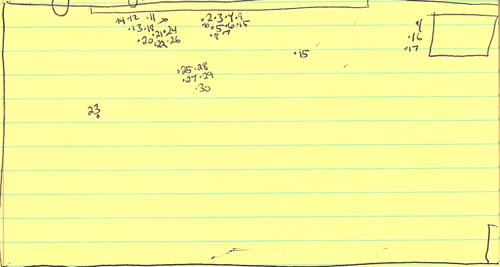
Part of my observation involves a dot plot of teacher position over the first thirty minutes of class. With two exceptions (so far) they all look like this:
The sage on the stage is real, though she’s far more stage than sage. She’s tethered. She doesn’t leave the board. She doesn’t deviate from a tight route she’s defined between her teacher desk and the overhead projector.
She puts five problems up on an opener and models three separate skills in a lecture without once venturing out and examining student work. Not only does this construct an artificial wall between teacher and student but it makes checking for understanding very difficult.
What I’m saying is that reduced class size is useless if you’re still going to teach like you’re a lecturer in some intro course at some enormous public university.
And now enter student response systems, technology which enables this detachment, which tells teachers which students picked the right answer and which picked the wrong answer as formulated by the teacher but not which students picked the wrong answer as formulated by the student.
Get a wireless remote. Project a problem, something meaty with a lot of steps and maybe a couple of twists somewhere near the end, and then walk around – through the rows, not just around the periphery – noting common errors. Have a conversation with your students.
Because none of this intervention – I don’t think –Â makes any difference if you haven’t already asked your students, “How are you doing today?” But I dunno. Maybe just let them select the answer to that question with their student response systems.
or: My First Ed-Tech Conference
also: My Last Ed-Tech Conference
I’m back now from the Innovative Learning Conference in San Jose, CA. When I first bumped into Alice Mercer, she said, “This doesn’t seem like your kind of thing.” She’s either right, and I’m just the wrong person for ILC, or else ILC should have stepped its game up in a lot of ways. Obviously, I’m biased toward the latter. Either way, I shouldn’t have missed class time for this.
Therefore, a brief preface of ILC’s good stuff and then my best advice for the presenters there. If you’re reading this and you presented at ILC, obviously I’m not talking about you, or your session, etc., and hopefully you all realize by now that I reserve my harshest criticism for myself.
Preface
It was nice meeting Collette, Rushton, Alice, Gail, and some other folks; CUE organized the conference well, with the right number of sessions per day (five) at the right length (an hour, though some presenters didn’t earn ten minutes); the catered lunch was fine, just fine.
That Said
In order to earn one seat-hour from a few dozen people, your presentation needs either:
a compelling personality behind it;
expertise, the sort of expertise DFW wrote about, the kind that has such a tight conceptual grasp, it can explain itself from any side, from any angle, from a macro- or microscopic lens;
a compelling narrative, something with an antagonist, with obstacles to overcome, even if they’re just stubborn network administrators; this is why I pinned my talk on math methods (back in the day) to a fictional student and gave her a photo;
illustrative, complementary visuals; video, PowerPoint, handouts, makes no difference to me so long as they’re pretty and useful;
empathy for audience expectations, the sort of clairvoyance where you know what your audience is wondering, what it’s waiting to see.
Fourteen of eighteen presentations I attended couldn’t manage one of those.
There was the usual PowerPoint plague, presenters standing for thirteen minutes stock-still in front of a bulleted slide, that flat text often describing a highly visual conceptThere is no excuse for describing student video production with text bullets. Show video!, those bullet points often disregarding basic mechanical Englishie. If you’re going to shame yourself with bullet points, they should read (eg.) “Noun; Noun; Noun; Noun” not (eg.) “Noun; Noun; Noun; Past-Tense Verb.”.
As a guy who teaches compulsory Algebra to kids who have hated Algebra, I don’t see how fourteen presenters managed to blow a scenario where an audience volunteered to attend their sessions. Where the audience is interested in the session (provided the presenter didn’t falsely bill it). Where the audience is pulling for the presenter. Where the audience is eager to be dazzled, fed, or inspired.
ILC was like walking into eighteen car dealerships, pockets bulging with cash, declaring to every salesperson, “I’m here to buy,” and discovering that fourteen of them couldn’t close the sale.
Equivocations
I don’t mean to be overly particular but what I saw this weekend was visual- and verbal illiteracy at a high level. I saw fourteen educated professionals put styrofoam on a plate, convinced it was steak. I want no part in that sorry transaction. I want to produce and consume the best I can while I still can.
I’m speaking at CMC-North in Monterey this December on how not to ruin entire classes with visual illiteracy. I realize it’ll serve me right to have some punk kid out there in the audience, snarking about me on his blog and on Twitter.
All I can do is hold myself to this same standard.
Promoting Quality
If you’re cool with some profanity and if you’re even a little invested in the state of online gaming, check out this presentation from NY Tech Meet-Up. It did more to inspire, educate, and illustrate in five minutes and change than did the median presentation at ILC 2008.
Downes on the amateurish state of digital video online:
To me, what we are seeing reminds me of the early days of HTML, when some web pages were just awful. We rarely see that any more – not because people became better HTML programmers, but because the tools made HTML programming unnecessary. The same will be true of video.
This would be true if video production’s tallest hurdle were technical, as it was when all these competent writers found a way past HTML programming with blogging. Rather, video’s tallest hurdle is creative. Cheap hardware and simple software won’t matter a bit if you don’t know where to put the camera or where to put that edit.
Stephen’s outlook on digital video struck me as overly sanguine last November. A year later, having completed just ten videos with dy/av, I can report that no form of creative expression has been so difficult, or so satisfying.
I mean did anybody seeThe Devil Wears Prada?! Anne Hathaway went insane from the non-stop multi-tasking. Is it too much to ask for a little restraint even as we prepare our students to compete with the Chinese / Indian economic menace, etc.? Where’s Dina.