Category: tech enthusiasm

Total 120 Posts

Three Claims Function Carnival Makes About Online Math Education

Today Desmos is releasing Function Carnival, an online math happytime we spent several months developing in collaboration with Christopher Danielson. Christopher and I drafted an announcement over at Desmos which summarizes some research on function misconceptions and details our efforts at addressing them. I hope you’ll read it but I don’t want to recap it here.

Instead, I’d like to be explicit about three claims we’re making about online math education with Function Carnival.

1. We can ask students to do lots more than fill in blanks and select from multiple choices.

Currently, students select from a very limited buffet line of experiences when they try to learn math online. They watch videos. They answer questions about what they watched in the videos. If the answer is a real number, they’re asked to fill in a blank. If the answer is less structured than a real number, we often turn to multiple choice items. If the answer is something even less structured, something like an argument or a conjecture … well … students don’t really do those kinds of things when they learn math online, do they?

With Function Carnival, we ask students to graph something they see, to draw a graph by clicking with their mouse or tapping with their finger.

We also ask students to make arguments about incorrect graphs.

I’d like to know another online math curriculum that assigns students the tasks of drawing graphs and arguing about them. I’m sure it exists. I’m sure it isn’t common.

2. We can give students more useful feedback than “right/wrong” with structured hints.

Currently, students submit an answer and they’re told if it’s right or wrong. If it’s wrong, they’re given an algorithmically generated hint (the computer recognizes you probably got your answer by multiplying by a fraction instead of by its reciprocal and suggests you check that) or they’re shown one step at a time of a worked example (“Here’s the first step for solving a proportion. Do you want another?”).

This is fine to a certain extent. The answers to many mathematical questions are either right or wrong and worked examples can be helpful. But a lot of math questions have many correct answers with many ways to find those answers and many better ways to help students with wrong answers than by showing them steps from a worked example.

For example, with Function Carnival, when students draw an incorrect graph, we don’t tell them they’re right or wrong, though that’d be pretty simple. Instead, we echo their graph back at them. We bring in a second cannon man that floats along with their graph and they watch the difference between their cannon man and the target cannon man. Echoing. (Or “recursive feedback” to use Okita and Schwartz’s term.)

When I taught with Function Carnival in two San Jose classrooms, the result was students who would iterate and refine their graphs and often experience useful realizations along the way that made future graphs easier to draw.

3. We can give teachers better feedback than columns filled with percentages and colors.

Our goal here isn’t to distill student learning into percentages and colors but to empower teachers with good data that help them remediate student misconceptions during class and orchestrate productive mathematical discussions at the end of class. So we take in all these student graphs and instead of calculating a best-fit score and allowing teachers to sort it, we built filters for common misconceptions. We can quickly show a teacher which students evoke those misconceptions about function graphs and then suggest conversation starters.

A bonus claim to play us out:

4. This stuff is really hard to do well.

Maybe capturing 50% the quality of our best brick-and-mortar classrooms at 25% the cost and offering it to 10,000% more people will win the day. Before we reach that point, though, let’s put together some existence proofs of online math activities that capture more quality, if also at greater cost. Let’s run hard and bury a shoulder in the mushy boundary of what we call online math education, then back up a few feet and explore the territory we just revealed. Function Carnival is our contribution today.
101questions Updates, Gets A Lot More Useful

I updated 101questions today to include a single major new feature: a lesson editor.

130319_1

Creating webpages like this soaks up too much of my time. I have to upload files in three different places. Changing a single word in the lesson means firing up an FTP client. Changing anything about an image takes ten minutes at least. None of this is creative work.

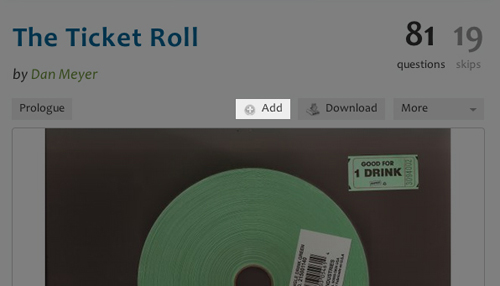
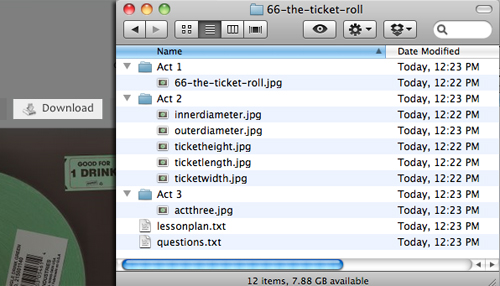
So I put together the task editor I want to use. You can add supporting materials โ€“ photos, videos, questions, teacher notes, student notes, links, and more. You can re-order them quickly, all from the browser. More fun is that other users can download them quickly. Click the “Download” button and Internet pixies will zip all the resources up and send the file to your computer.

130319_2

I’ve been using it for a couple of weeks and I’d like you to use it also.

I’ve added other features some of you have asked for:

Better tagging.

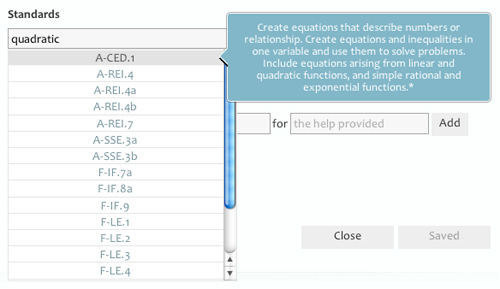
You can add tags like “pizza” or “basketball” or “money.” You can type a few key mathematical terms into the Common Core search bar and it will locate standards for you. Of course, all of this will make the search engine much smarter.

130319_3

A smarter search engine.

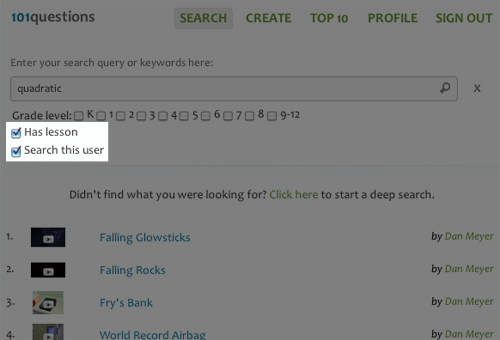
People e-mail now and then telling me in kind terms how awful this spreadsheet is. I’m in total agreement. Unless you’re fluent in Common Core shorthand, it’s impossible to find tomorrow’s topic today. So now you can head to my page on 101questions, click Search, and then click “Search this user.” Type in what you’re looking for. Click “Has lesson” to narrow down my material to everything that’s been a little more developed. Click the grade boxes to tighten the results down even more.

130319_4

Try it out. Add some tags to your old material. Leave me some comments here. I’ll need as much useful criticism as you can offer. Let’s make this great together.

[Future Text] Ice Cream Stand

a/k/a Dave Major Goes Bananas

Shorter: Dave Major and I are experimenting again with what math textbooks could look like on devices that are digital and networked. Our most recent experiment is Ice Cream Stand.

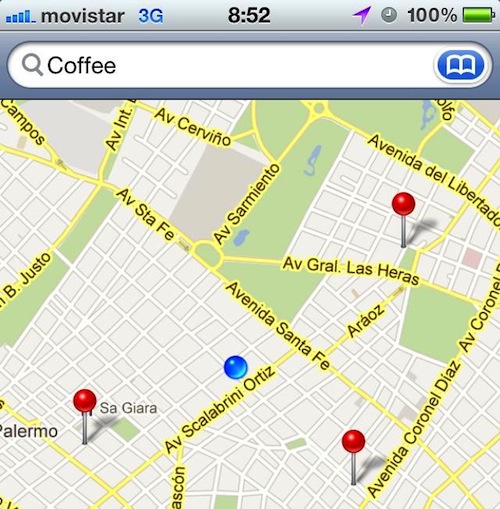
Longer: Last September, Kate posted this image to Twitter attached to the tweet, “Worst geometry problem ever: can’t be solved until after you solve it.”

Clever bit, right? Classic Kate.

We could print that out and have students use a compass and straightedge to construct the circumcenter (the point that’s equidistant from all three coffee shops). That’d be a fine summative assessment. Very “real world,” etc.

But if you’d like to use Kate’s tweet to motivate the need for the circumcenter, to give students a reason to care about the circumcenter, we’ll need to start much lower on the ladder of abstraction. We’ll need to throw out formal vocabulary and formal operations for a few minutes. We’ll need to start with intuition.

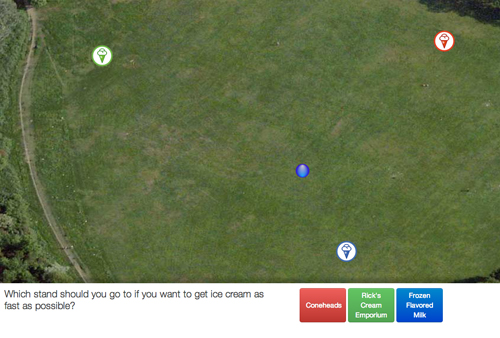
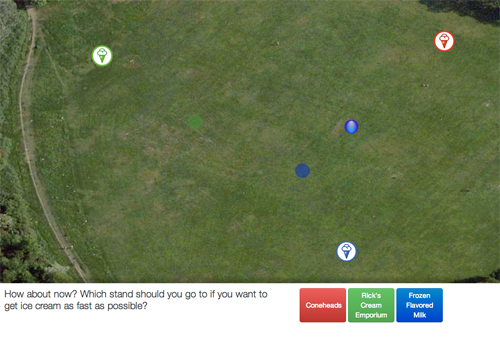
So we changed the domain from coffee to ice cream. We changed the environment from a roadway (a complicated space) to a park (an open space). And we gave students a few easy choices. “Which ice cream stand would you pick, given where you’re standing right now?

130318_1

Students see that they’re basically painting the field one dot at a time.

130318_2

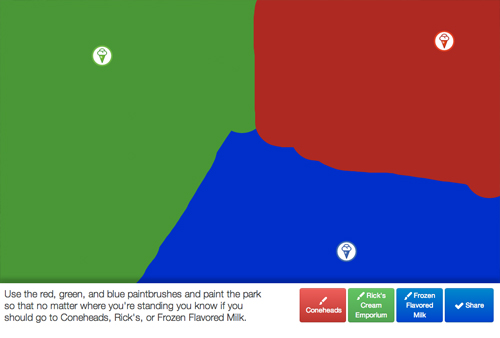
So we ask them to extend that metaphor and paint the entire field so that someone else can see which stand is the closest no matter where they are in the park.

130318_3

This is a task that a lot of students can complete regardless of their mathematical knowledge. It’s expensive, but not impossible, to provide this task on paper. It’s impossible to do on paper what comes next.

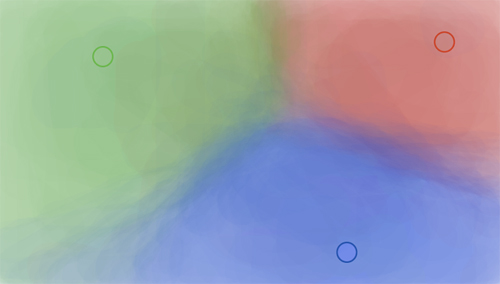
We combine the entire class’ park paintings.

130318_4

That’s a composite from three dozen people on Twitter.

Dave and I then asked students for some preliminary thoughts about how we could calculate the right painting. But that’s where we finished. The point is, students now want to know, “Who’s right? Who’s closest?” And what’s weird is that our intuition validates the math to a degree.

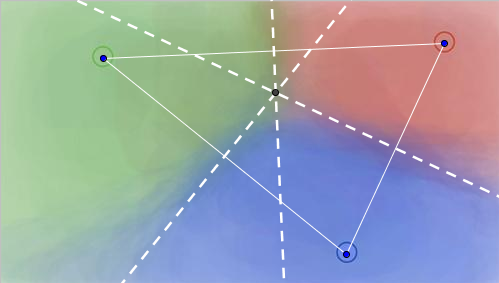
That is to say, you can see areas where Twitter agreed with itself. You can see areas where Twitter disagreed with itself. When you construct the circumcenter from the perpendicular bisectors, you’ll find that they overlay rather neatly on the areas of disagreement.

130318_5

That’s the ladder of abstraction. It isn’t impossible to climb it with print-based tasks, but a digital networked device makes it a lot easier.

Open Questions

  • Q: Where does this activity go next? We could add some expository text about the circumcenter. We could leave that to the teacher. We could calculate which student took the best guess in her painting of the field. A huge open question throughout these projects is, “What role does the teacher play here?”
  • Q: Another huge, open question is, “What happens to the first student who runs through this activity?” Her composite painting is just her own painting. Dave and I are developing activities that exploit the network effect. They get better and more interesting when more students use them. So again: what happens to the first student through?

BTW. Dave Major wrote his own post about this project.

Featured Comments

Alexandre Muniz:

The burning question I have after looking at this is, why is the average line a bit wrong? (Especially the blue/green line.)

Evan Weinberg:

The line of uncertainty shows where the intuitive power of the brain breaks down. This is where the power of mathematical tools can step in to hone in on a more precise answer. What strikes me here is that the mathematical tools donโ€™t do that much better of a job.

Jason Dyer:

If you allow the first student through to see the picture as it gets revised (via a reload button or some auto-update), I donโ€™t see a terrible problem (except for the usual classroom dilemma of what you do with any student that finishes fast).

Stanford History Education Professor Sam Wineburg Learns To Tweet

Last June, Stanford history education professor Sam Wineburg went to Umeรฅ University in Sweden to accept an honorary doctorate. He had prepared remarks on his recent Howard Zinn critique [pdf] but instead chose to analyze his complicated sense of relevance in the age of Twitter.

It’s fascinating introspection on what counts as scholarship, how status is awarded, and how we define academic relevance in the 21st century. It’s particularly interesting given that he’s a tenured professor at an elite university. He’s throwing stones from inside the glass house, basically. On a personal level, having felt forced to maintain something of a firewall between my Internet advocacy and my work at Stanford, it was cathartic to hear that one of my professors isn’t just aware of Twitter but understands that it complicates and enriches his professional existence.

There are plenty of interesting moments throughout the 20-minute talk. Here are a few I wanted to transcribe and collect:

On publishing:

After I received tenure … I had an opportunity to reflect upon the way that my own values had become changed by the culture of the university in which I was rewarded for publishing in the most prestigious journals, whether or not those journals had any effect on anyone else except for the small number of people reading those journals.

A foundation supervisor asked him about his theory of change. His response:

Our theory of change is that we will produce materials that are better than those that are commercially bought and the commercial companies will start to see that people are downloading our materials for free and they will start to copy what we are doing and imitate what we are doing.

On the waning relevance of universities:

Our worry is that, as we continue to produce only our refereed journal articles, we are not understanding the profound changes in how information is disseminated in modern society. The university, particularly professional schools that are supposed to be producing knowledge for practitioners, are being left behind. We are becoming less and less relevant to the people who most need our knowledge โ€“ teachers and students and principals and decisionmakers in the field.

He’s on Twitter. I’ll encourage him (and anyone else feeling his angst) to look to Jon Becker, Cedar Riener, Sara Goldrick-Rab, and Bruce Baker as academics doing interesting advocacy on Twitter.

2013 Feb 19. Here is another disclosure from Prof. Wineburg, a brief interview on his struggle with depression.

An Aggravating And Energizing Hypothetical

Andrew Leonard:

All we need is one superb remedial algebra course that can be effectively delivered online and, theoretically, the demand for a zillion remedial algebra courses taught at a zillion community colleges suddenly drops off a cliff.

This hypothetical drives me up the wall, oblivious as it is to all the very interesting things that can happen in a brick-and-mortar classroom that can’t yet happen on the Internet.

The Internet is like a round pipe. Lecture videos and machine-scored exercises are like round pegs. They pass easily from one end of the pipe to the other.

But there are square and triangular pegs: student-student and teacher-student relationships, arguments, open problems, performance tasks, projects, modeling, and rich assessments. These pegs, right now, do not flow through that round pipe well at all.

So I’m aggravated by the hypothetical and, especially, its seductive allure to money-men and policy-makers.

But it also energizes me. It makes our job rather clear, doesn’t it?

Promote the hell out of the square and triangular pegs.

Push them into the plain view of anybody who’d love to believe math education isn’t anything more than a set of round pegs ready for a trip down the round pipe.

[via]