Category: tech enthusiasm

Total 120 Posts

“Get A Blog Already, Okay?”

I’ve mentioned my enthusiasm for Sam Shah’s outreach to new math edubloggers, including his how-to guide for getting started. I contributed a video profile to his project where I try to describe why getting a blog has been such an awesome, weird thing for my career and then convince you to get one yourself:

The transcript:

Hi my name is Dan Meyer and I’ve been blogging for six years. I still remember the day I set it up – just a casual decision to create a free blog. I blogged not because I wanted a huge readership but because I wanted to debrief myself after particularly good or bad lessons. I wanted to be able to read about it later. That’s it. But it turns out people like reading about that sort of thing so I slowly got a readership and even with a small one I started getting so much better as a teacher. I would ask for feedback explicitly. I would throw some praise on the people who offered critical feedback. That’s not easy to do. And the result of all that critical feedback, I’m pretty sure, is that I grew two years of professional growth for every one year I was in the classroom, which is totally unscientific there, but that’s how it felt. I’m pretty sure that without my collection of blogs and readers and critical comments, I’d still be back there totally psyched about that amazing worksheet I came up with. So give it a try. Get a blog. Write for yourself. Let other people know about it. And above all have fun.

Khan Academy’s Introduction to Programming Modules Are Really Something Special

Khan Academy released their Introduction to Programming modules today and they’re really great. Go play. Here are my favorite pieces:

Changes to the code affect the output dynamically. No rendering, no compiling, no reloading. Change the width parameter of a rectangle in the code and the rectangle changes without any extra effort on your part. You can hover your mouse over any parameter and a slider appears, letting you change that parameter smoothly over a range of values. (Bret Victor modeled this kind of programming environment in his Inventing on Principle talk. Try it out on the tree generator.)

Contrast this with Codeacademy where you have to click “Run” or press “Enter” to see the result of your work. Or just now, when I was working on my front-end web development final project, I would make a change to my code in one window, click over to my web browser in another, and then click “Reload” to see the result. That friction may not sound like much but it often makes programming feel less creative and more mechanical.

You can interrupt the lectures at any point and mess around with the lecturer’s code. You press play on the video and you watch the lecturer type code on the screen. You hear the lecturer talk about the code as she types it. This is how I’d predict “Khan Academy does introduction to programming” would look. But the student can press pause at any point, mess around with the current state of the lecturer’s code, and watch the result change in the output window. She presses play and her changes revert back to the lecturer’s code and the lecturer continues on.

Don’t underestimate this feature. This means that if an explanation is unclear, if the student doesn’t understand the effect of a given parameter in a function, she can pause the explanation and instantly generate a series of examples of the parameter’s effect. (eg. “Oh I thought that parameter was the top coordinate of the rectangle but now I see it’s the height.”)

The lecturer is Vi Hart Khan Academy intern Jessica Liu. That’s (still) fun.

Students are doing and listening simultaneously. This isn’t the place to contrast Khan Academy’s treatment of math against its treatment of programming. Let’s just note that students play a very active role in these lectures. They’re going to love it.

2012 Aug 14: John Resig has an interesting write-up of the development process and explicitly namechecks Bret Victor’s talk as an inspiration.

Featured Comments:

The Puzzle School:

If we can add in challenges (e.g. Angry Birds) where students have access to environments and tools that offer this type of instantaneous feedback so that students can solve those challenges through hypothesis that can quickly be validated or invalidated through the feedback loop then I think we will have a learning environment that completes the loop by providing intrinsic motivation to engage with the environment by solving the challenges.

Michael Pershan:

I love that the lectures are from a woman, that she uses “her,” “his,” “he,” and “she” in roughly equal proportion and talks about “your mother, the programmer.”

Matt McCrea:

Wouldn’t it be great if the math section were executed in a similar way? Imagine a video that poses a question with a scratch space to execute and test solutions. Obviously much more complicated, but I’d bet there are certain situations in which at least it’d be a great step in the right direction without too much effort.

David Patterson:

I think most Computer Scientists would cringe at this being called “Computer Science.”

If Math Is Basketball, Let Students Play The Game

Konstantin Kakaes:

Math and science can be hard to learn–and that’s OK. The proper job of a teacher is not to make it easy, but to guide students through the difficulty by getting them to practice and persevere. “Some of the best basketball players on Earth will stand at that foul line and shoot foul shots for hours and be bored out of their minds,” says Williams. Math students, too, need to practice foul shots: adding fractions, factoring polynomials. And whether or not the students are bright, “once they buy into the idea that hard work leads to cool results,” Williams says, you can work with them.

There are plenty of lines to cringe at in Kakaes’ article. PJ Karafiol knocks down most of them in a great post that was eventually syndicated by Slate. (Good for Slate. Good for Karafiol.) Mr. Williams’ metaphor deserves extra scrutiny, though. Here are just two of its most screwy aspects:

  1. Drills aren’t a basketball player’s first, only, or most prominent experience with basketball. Drills come after a student has been sufficiently enticed by the game of basketball – either by watching it or playing it on the playground – to sign up for a more dedicated commitment. If a player’s first, only, or most prominent experience with basketball is hours of free-throw and perimeter drills, she’ll quit the first day – even if she’s six foot two with a twenty-eight inch vertical and enormous potential to excel at and love the game.
  2. Basketball players aren’t bored shooting foul shots. Long before “math teacher” was on my resume, I was a lanky high school basketball player trying to get his foul shooting above 50%. I’d shoot for hours but I wouldn’t get bored, as Williams suggests I must have been. That’s because I knew my practice had a purpose. I knew where that practice would eventually be situated. I knew it would pay off in a game where I’d be called to the line for a shot that had consequences.

There is a place for drills and explanation in mathematics, as in basketball. But consider what little good they do in either arena if the student isn’t first made aware of the larger, more enticing purposes they serve.

BTW. The worked examples literature leans heavily on De Groot’s research into chess masters who, it turns out, have memorized an enormous number of board configurations relative to casual players. This is unsurprising in the same way it’s unsurprising that professional basketball players practice their free throws much more often than amateurs. But it doesn’t necessarily follow from either of those facts that the best way to start inducting new members into either of those groups is to force novice chess players to memorize board configurations for hours or new basketball players to shoot hours of free throws from the line.

BTW. Max Ray articulates a strong framework for technology use in the math classroom at the end of his recent post at the Math Forum.

2012 Jul 11. PJ Karafiol follows up.

Featured Comment.

Jeff de Varona:

Am I the only one who is reminded of The Karate Kid? Mr. Miagi has Daniel do crazy, de-contextualized drills without knowing their purpose. In the end it works (because it’s a movie), but in the meantime Daniel gets extremely frustrated and wants to give up. Perhaps if Mr. Miagi had made it more clear what the “cool results” would be or how he would be “painting the fence” and “sanding the floor” in a tournament, Daniel-san would have been more than happy to wax all his cars.

Technology Is The Oxygen

Kate Nowak recommends you rethink your upcoming session, “20 Ways To Use Pinterest In The Classroom!”:

But when people talk to me about the technology I have to constantly Reframe the Issue and explain how I’m not all pro any technology for its own sake. You don’t go, “Oh here’s this cool technology let me shoehorn it into my classroom.” Instead you go, “I think I have thought of the best way to teach this, and it would be impossible in an analog world, but I know enough about the technologies to realize this idea.” You don’t go to a twenty-minute inservice about xyz.com and go “I’m going to make an xyz.com lesson.” You use xyz.com for your own purposes, or you suspect its utility and put it in your back pocket, until your awesome instruction idea needs xyz.com in order to exist. Your lesson is the fuel and xyz.com is the oxygen.

BTW: I’m co-facilitating a workshop called “Technology Applications in Math and Science Classrooms” at Stanford this summer, July 30 through August 2. It’s open to the public. Registration information is at the bottom of this page.

101questions: Behind The Scenes

[cross-posted to the 101questions blog]

We’re one week into 101questions and the early feedback has been encouraging. For a certain kind of warped individual (ie. my kind of individual) the experience seems to be, in a word, addicting. It’s also fun to find a non-trivial Swedish contingency jumping aboard. The more effective use we make of visuals, the more we can include learners who speak English as a second language, if they speak it at all.

After a week, 500+ registered users have uploaded 300+ photos and videos which have provoked 10,000+ questions across all users, including a number of unregistered users I haven’t counted. (The analytic component of site administration is right in my wheelhouse, as you can see.) We even have a registered troll, which means we’re halfway to a full-fledged online community.

Here’s a description of where 101questions came from, the problems it tries to solve, and a few notes on where it might go.

Where It Came From

I piloted the idea online in webinars and face-to-face in workshops. I tweaked the constraints and the implementation and arrived at an exercise that teachers found both challenging and fun, which seemed like the right combination. Teachers liked rating photos and videos as perplexing (or not). That same feedback on their own photos and videos helped them improve their eye for perplexity.

I introduced it on Twitter as #anyqs. You’d post a link to a photo or video (hereafter called “the first act”) and ask for questions. That implementation was good for a time, but ultimately very problematic.

Problems 101questions Tries To Solve, In Order Of Importance

Here’s the biggest:

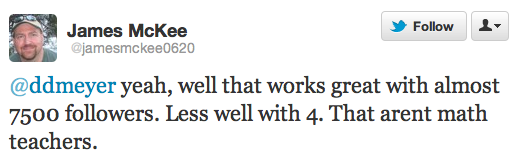
The feedback to your first act is proportional to the quantity of your Twitter followers.

yeah, well that works great with almost 7500 followers. Less well with 4. That arent math teachers.

I have the most followers of anyone who has contributed to the #anyqs tag. I also get the most responses to my photos and videos. That correlation extends all the way down to people with a dozen followers who get very few responses in spite of their work being thoroughly perplexing. That’s a pity.

At 101questions, your first act goes into a huge pile along with mine and both of ours are served up randomly to other users until it gets 100 responses.

People post whatever they want and tag it #anyqs.

I’m talking about full web pages, long, meandering videos, Flash applets, etc. There is a place for all those things, but they all miss the design of the exercise: one photo or one minute of video.

At 101questions, your attempt to upload anything outside of those constraints will get you an invitation to revise and resubmit.

Tweets are fleeting. Perplexity should endure.

We don’t have a record of all the perplexing photos and videos you’ve posted on Twitter. Many of the #anyqs participants likely couldn’t dredge up their own contributions. I’ve saved all of them locally, but that takes a lot of diligence and they’re basically lost to the wind for everybody else. Along those lines, it’s also hard to know if someone has already posted a particular first act.

At 101questions, your contributions are stored in a database and logged in your profile. (Here’s mine.) The application also checks to see if a particular link has already been uploaded and, if so, points you to it. There is a bookmarking feature. You can save first acts for later.

It’s hard to know if you’re bored by my first act or if I just missed you.

I wish there were a “Skip It, I’m Bored” button attached to my #anyqs submissions on Twitter. If responses to my first act are light, I may infer it wasn’t perplexing, but sometimes I wonder if I just queried my followers at the wrong time.

At 101questions, there is a “Skip It, I’m Bored” button.

There isn’t any way to filter for quality.

What was the best photo posted last month? Which people post the best material most consistently? Where can I find their photos and videos? How are we defining “best” anyway? Those questions can’t be answered within our Twitter pilot.

At 101questions, I’ve set up a metric called “perplexity” which amounts to the likelihood your first act will provoke a question. (Technically, it’s the number of questions that have been asked about your first act expressed as a percentage of total skips and questions. 75 means three quarters of everybody who has seen your first act have asked a question about it.)

People post material because it seems vaguely connected to a discipline, not because it provokes a question.

“Interesting” isn’t the same as “perplexing.” “Engaging” is a different animal also. It’s easier to dazzle a student with fireworks than to provoke her to wonder a question. When I’m unperplexed by someone’s #anyqs material on Twitter, I’ll often tweet back, “What question did that photo make you wonder?” In my perfect world, I’d see your own question alongside the first act you uploaded, but only after I submitted my own, so my question is raw and unbiased by yours.

At 101questions, the upload page has fields for a link and a title. Then a blank for your question.

It’s difficult to see other people’s questions about a first act.

If someone tweets a first act I find perplexing, I often want to know if it perplexed other people and, if it did, the questions they asked. That’s difficult on Twitter.

At 101questions, everyone’s questions are logged beneath each first act.

Where This Might Go

Tagging. Searching. Commenting. Top ten lists for “today” and “the last week,” not just “all time.” A mobile application. The ability to submit files from your phone or computer, not just links. Complete mathematical stories, not just the first act. If we’re working on circumference tomorrow, I’d like to go to 101questions, find a list of complete mathematical stories for “circumference” sorted from most perplexing to least, and then download it to my hard drive. Those features will be expensive to develop and sustain. The core feature – getting 100 responses to your first act – will always be free but I may invite you to pay community membership dues for access to the fancier stuff.

Way, Way Behind The Scenes

One of the most annoying features of edu-punditry is how quickly our gurus decide they’ve done absolute everything they can to help us understand and accomplish their vision for learning. They write their blogs, publish their books, tweet their tweets, and give their speeches. Having decided they’ve done everything possible to help us wrap our brains around ideas that are obvious to them, their last recourse is to snark, sarcasm, hectoring, and irrelevancy.

In reality, their messages can almost always be clarified, made easier, more fun, and less expensive. I want nothing to do with that culture of punditry. I can be clearer. I can find new metaphors. I can publish in more media. And I can create tools to make these practices easier. That’s 101questions.