Category: tech enthusiasm

Total 120 Posts

“The Cup Is the Y-Intercept”

Are your students overgeneralizing their models? After working exclusively with proportional relationships for the last month, are they describing every new relationship as proportional?

This isn’t a task, or a lesson, or anything of that scope. It’s a resource, a provocation, one that gives students the chance to check their assumptions about what’s going on.

Play this video and pause it periodically, asking students to decide for themselves, and then tell a neighbor, what’s coming next.

160529_1lo

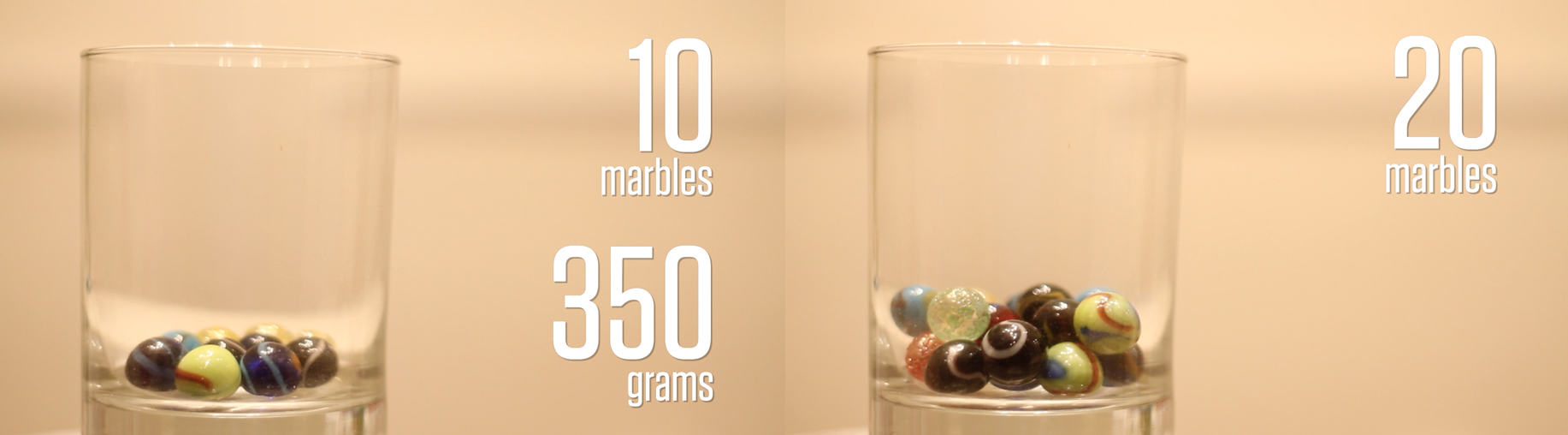
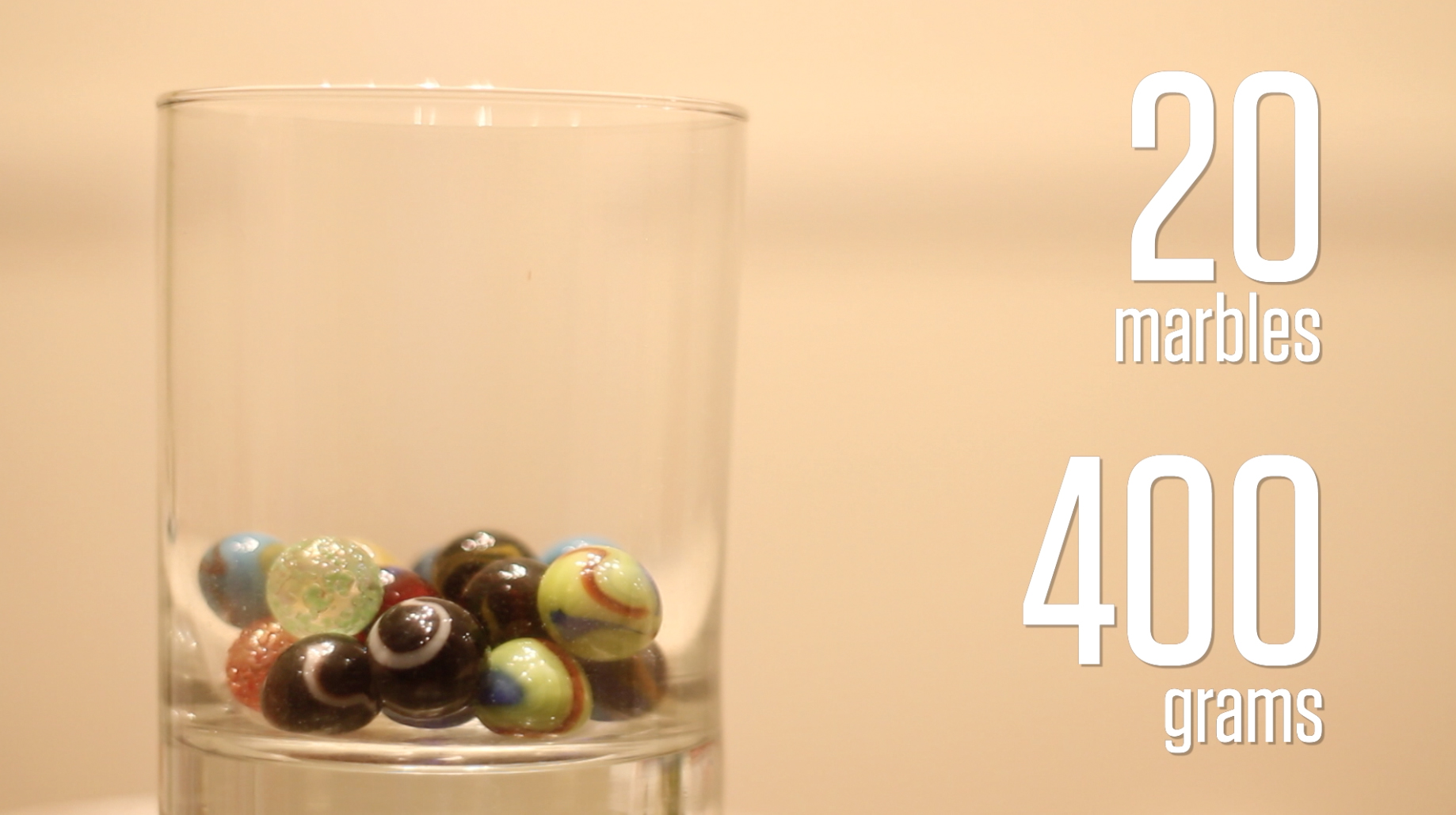
10 marbles weigh 350 grams. So 20 marbles should weigh how much? I’m curious which students will say the answer is less than, exactly, or more than 700 grams. I’m curious which students will say it’s impossible to know.

Reveal the answer.

160529_2lo

That will be surprising for some. Now invite them to speculate about 30 marbles. 40 marbles. And 0 marbles.

Let me end with three notes.

First, my thanks to Kevin Hall who had the fine idea for the video and encouraged me to make it. I’ve never met Kevin. That’s the kind of internet collaboration that makes my week.

Second, the stacking cups lesson offers a similar moment of dissonance. Can you find it?

Third, here’s Hans Freudenthal on technology in 1981:

What I seek is neither calculators and computers as educational technology nor as technological education but as a powerful to arouse and increase mathematical understanding.

Featured Tweet

Michael Jacobs:

I always like creating a proportional reasoning speed bump by giving these types of questions.

160531_2

160531_1

Featured Comment

Kate Nowak:

Hey! Nice idea for helping kids make the turn from proportional to linear relationships. There were two things I wanted to change:

– the discrete nature of the domain
– the way itโ€™s not clear in the still images whether we are being shown the mass of just the marbles or the mass of the marbles + the glass together (the brief shot of the balance scale with the glass on it at the beginning of the video wasnโ€™t doing it for me).

So I made a video! Here! It was shot on my phone using a jar of cumin to stabilize, so it could certainly be professionalized.

The Difference Between Sketching and Graphing

Here is what I mean. Ask a student to:

Give an algebraic function whose graph has one positive root, a negative y-intercept, and an asymptote at x = -5, if that’s possible. If it’s impossible, explain why you can’t.

Maybe the student can determine the function. At some point, an advanced algebra student should determine the function. But what do I learn from a student who can’t determine the function? What does a blank graph tell me?

160523_1lo

The student might understand what roots, intercepts, and asymptotes are. She might understand every part of the task except how to form the function algebraically. I won’t know because I’m asking a very formal task.

This is why a lot of secondary math teachers ask a less formal question first. They ask for a sketch.

Sketch a function whose graph has one positive root, a negative y-intercept, and an asymptote at x = -5, if that’s possible. If it’s impossible, explain why you can’t.

160523_3hi

Think of what I know about the student that I didn’t know before. Think of the feedback that’s available to me now that wasn’t before.

Desmos just added sketching into its Activity Builder. That was the result of months of collaboration between our design, engineering, and teaching teams. That was also the result of our conviction that informal mathematical understanding is underrepresented in math classes and massively underrepresented in computer-based mathematics classes. We want to help students express their mathematical ideas and get feedback on those ideas, especially the ones that are informal and under development. That’s why we built sketch before multiple choice, for example. I’m stating this commitment publicly, hoping that one or more of you will help us live up to it.

Blue Point Rule

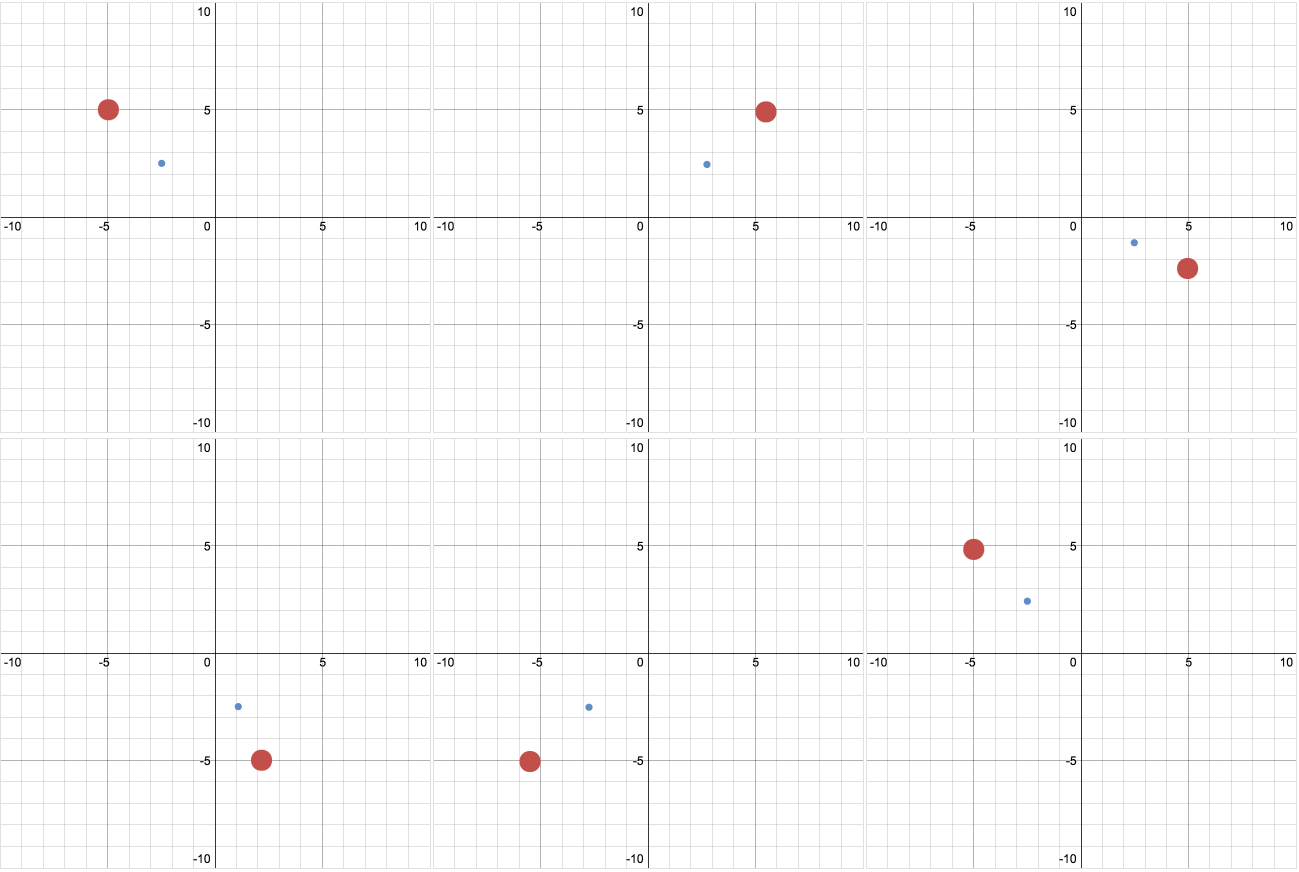
What is the rule that turns the red point into the blue point?

160512_1hi

My biggest professional breakthrough this last year was to understand that every idea in mathematics can be appreciated, understood, and practiced both formally and also informally.

In this activity, students first use their informal home language to describe how the red point turns into the blue point. Then, more formally, I ask them to predict where I’ll find the blue point given an arbitrary red point. Finally, and most formally, I ask them to describe the rule in algebraic notation. Answer: (a, b) -> (a/2, b/2).

It’s always harder for me to locate the informal expression of a idea than the formal. That’s for a number of reasons. It’s because I learned the formal most recently. It’s because the formal is often easier to assess, and easier for machines to assess especially. It’s because the formal is often more powerful than the informal. Write the algebraic rule and a computer can instantly locate the blue point for any red point. Your home language can’t do that.

But the informal expressions of an idea are often more interesting to students, if for no other reason than because they diversify the work students do in math and, consequently, diversify the ways students can be good at math.

The informal expressions aren’t just interesting work but they also make the formal expressions easier to learn. I suspect the evidence will be domain specific, but I look to Moschkovich’s work on the effect of home language on the development of mathematical language and Kasmer’s work on the effect of estimation on the development of mathematical models.

Therefore:

  • Before I ask for a formal algebraic rule, I ask for an informal verbal rule.
  • Before I ask for a graph, I ask for a sketch.
  • Before I ask for a proof, I ask for a conjecture.
  • David Wees: Before I ask for conjectures, I ask for noticings.
  • Before I ask for a calculation, I ask for an estimate.
  • Before I ask for a solution, I ask students to guess and check.
  • Bridget Dunbar: Before I ask for algebra, I ask for arithmetic.
  • Jamie Duncan: Before I ask for formal definitions, I ask for informal descriptions.
  • Abe Hughes: Before I ask for explanations, I ask for observations.
  • Maria Reverso: Before I ask for standard algorithms, I ask for student-generated algorithms.
  • Maria Reverso: Before I ask for standard units, I ask for non-standard units.
  • Kent Haines: Before I ask for definitions, I ask for characteristics.
  • Andrew Knauft: Before I ask for answers in print, I ask for answers in gesture.
  • Avery Pickford: Before I ask for complete mathematical propositions, I ask for incomplete propositions.
  • Dan Finkel: Before I ask for the general rule, I ask for a specific instance of the rule.
  • Dan Finkel: Before I ask for the literal, I ask for an analogy.
  • Kristin Gray: Before I ask for quadrants, I ask for directional language.
  • Jim Murray: Before I ask for algorithms, I ask for patterns.
  • Nicola Vitale: Before I ask for proofs, I ask for conjectures, questions, wonderings, and noticings.
  • Natalie Cogan: Before I ask for an estimation, I ask for a really big and really small estimation.
  • Julie Conrad: Before I ask for reasoning, I ask them to play/tinker.
  • Eileen Quinn Knight: Before I ask for algorithms, I ask for shorthand.
  • Bill Thill: Before I ask for definitions, I ask for examples and non-examples.
  • Larry Peterson: Before I ask for symbols, I ask for words.
  • Andrew Gael: Before I ask for “regrouping” and “borrowing,” I ask for grouping by tens and place value.

At this point, I could use your help in three ways:

  • Offer more shades between informal and formal for the blue dot task. (I offered three.)
  • Offer more SAT-style analogies. sketch : graph :: estimate : calculation :: [your turn]. That work has begun on Twitter.
  • Or just do your usual thing where you talk amongst yourselves and let me eavesdrop on the best conversation on the Internet.

BTW. I’m grateful to Jennifer Wilson and her post which lodged the idea of a secret algebraic rule in my head.

Featured Comment

Allison Krasnow points us to Steve Phelp’s Guess My Rule activities.

David Wees reminds us that the van Hiele’s covered some of this ground already.

[Updated] Will It Hit The Hoop?

160323_1lo

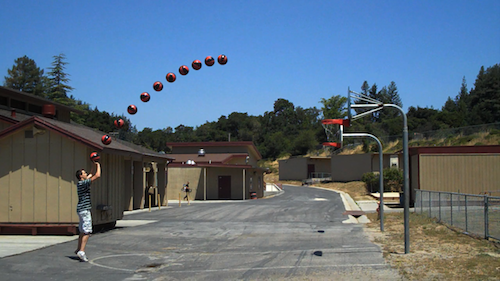
Six years ago, I released a lesson called Will It Hit The Hoop? that broke the math education Internet. (Not a big brag. It was a much smaller Internet back then.)

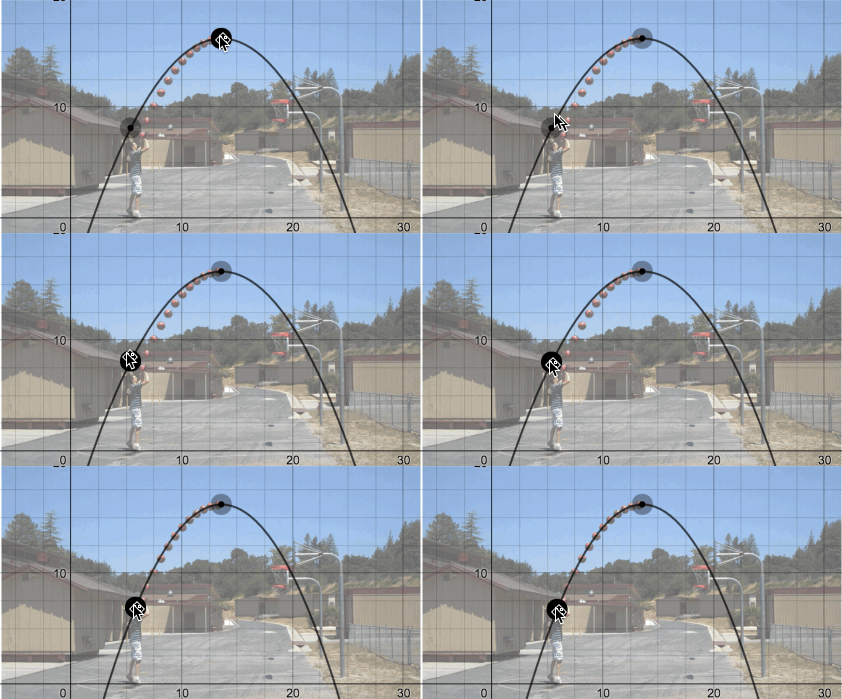
I think the core concept still works. First, students predict whether or not a shot goes in the hoop based on an image and intuition alone. Then they analyze the shot using quadratic modeling and update their prediction. Then they see the answer. For most students, quadratic modeling beats their intuition.

160323_5

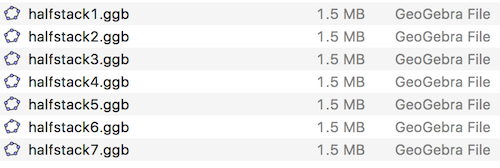
The technology was a chore, though. Teachers had to juggle two dozen different files and distribute some of them to students. I remember loading seven Geogebra files onto student laptops using a thumb drive. That was 2010, a more innocent time.

160323_2

So here’s a version I made for the Desmos Activity Builder which you’re welcome to use. It preserves the core concept and streamlines the technology. All students need is a browser and a class code.

Six year older and maybe a couple of years wiser, I decided to add a new element. I wanted students to understand that linears are a powerful model but that power has limits. I wanted students to understand that the context dictates the model.

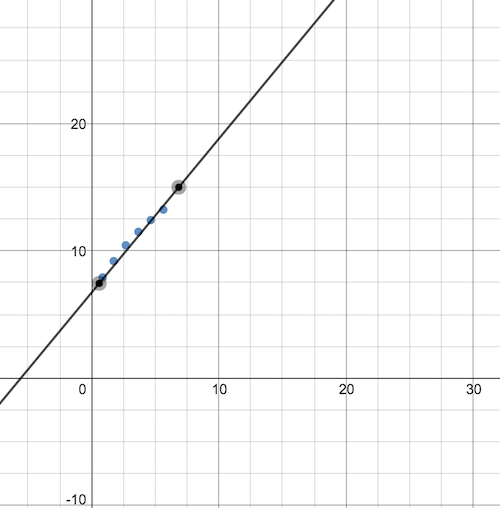
So I now ask students to model this data with a linear equation.

160323_3lo

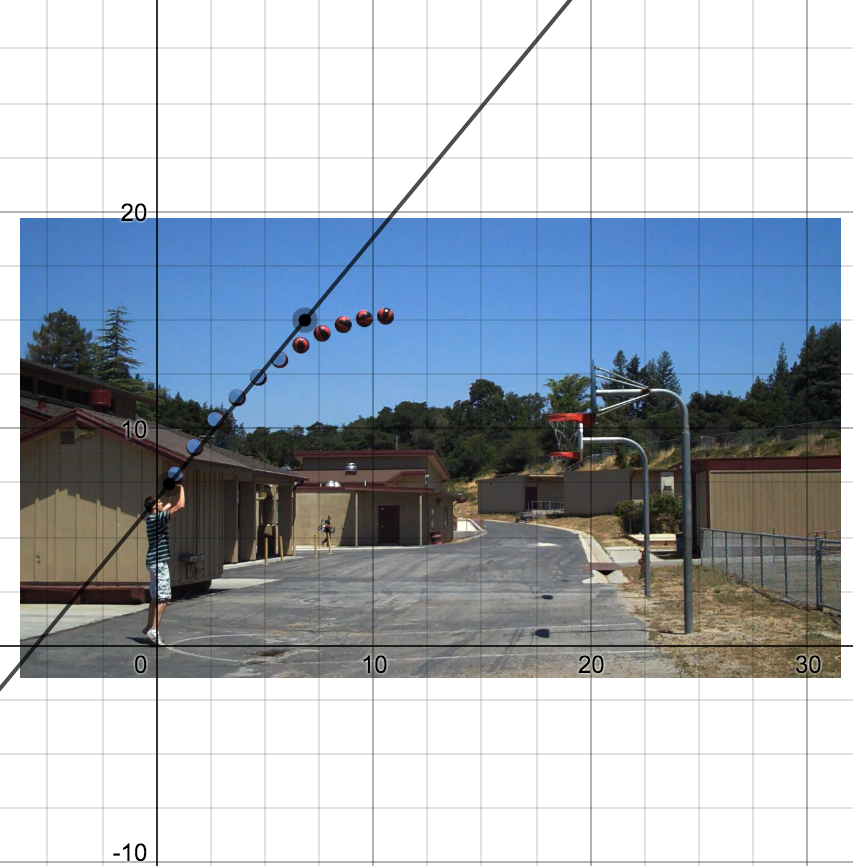
Then I show students where the data came from and ask them to describe the implications of their linear model. (A: Their linear ball goes onwards and upwards forever.)

160323_4lo

And then we introduce parabolas.

The Future Of Handwriting Recognition & Adaptive Feedback In Math Education

In math education, the fields of handwriting recognition and adaptive feedback are stuck. Maybe they’re stuck because the technological problems they’re trying to solve are really, really hard. Or maybe they’re stuck because they need some crank with a blog to offer a positive vision for their future.

I can’t help with the technology. I can offer my favorite version of that future, though. Here is a picture of the present and the future of handwriting recognition and adaptive feedback, along with some explanation.

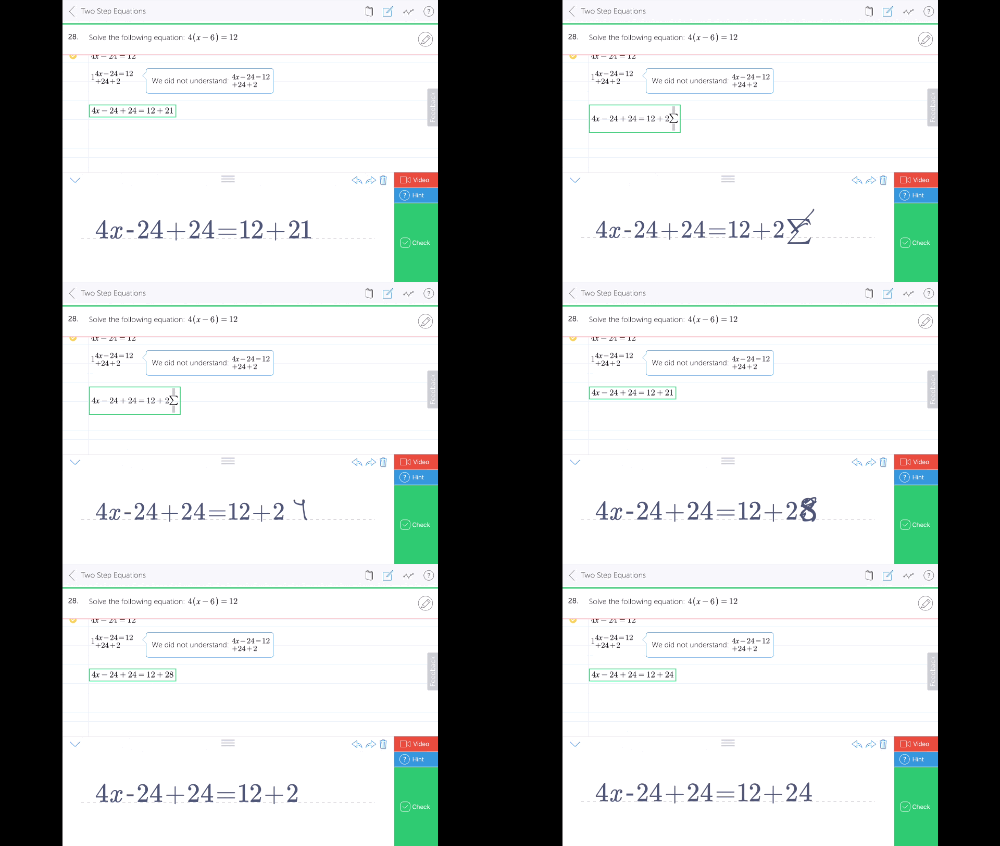
In the future, the computer will recognize my handwriting.
160131_1

Here I am trying hopelessly to get the computer to understand that I’m trying to write 24. This is low-hanging fruit. No one needs me to tell them that a system that recognizes my handwriting more often is better than a system that doesn’t.

But I don’t worry about a piece of paper recognizing my handwriting. If I’m worried about the computer recognizing my handwriting, that worry goes in the cost column.

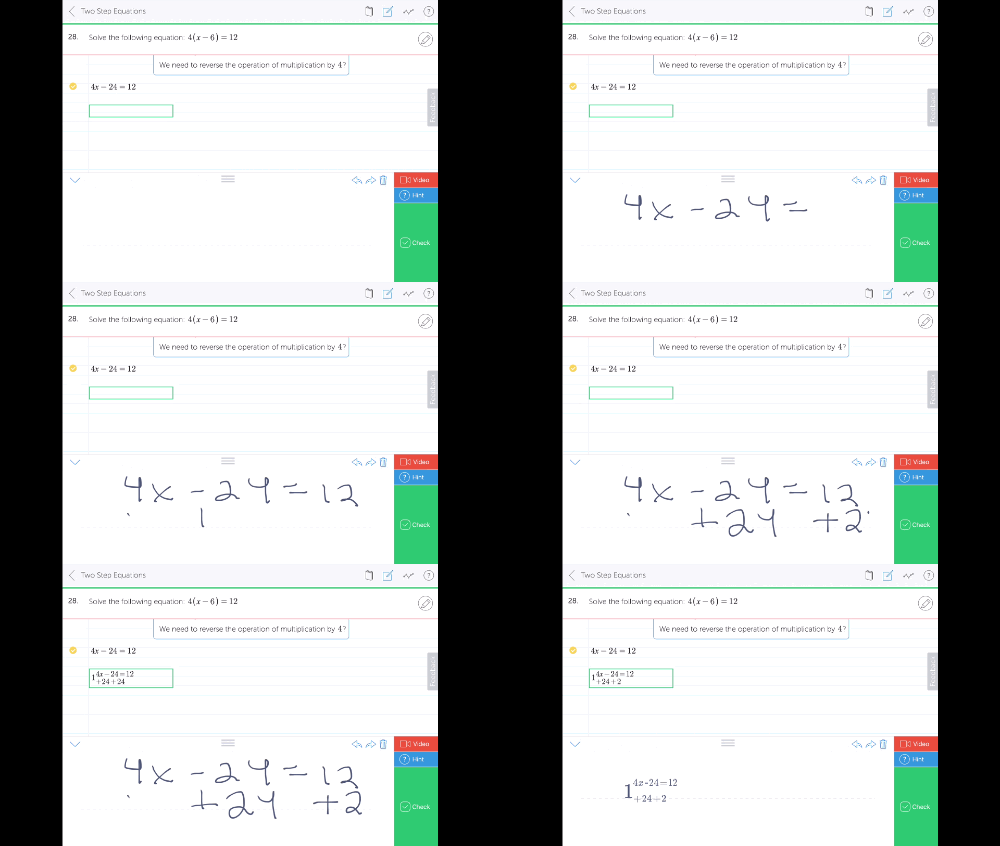
In the future, I won’t have to learn to speak computer while I’m learning to speak math.
160131_3

In this instance, I’m learning to express myself mathematically โ€” hard enough for a novice! โ€” but I also have to learn to express myself in ways that the computer will understand. Even when the computer recognizes my numbers and letters, it doesn’t recognize the way I have arranged them.

Any middle school math teacher would recognize my syntax here. I’ll wager most would sob gratefully for my aligned operations. (Or that I bothered to show operations at all.) If the computer is confused by that syntax, that confusion goes in the cost column.

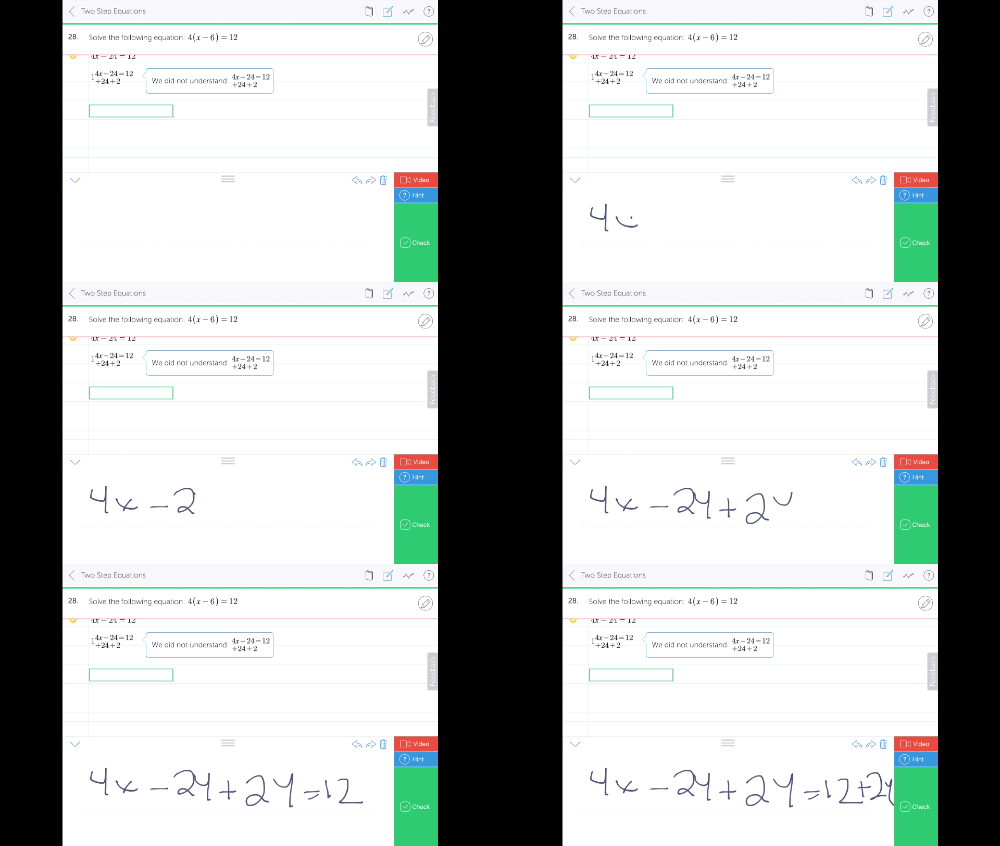
In the future, I’ll have the space to finish a complete mathematical thought.
160131_2

Here I am trying to finish a mathematical thought. I’m successful, but only barely. That same mathematical thought requires only a fraction of the space on a piece of paper that it requires on a tablet, where I always feel like I’m trying to write with a bratwurst. That difference in space goes in the cost column.

That’s a lot in the cost column, but lots of people eagerly accept those costs in other fields. Computer programmers, for example, eagerly learn to speak unnatural languages in unusual writing environments. They do that because the costs are dwarfed by the benefits.

What is the benefit here?

Proponents of these handwriting recognition systems often claim their benefit is feedback โ€”ร‚ย the two-sigma improvement of a one-on-one human tutor at a fraction of the cost. But let’s look at the feedback they offer us and, just as we did for handwriting recognition, write a to-do list for the future.

In the future, I’ll have the time to finish a complete mathematical thought.

If you watch the video, you’ll notice the computer interrupts my thought process incessantly. If I pause to consider the expression I’m writing for more than a couple of seconds, the computer tries to convert it into mathematical notation. If it misconverts my handwriting, my mathematical train of thought derails and I’m thinking about notation instead.

Then I have to check every mathematical thought before I can write the next one. The computer tells me if that step is mathematically correct or not.

It offers too much feedback too quickly. A competent human tutor doesn’t do this. That tutor will interject if the student is catastrophically stuck or if the student is moving quickly on a long path in the wrong direction. Otherwise, the tutor will let the student work. Even if the student has made an error. That’s because a) the tutor gains more insight into the nature of the error as it propagates through the problem, and b) the student may realize the error on her own, which is great for her sense of agency and metacognition.

No ever got fired in edtech for promising immediate feedback, but in the future we’ll promise timely feedback instead.

In the future, computers will give me useful feedback on my work.

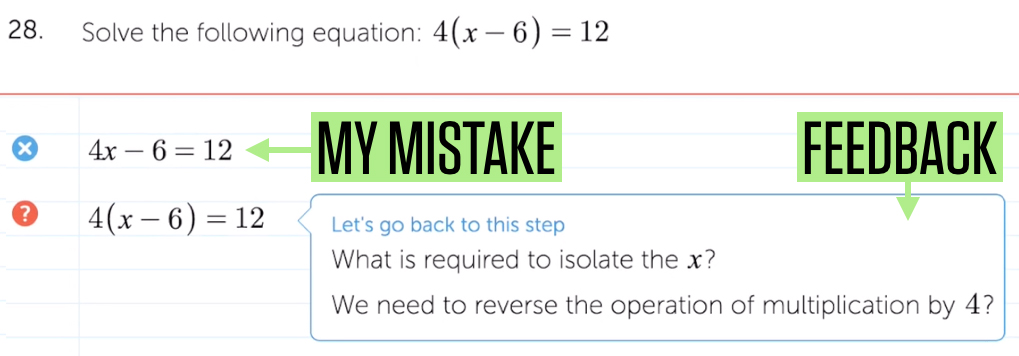
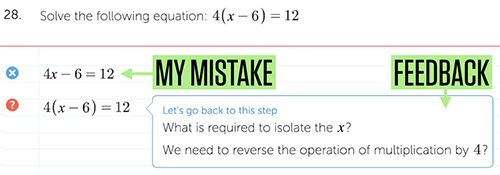
I have made a very common error in my application of the distributive property here.
160131_4lo

A competent human tutor would correct the error after the student finished her work, let her revise that work, and then help her learn the more efficient method of dividing by four first.

But the computer was never programmed to anticipate that anyone would use the distributive property, so its feedback only confuses me. It tells me, “Start over and go down an entirely different route.”

The computer’s feedback logic is brittle and inflexible, which teaches me the untruth that math is brittle and inflexible.

In the future, computers will do all of this for math that matters.

I’ve tried to demonstrate that we’re a long way from the computer tutors our students need, even when they’re solving equations, a highly structured skill that should be very friendly to computer tutoring. Some of the most interesting problems in K-12 mathematics are far less structured. Computers will need to help our students there also, just as their human tutors already do.

We want to believe our handwriting recognition and adaptive feedback systems result in something close to a competent human tutor. But competent tutors place little extraneous burden on a student’s mathematical thinking. They’re patient, insightful, and their help is timely. Next to a competent human tutor, our current computer tutors seem stuttering, imposing, and a little confused. But that’s the present, and the future is bright.

Need A Job?

I work for Desmos where we’re solving some of the biggest problems in math edtech. Teachers and students love us and we’re hiring. Come work with us!