Category: uncategorized

Total 483 Posts

Study: Implicit Instruction Rated More Interesting Than Explicit Instruction

Show the following five sentences to one group of students:

  1. A newly-wed bride had made clam chowder soup for dinner and was waiting for her husband to come home.
  2. Although she was not an experienced cook she had put everything into making the soup.
  3. Finally, her husband came home, sat down to dinner and tried some of the soup.
  4. He was totally unappreciative of her efforts and even lost his temper about how bad it tasted.
  5. The poor woman swore she would never cook for her husband again.

Then show all those sentences except the fourth, italicized sentence to another identical group of students.

Which group of students will rate their passage as more interesting?

For Greg Ashman, advocate of explicit instruction, the question is either a) moot, because learning matters more than interest, or b) answered in favor of the explicit version. Greg has claimed that knowledge breeds competence and competence breeds interest.

I don’t disagree with that first claim, that disinterested learning is better than interested ignorance. (Mercifully, that’s a false choice.) But that second claim is too strong. It fails to imagine a student who is competent and disinterested simultaneously. It fails to imagine that the very process of generating competence could be the cause of disinterest. It fails to imagine PISA where some of the highest achieving countries look forward to math the least.

That second claim is also belied by the participants in Sung-Il Kim’s 1999 study who rated the implicit passage as more interesting than the explicit one and who fared no worse in a test of recall. Kim performed two follow-up experiments to determine why the implicit version was more interesting. Kim’s determination: incongruity and causal bridging inferences.

That fifth sentence surprises you without the context of the fourth (incongruity) and your brain starts working to understand its cause and connect the third sentence to the fifth (casual bridging inference).

Kim concludes that “stories are interesting to the extent that they force challenging but resolvable inferences on the reader” (p. 67).

So consider a design principle for your math classes or math curriculum:

“Ask students to make challenging but resolvable inferences before offering them those resolutions.”

Start with estimation and invention, both of which offer cognitive benefits over and above interest.

[via Daniel Willingham’s article on the brain’s bias towards stories, which you should read]

2015 Jan 11. John Golden attempts to map Willingham’s research summary onto mathematics instruction.
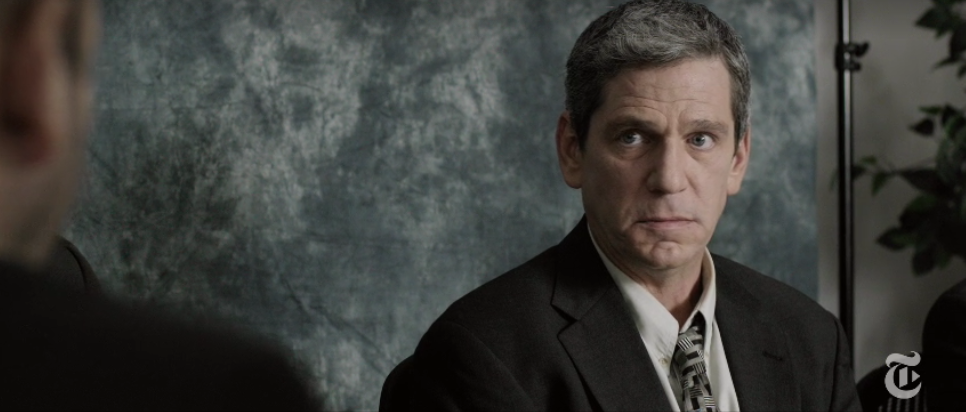
“I’m gonna use my formula sheets and that’s the only way I’m gonna do stuff.”

160101_1lo

The New York Times looks at the dismal testimony of an “accident reconstructionist”:

The “expert witness” in this case would not answer questions without his “formula sheets,” which were computer models used to reconstruct accidents. When asked to back up his work with basic calculations, he deflected, repeatedly derailing the proceedings.

Watch the video. It’s well worth your time and I promise you’ll see it in somebody’s professional development or conference session soon. It offers so much to so many.

And then help us all understand what went wrong here. What’s your theory? Does your theory explain this catastrophe? Does it recommend a course of action? If you could go back in time and drop down next to this expert as he was learning how to make and analyze scale drawings, how would you intervene?

My own answer starts off the comments.

BTW. Can anyone help us understand how the expert came to the incorrect answer of 68 feet?

BTW. Hot fire:

The motorcyclist’s lawyer filed a counter-motion to refuse payment to the expert witness. It contained the math standards for Wichita middle schools.

[via Christopher D. Long]

2016 Jan 2. The post hit the top of Hacker News overnight.

2016 Jan 2. One of the Hacker News commenters notes that the actual deposition video is available on YouTube.

Featured Comments:

gasstationwithoutpumps offers one explanation of the error:

3 3/8”³ at a 240:1 scale gives 67.5”² which rounds to 68”²

It is easy to mix up 3/8”³ and 3/16”³, which is one reason I prefer doing measurements in metric units.

katenerdypoo offers another:

It’s quite possible he accidentally keyed in 6/16, which when multiplied by 20 gives 7.5, therefore giving 68 feet. This is also a reasonable error, since the 6 is directly above the 3 on the calculator.

Jo illustrates a fourth grader’s process of solving the scale problem.

Robert Kaplinsky chalks this up to pride:

Lastly, it’s worth noting that eventually the heated conversation shifts from the actual math to whether or not he will do it or can do it. At that point it seems to become a pride issue.

Alex blames those awful office calculators:

The reconstructionist is given an office calculator, which doesn’t even have brackets. He needs to enter a counter-intuitive sequence of “3/16+3” to even get the starting point. When I was at school I remember being aware that most people wouldn’t be able to handle that kind of mental contortion. They’d never been asked to.
So what’s the problem, and how might we solve it? Well, the man’s been given the wrong tool for the job. He’s never been asked to use the wrong tool before & so this throws him. This makes him defensive and he latches onto an excuse about formula sheets.

Jeff Nielso:

The motorcyclist’s lawyer is the unrelenting classroom didactic whose motivation is based on making his student look and feel stupid. I was waiting for Act 2 where the lawyer would jump up, grab his felt marker, and demonstrate just how easy he can show the procedure.

Anna:

Interesting note: my grade 7 math class is in the middle of our unit on fractions, decimals, and percents, so I showed them this video so we could work on the problem. I thought they’d get a chuckle out of it and feel good about solving a problem that the expert on TV couldn’t solve.

Their reaction was unanimous. They identified with the guy and wanted them to give him his formula sheets. Some of them were pretty riled up about it!

They’re quite accustomed to me showing them videos and doing activities that are designed to build up their understanding that everyone approaches things differently, and we’ll all get there even if we take different paths. This guy wasn’t allowed to follow his path and do it his own way, and they were unfairly putting him on the spot and forcing him to do it their way.

It’s a rich problem, so I’ll use it again, but I think I’ll set it up and frame it a little differently next time!

Professional Development: Getting Worse Before We Get Better

151226_1lo

Malcolm Swan:

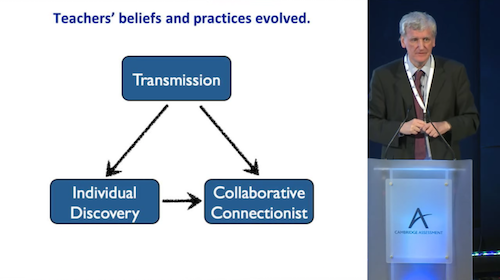
When we’ve done analyses of the results of [our professional development efforts], we’ve found that teachers often move from a transmission approach where they tell the class everything and the students have been fairly passive, they’ve usually moved in two directions.

One is retrograde. They’ve moved towards individual discovery. They say “I’ve been saying everything to these students for so long. What I’ll do now is withdraw and let them play with the ideas. I’ve been saying too much. I’ll withdraw and let them discover stuff.” That’s worse than the place where they started.

The other place is where they move in and they challenge students and work with them on their knowledge together. That’s a better place. That’ smore effective.

And so in professional development, people take a path. Over time they might move from transmission to discovery to collaborative connectionist. So they might actually get worse before they get better.

That’s one of the problems with evaluating whether its been successful by looking at student outcomes. People take awhile to learn new things.

Earlier in the talk, he describes counterproductive designs for professional development:

Most of the time [in teacher professional development] we inform people of something and then we say “go and do it.” That’s not the way people learn. Usually they learn by doing something and then reflecting upon it.

So when you start with a professional development, you say, “Try this out in your classroom. It doesn’t matter if it doesn’t work. Then observe your students and then as a result you might change your beliefs and attitudes.”

You don’t set out by changing beliefs and attitudes. People only change themselves as they reflect on their own experiences.

And then productive ones:

If you’re designing a course, we usually start by recognizing and valuing the context the teacher is working in and trying to get them to explain and explore their existing values, beliefs, and practices.

Then we will provide them with something vividly challenging. It might be through video or it might be through reading something. And this is really different to what they currently do.

And through this challenge we ask them to suspend their belief and try and act in new ways as if they believed differently.

And as they do this we offer support and mentoring as they go back into the classroom to try something out.

And then they come back together again and it’s taken over then by the teachers who reflect on the experiences they’ve had, the implications that come out of their experiences, and recognize and talk about where they’ve changed in their understandings, beliefs, and practices.

What’s great about Malcolm Swan and the Shell Centre is their designs for teacher learning line up exactly with their designs for student learning. It all coheres.

NCTM Gets It

Here are two reasons to be encouraged about the work and vision of the National Council of Teachers of Mathematics, followed by my hope for its future.

NCTM is obviously interested in recruiting new members, along with all of their new ideas.

Two years ago there was a panel discussion dedicated to technology in math education which featured a bunch of math Twitter-types. The following year saw an entire strand dedicated to ideas from those math Twitter-types. Then the math Twitter-types occupied the opening keynote at this year’s Nashville regional conference, immediately after which Robert Kaplinsky took my favorite photo from that conference.

Mark it, friends, or correct me if I’m wrong: that’s the first appearance of a current NCTM President at what the Twitter-types call a “tweetup.”

Just five years ago, these Twitter-types occupied the fringe. It’s so nice to see everybody making friends and learning from one another. This only bodes well.

NCTM’s new conference website has promise.

The history: Zak Champagne, Mike Flynn, and I ran Shadow Con as an experiment in extending the face-to-face conference experience. We offered speakers a more powerful platform on the web for interacting with attendees (live and virtual) than NCTM’s existing read-only conference program website.

We reported the results of that experiment to NCTM’s executive team and that was the last any of us heard from them until this year’s regional conferences when they tweeted out their new conference website. Look at it!

151201_1lo

The featured speakers at the regional conferences each get their own page on a WordPress installation. On first glance those pages look just like a conference website. Title, description, and time. Just the facts. But speakers can add files, videos, and other resources. Then there is a comment box where attendees can get in touch before and after the session.

A colleague of mine remarked: “It’s a mixed bag.” Yeah, but what a mix!

Out of the 28 featured sessions across the three regional conferences, seven presenters don’t seem to have visited their page. That lack of attention has basically zero downside. Their pages look just like they would on any read-only conference program website. Title, description, and time. Just the facts.

And across the other 21 sessions, there is a pile of activity!

All of this is possible without NCTM site’s but none of it is easy to do and none of it is easy to find.

So here is my hope for the future of NCTM conferences.

Extend this website to cover all presenters from all NCTM conferences and offer it to affiliate organizations for their conferences as well.

I want to click Annie Fetter’s name on one page and see all the talks she’s ever given, across geography and time, including five years ago at some random state affiliate conference I never knew existed.

I want to search for “Kate Nowak NCTM” in Google and find her past conference pages and also her upcoming talks.

Before I attend a conference, I want to locate presenters whose talks seem to provoke a lot of online discussion afterwards, and then attend those.

If NCTM makes this commitment, they’ll increase their value to current and prospective members several times over.

For current members, they increase the value of conference attendance and decrease the pressure on attendees to attend every session. (Expect the question “Will you be posting your resources to your page?” to float around Twitter in the weeks leading up to every conference.) The conference page will connect attendees and speakers in the twelve months between annual conferences.

Prospective members, the kind who wonder “Why NCTM?”, may start to land on conference pages more often than Pinterest boards when they search for resources. As those prospective members explore the resources on those conference pages, NCTM can recommend journals, articles, books, tasks, and other conference pages that may also be helpful. NCTM can point those visitors to upcoming conferences and sessions on those themes, converting non-members into members and members into stronger teachers.

Until future notice, I am a single-issue voter in all NCTM elections and this is my issue.

The Difference Between Traditional & Progressive Math In One Exchange

We’re continuing to host commenters from across a vast philosophical divide (including the co-authors of The Atlantic article under discussion) commenters who are unlikely to share the same physical space any time soon. People have largely kept it together and you’d have to be a committed ideologue not to walk away with a better understanding of the people who disagree with you.

I haven’t been able to shake one particular exchange, though.

Halfway through the comments, two people who disagree with each other as completely as anyone could each made a precise and articulate case for their diametrically opposite theories of learning.

Ze’ev Wurman, a longtime advocate of traditional math instruction:

I thought the purpose of a problem in a classroom is to check whether a student knows sufficient math to solve it, rather than learn bout the nature of human thinking processes. If it is the latter, Dan is completely right, except it belongs to cognitive science experiment rather than a classroom.

Brett Gilland, an infrequent blog commenter who should comment more frequently:

I can not disagree with this enough. The purpose of a problem in my classroom is almost always to understand the nature of that human’s thinking processes. This allows for amplification, further investigation into how the student is able to navigate similar problems with subtle variations and complications, and attempts to draw student mental models into internal conflict to create pressure for remediation and revision of said mental models.

Ze’ev Wurman:

I suspect that Gilland’s employer, and certainly the parents of his students, would also disagree. Some quite strongly. The primary purpose of school is to educate the kids at hand, not to train the teacher. This doesn’t mean that teachers do not learn from experience, but if gaining experience and insight is the primary reason for what the teacher does, he’d better get approval from an IRB and a waiver from each individual student or parent that attend his class.

Brett Gilland:

Funny thing, that. My employer, my parents, my students, my district, the state evaluator for my school, etc. all support my teaching. Most quite strongly. This might be due to the fact that when most people hear “I work really hard to understand your child’s thought processes so that I can better guide their thinking and draw out subtleties and conflicting mental models,” they don’t think “Oh my God, that man is performing experiments on my child to improve his educational practice.” Instead, they think “Oh my God, that man really cares about what is going on inside my child’s head and is attempting to tailor instruction to what he finds there. Thank goodness he isn’t stuck with a teacher who believes that teaching is just lectures interspersed with quizzes to determine if my child gets it or needs to be droned at more with another utterly useless generic explanation that takes no account of what my particular child is thinking!”

I’m sure that everyone walked away feeling like their side won, but one side is wrong about that.

Featured Comments

Chris H:

“Every school should be organized so that the teachers are just as much learners as the students are.” (Adding It Up, 2001, pg. 13)

jennifer potier:

Alas, I feel that Mathematics is reaching a junction — in which the traditionalists and the progressives must come to a head and work together to forge a stronger future for our young mathematicians! Whilst today’s world demands an ability to think and to use available resources to find new meaning, we must not forget those who generated those resources in the first place. a fine craftsman needs to learn the tools of his trade before he or she can produce the creative thinking in his head. A computer programmer must use efficient logic before we can play those game or use those apps to be progressive learners. To what degree should thinking, reasoning, and problem solving come before skills acquisition , or vice versa? Sound like the chicken and the egg to me.

My biggest fear for us as teachers is that we are robbing our young people of the beauty and passion for maths through repetitive, applied drill, just so that they can demonstrate a high level skill skill that they will never use. or, we are not providing enough technical skills to enough of our students to ensure quality craftsmanship I am saddened every single time that my best mathematics students tell me they want to study medicine or dentistry instead of using their mathematical ability to grow our field.

Let us first and foremost provide our students with mathematical challenge- that requires both the creative solution and advanced skills acquisition. Whether the challenge be abstract or modelling a real situation need not matter. What is important is bringing back the passion for mathematics that we, as mathematics educators share, passion- through intrinsic motivational challenge and drive.