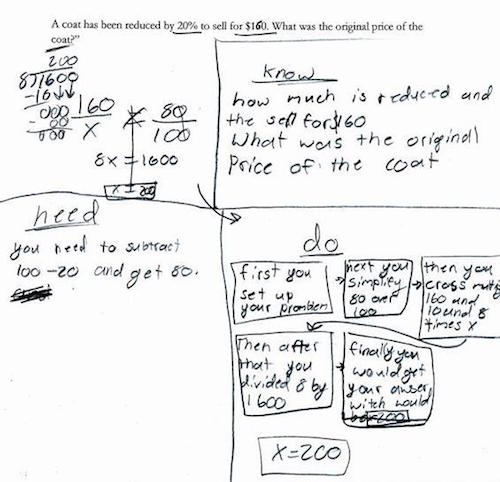
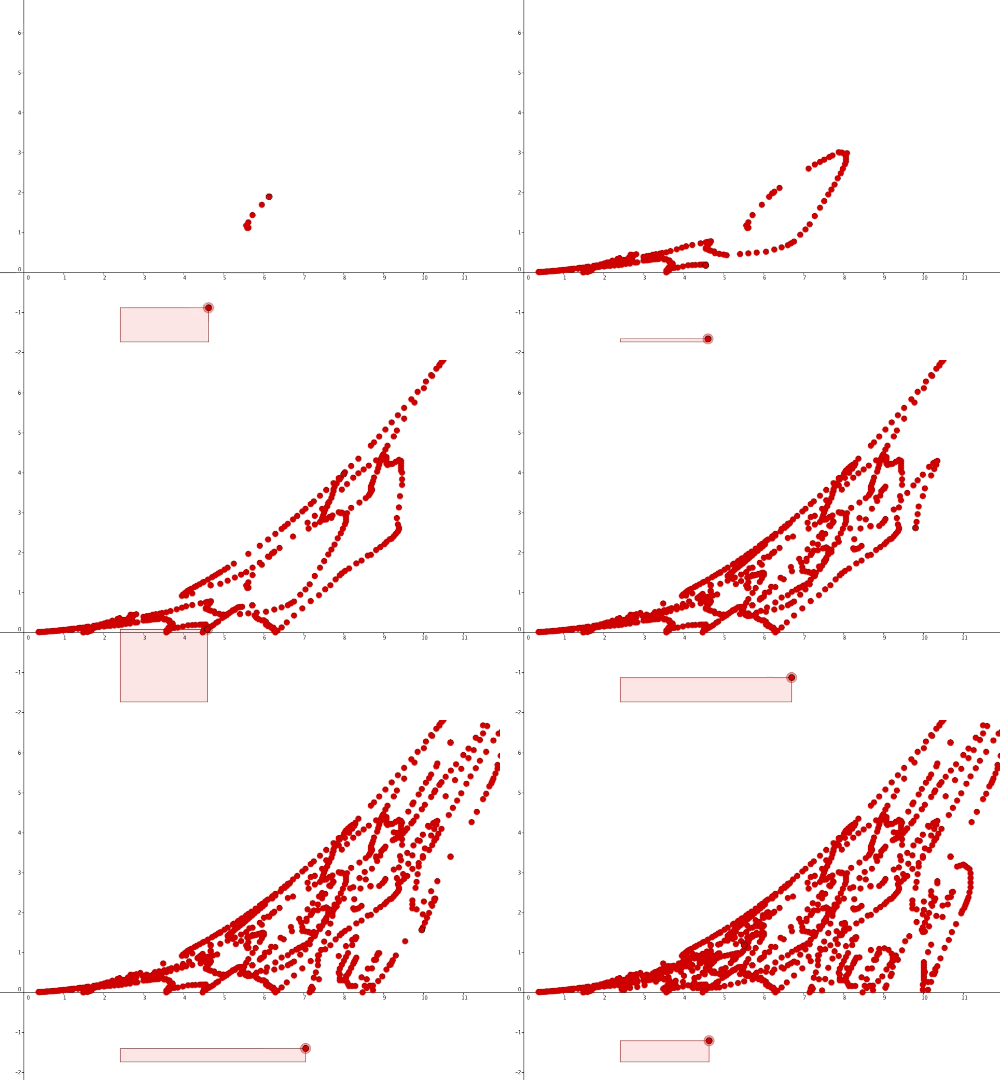
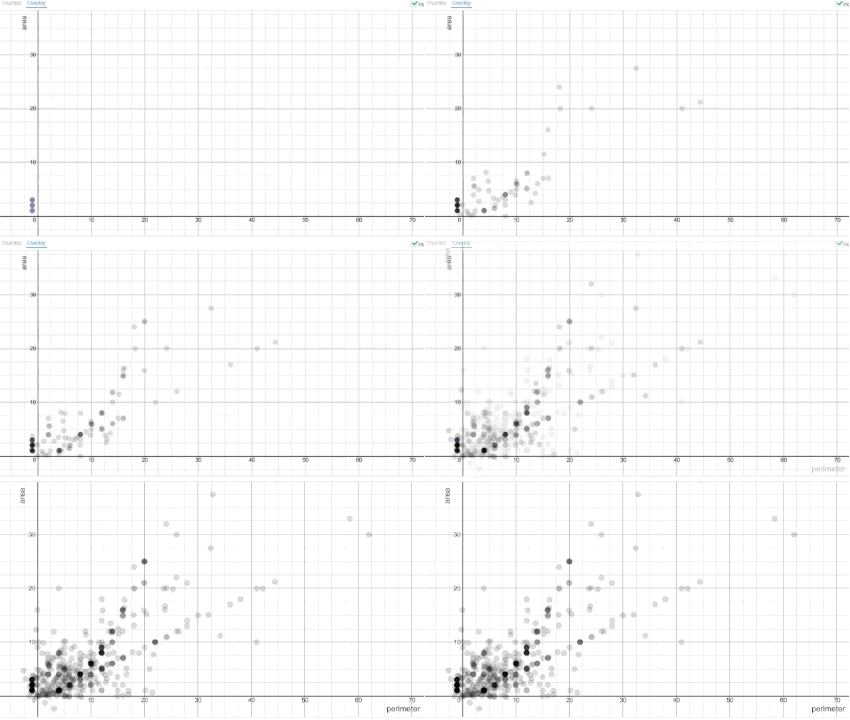
In response to yesterday’s post, Jason Dyer offers us a useful thought experiment:
- Is there a problem that could be completely explained using symbolic notation alone?
- Is there a problem that symbolic notation cannot sufficiently explain?
I vote yes for both and have added my examples in the comments.
BTW.
I realized that the headline from the Garelick & Beals article doesn’t match their argument.
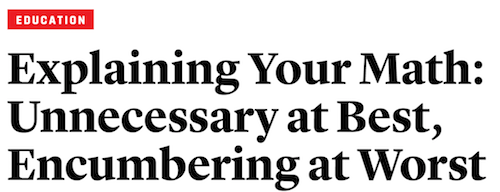
The headline: “Explaining Your Math: Unnecessary at Best, Encumbering at Worst”
Their article: “At best, verbal explanations beyond ‘showing the work’ may be superfluous; at worst, they shortchange certain students and encumber the mathematics for everyone.”
I can see why The Atlantic would want to sharpen their writing for the headline. They qualify themselves twice in the article (“at best” and “may be”) barely making a claim.
So if they think symbols are always sufficient explanations, let’s offer questions in the comments for which they aren’t. If they think verbal explanations are sometimes necessary, let’s let them articulate when.
Featured Comment:
There’s a place in instruction (somewhere between ages 3 and 8) where each of the symbols “3” and “+” and “4” and “=” and “7” each need explanation, which might look like
… + …. = … …. = …….I am pretty sure that Common Core haters dislike the notion that any of that ought to be explained, that they would prefer that this just be one of the 55 addition facts that ought to be memorized, and let’s move on.
At the same time, requiring 3rd or 4th graders to explain why 3 + 4 = 7 seems ridiculous, EVEN THOUGH SOME 3RD GRADERS HAVEN’T MASTERED ADDITION.
I would ask my 8th graders to explain why 3x + 4 != 7x, but I wouldn’t ask for this in a Calculus class, EVEN THOUGH IT HAS NOT BEEN MASTERED BY ALL.
My point is that we use symbols for efficiency, to avoid explanation. Symbols are NEVER enough explanation at the beginning of instruction.
A student’s presence in a given class presumes a level of previous mastery and efficiency WHICH IS NOT ALWAYS THERE, and instruction examples demonstrate the level of explanation that is expected.
To Chester Draws about the quadratic, I would hope for words like “Quadratic => 0, 1, or 2 solutions” in an explanation.
So a really good question is “what level of explanation should students be expected to demonstrate on a national test? (all right, multi-state, but I am in favor of a national curriculum).