Category: uncategorized

Total 483 Posts

Sal Khan Comments On #MTT2k In Chronicle of Higher Education

Sal Khan, responding to our #mtt2k contest in a (paywalled) article in the Chronicle of Higher Education:

There’s always the critique that Khan Academy is not pedagogically sound, that we’re procedural-based, focusing on mechanics without base understanding but I actually think we’re the exact opposite of that.

[..]

With procedural, worked problems: That’s how I learned, that’s how everyone I knew learned. But we do have videos explaining the ‘why’ of things, like borrowing, or highly rigorous concepts like college-level linear algebra, so it’s kind of weird when people are nitpicking about multiplying negative numbers.

Maybe something got lost in the edit, but I can’t seem to reconcile those two statements. On one line, Khan Academy is the opposite of procedural learning. In the next paragraph, Khan offers a full-throated endorsement of procedural learning through worked examples.

We will never say that our visual library is perfect. And we’re constantly trying to improve. But I think it’s a straw-man argument to pick one video and say, ‘This is a procedural video, it is not conceptual, they’re all like this, these people don’t have an understanding of pedagogy.’ That is, frankly, a bit arrogant and disparaging.

The statement “this should have been better” isn’t the same as “this should have been perfect.” Khan has god-knows-how-many videos at this point, some of which he made with only his cousins in mind, and we should expect a wide distribution of quality.

Setting aside any of our concerns about the best place for video lectures in a math classroom, we all have an interest in Khan’s video lectures being as mathematically correct as possible. But Khan thinks it’s arrogant and disparaging for people who have spent decades witnessing and cataloging every possible misconception about negative numbers to step in and say, “Your video may lead to misconceptions about negative numbers.” That’s a pity. I encourage Khan and his staff to find a more productive way to engage this deep bench of unpaid, well-informed critics.

BTW. If Khan is wondering why math teachers worry about his pedagogical content knowledge, this is the sort of decision that gives us the heebie-jeebies:

Mr. Khan says he intentionally mixed up the transitive and associative properties to show that understanding that a times b is the same as b times a is more important than the procedural process of memorizing vocabulary.

Comments closed.
Bill Gates Just Put A Hit Out On John Golden And David Coffey

This strikes me as a really, really effective way to assess the pedagogical content knowledge of new teachers: critique the pedagogy of the Khan Academy video of your choice. You could write an essay and add timecodes for reference or you and a friend could sit in front of the screen MST3K-style and snark your way through Khan’s lecture like John Golden and David Coffey.

I’m really curious how the Church of Our Lady of Technology in Silicon Valley will react to this kind of critique. That church tends to write off most educators’ criticism of Khan Academy as some admixture of jealousy and entrenchment. They aren’t always wrong about that. But the criticism that “this is actually fairly poor lecturing that’ll leave students with shaky procedural understanding and even shakier conceptual understanding” is much harder to refute. It’s also a difficult criticism to illustrate for people who aren’t teachers. This is the best illustration of that critique I’ve seen.

BTW. The low-rent production values don’t do justice to the quality of their concept and critique, though. Thirty dollars on sound equipment would go a long way towards making this a series math supervisors around the US would make required viewing for their inservice teachers.

2012 Jun 20. Kent Haines has eagle eyes and points out that Khan Academy pulled their video within a couple hours of this post. Christopher Danielson asks the right question, I think. Are they pulling the video to correct the mathematical errors, the pedagogical errors, or both. It’s one thing to mistakenly refer to the transitive property when you mean the commutative property. It’s another to teach students that multiplying integers requires the memorization of a bunch of rules that look like magic but just memorize them because okay?

2011 Jun 21. I had high hopes for that comments thread but it wobbled off course pretty fast.

2011 Jun 22. A reader e-mailed asking what kind of audio setup I’d recommend. Here’s what I wrote back:

There are lots of configurations that’ll serve our needs here and probably several that are cheaper or less cumbersome than the one I use to record audio of myself in presentations and lectures. Lately, though, I record video using whatever I have on hand. Then for audio I use:

Then I sync the audio and video in post. Here’s a video explaining the setup.

2012 Jun 22. Khan Academy has re-uploaded the video and the difference is stark. The new version is oriented towards conceptual understanding whereas the last offered you the bare minimum necessary to pass a multiple-choice test or keep your teacher and parents off your back.

An Incomplete History Of The Math Edublogosphere

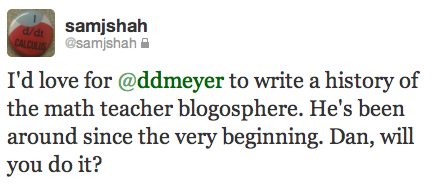
I'd love for @ddmeyer to write a history of the math teacher blogosphere. He's been around since the very beginning. Dan, will you do it?

I don’t know much about history (” … and Nowak begat Townsley, father of Cornally … “) but here are a couple of observations from a few years of watching math edubloggers come and go.

There are a few crude but useful ways to categorize math edubloggers. Some stay. Others quit. Some blog regularly. Others blog sporadically. Some bloggers construct posts while they’re teaching. Others construct posts after they’ve taught. The first two are fairly obvious, I suppose. The last one is the most interesting to me. You’ll find bloggers who include photos, student work, and other classroom artifacts in their posts as a matter of routine. These bloggers were developing those blog posts – maybe consciously, maybe subconsciously – at the same time they were developing those lesson plans.

Speaking personally, I realized one day that without intending to I had developed a critical community around my blog, a group of people who were willing to save me from my own lousy classroom design choices. They got better at giving criticism and I got better at receiving it. I also got better at posting the kind of rich, multimedia artifacts of classroom practice – photos, videos, handouts, etc. – that facilitated that criticism. I started to plan lessons while wondering at the same time, “What about this is gonna be worth sharing?” Lesson planning and blogging became hopelessly and wonderfully tangled up.

There are generations of math education bloggers that stick together in fascinating ways. Perhaps it goes without saying that math edubloggers start by reading blogs, then commenting on blogs they read, then writing their own blogs. (Not unlike every other kind of blogger, I suppose.) It’s interesting for me to lurk around, though, and see where the new bloggers are commenting. Totally anecdotally, new bloggers seem to interact primarily with a) bloggers who started blogging in their same generation and b) bloggers who started blogging in the previous generation. Confusing? Andrew Stadel and Fawn Nguyen both started blogging about math education at about the same time. They both provoke and encourage each other on their blogs. I also see them interact with Christopher Danielson who started blogging a little over a year earlier. Meanwhile, they comment less often on this blog because, I dunno, I’m some kind of old timer and they’re ageist or something. Basically: new bloggers find community at their own level of experience and they find mentors one limb above them in the math education blogging family tree.

Those are my only observations that aren’t completely obvious. It’s a weird community that is always hungry for personality and wisdom, that occasionally collaborates and supports itself in spectacular ways that knock the wind out of me.

Your summer assignment: jump in.

2012 Jun 18. Matt Townsley has a Google survey which may help us construct a family tree. I added my details. Feel free to pitch in.

2012 Jun 19. And the results of that survey. What does it mean?

Asking Politicians To Take Summative Math Tests Devalues Math Education

Diane Ravitch (and Kate Nowak and Ben Blum-Smith):

Insist that all policymakers, think tank gurus, academic experts, and politicians who believe so passionately in standardized tests do this: Take the tests in reading and mathematics and publish your scores.

I understand the cathartic appeal of the challenge but I don’t understand what these educators think the inevitable failure of a politician, age 54, to recall advanced algebra will prove. What is the implication?

  1. We should only teach students the material a politician can recall at age 54?
  2. We should only assess students on the material a politician can recall at age 54?

Math educators struggle with this kind of shoddy post-hoc analysis all the time, which is why I’m surprised to see it grip Nowak and Blum-Smith. Parents tell their kids, “I can’t graph a polynomial to save my life and I’m doing fine,” as if the deficits and disinterests of a grownup should have more than a thimbleful of bearing on curriculum decisions we make on behalf of students.

There are valid arguments that advanced algebra is overvalued or that our summative assessments don’t accurately measure the value of advanced algebra. Let’s invest our energy there and not in this sideshow, the only result of which will be a little catharsis for reformers and lots of parents telling their kids, “The governor of New York can’t graph a polynomial to save his life and he’s doing fine.”

2012 Jun 3. Kate Nowak posts a follow-up:

So if any of you [politicians] are listening: take a test and see how you do, and reflect on what that number says about you. Reflect on what influences that number for a variety of kids with varieties of challenges in their lives. Reflect on whether it makes sense to judge and compare schools and teachers based on that number. Reflect on how kids and teachers are spending their time in school if they are motivated by fear to maximize that number, and whether you think that is a healthy use of their time. Ask yourself if punishment is an appropriate response. And then talk start listening and talking to people who know how to do this better.

No objections.

Visit a public school. Follow a student around for a day. Hang out in the faculty lounge. Take the tests. Reflect on all of the above. You’re a representative. Understand the outcomes of your policies on the people you represent.

None of that requires you to post your scores for the derision and catharsis of frustrated educators, simultaneously sending the message that the only point of education is to prepare students to become bureaucrats.

Grab Bag Of Awesome

Phil Daro:

Wrong answers are part of the process too. Time and again in the Japanese classroom you’ll see, “Jen discovered an approach that doesn’t work. Jen, explain your discovery to the class.” Jen explains the discovery to the class. “Does everyone understand Jen’s discovery? Now let’s all figure out why it didn’t work. Jen, did you figure out why it didn’t work? Let’s figure it out.” It’s actually often easier to get to the math figuring out why an approach didn’t work than why an approach did work.

[N.B. Often times a student has correctly answered a different question, and asking “For what question would Jen’s approach work very well?” is generative.]

Apostolos Doxiadis argues for more “paramathematicians”:

If our rationale for teaching a subject is circular — “you must learn it because it is useful, because it has uses, because it is useful, because you will need it later, because it is useful” — we won’t go a long way. A developing human being is many things, and chief among them a poet, an adventurer and a problem-solver. Give the poetry, the adventure and the problems, through stories, both small stories of environment and large stories of culture. Grip the heart — and the brain will follow.

As for the mathematicians themselves: don’t expect too much help. Most of them are too far removed in their ivory towers to take up such a challenge. And anyway, they are not competent. After all, they are just mathematicians — what we need is paramathematicians, like you…. It is you who can be the welding force, between mathematics and stories, in order to achieve the synthesis.

David Gessner built a shack for himself but left a gap between the door and the roof. He was rewarded when he didn’t patch that gap. Read about it and then imagine the contents of a blog post entitled, “Leave Some Gaps In Your Tasks.”

Featured Comment

Barry:

We may well ask of any item of information that is taught … whether it is worth knowing? I can only think of two good criteria and one middling one for deciding such an issue: whether the knowledge gives a sense of delight and whether it bestows the gift of intellectual travel beyond the information given, in the sense of containing within it the basis of generalization. The middling criterion is whether the knowledge is useful. It turns out, on the whole, … that useful knowledge looks after itself. So I would urge that we as school men let it do so and concentrate on the first two criteria. Delight and travel, then.