I’ve now spent enough time with both McGraw-Hill’s Algebra iBook and iBooks Author to know two things:
- I have no idea what iBooks Author will do to the publishing industry writ large or textbook publishing writ small. My hopes are high we’ll see a lot of productive chaos as well-heeled districts and non-profits finance mid- to high-quality textbooks that are then dumped at no cost on the market.
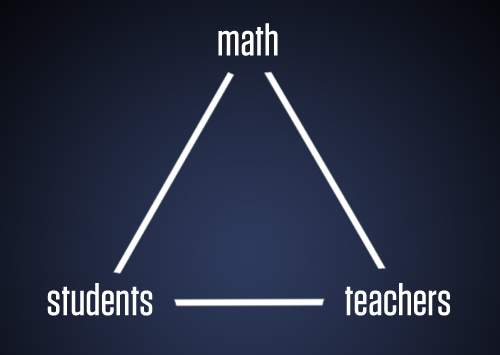
- The McGraw-Hill Algebra iBook doesn’t change any of these relationships in any ways that interest me:
No new technology is so novel we can’t subject it to the question, “How does it change the relationship between student and teacher, student and discipline, one student to another?”
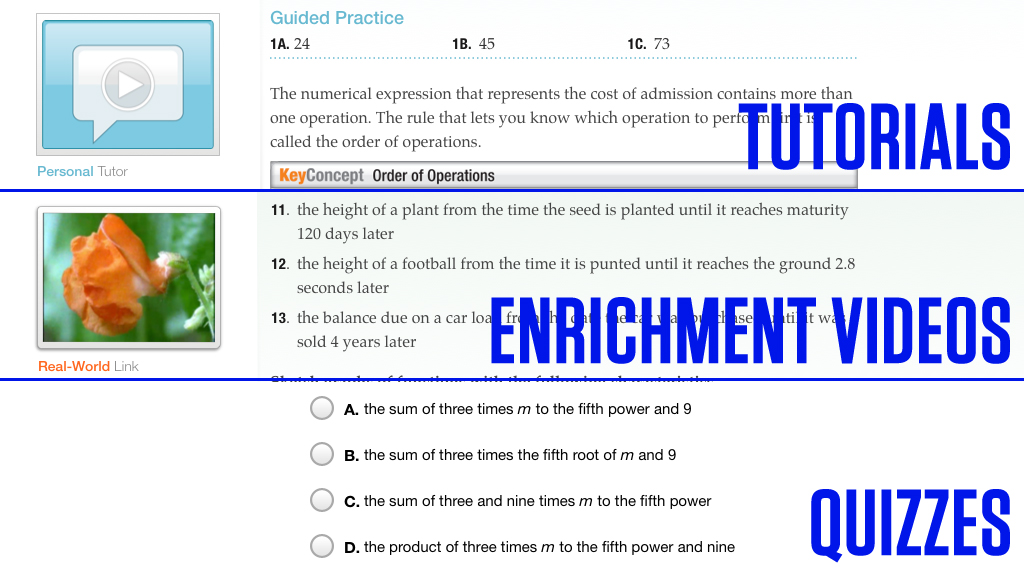
Algebra, as designed by McGraw-Hill for iBooks 2, is lighter by pounds. It’s indexed for search. It’s quick. You can highlight the text and insert notes. It removes one layer of abstraction between students and tools that already existed. Rather than accessing quizzes, tutorials, and enrichment videos by loading a CD-ROM into a computer or entering a password into a website, they’re a tap away.
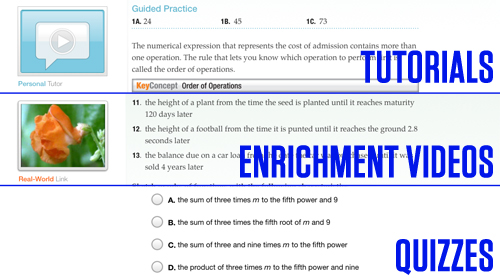
That’s where the differences end. Students still interact with mathematics as they always have. In a typical McGraw-Hill unit, students encounter expositional text that leads into skill practice that leads into application problems, the kind of which I’ve been a noisy opponent. Apple promotes the interactivity of these textbooks but that interaction is rare and heavily prescribed. At one point, you can modify the parameters of a linear equation and watch it change on the screen. On another page, I found a 3D model of a building that illustrated some algebraic property. I could rotate it with my finger.
The textbook is now digital but students still encounter it as they always have: wisdom to be received, perhaps highlighted, annotated, and memorized, but not created, constructed, or made sense of. Teachers still interact with students as they always have. The platform doesn’t offer them any new insights into the ways their students think about mathematics. As far as I can tell, the iBook doesn’t establish any new link between the student and teacher, or strengthen any old ones.
What I’m saying, basically, is that I’d have to modify, adapt, and extend the McGraw-Hill iBook in all the same ways that I modified, adapted, and extended the McGraw-Hill print textbook. We’d pull out the iBook just as infrequently as its printed sibling.
The McGraw-Hill authors may not have had much imagination for the possibilities of digital math curricula. Their iBook feels like a print product, through and through. On the other hand, they may have had plenty of imagination but insufficient support from Apple’s authoring tool. I’d like to examine that question –Â what is possible with digital math curricula and can iBooks Author realize those possibilities? –Â in another post.
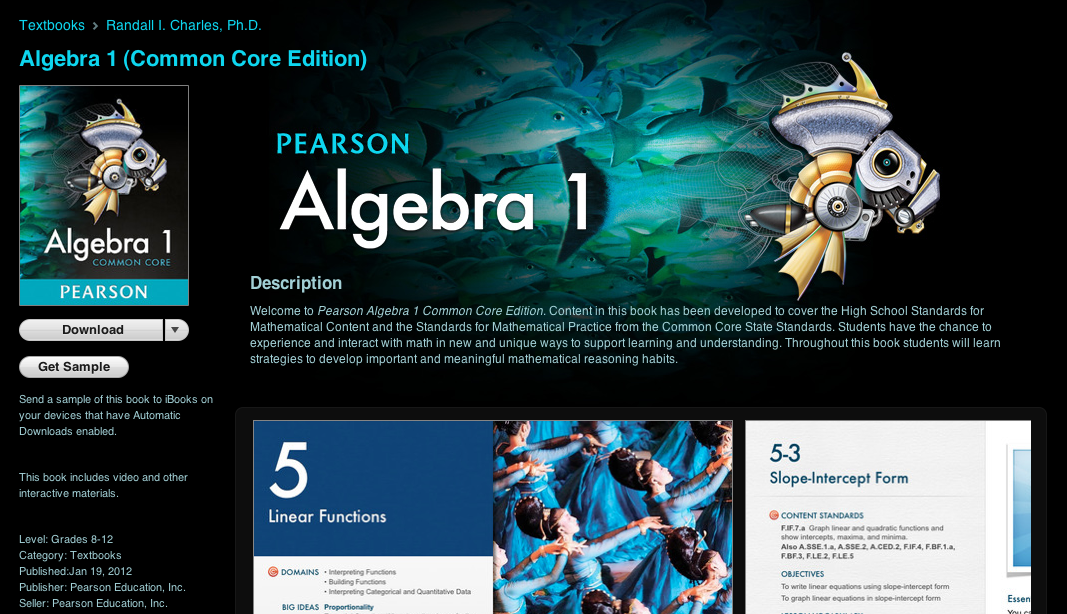
[Full disclosure: I’m a consultant for the Pearson Foundation on a different iPad project that’s still in production. Pearson has an Algebra 1 iBook that I haven’t reviewed here, only because I’m having a miserable time downloading these iBooks. The fact that its digital cover is the same as its print cover doesn’t exactly flood me with confidence, though. What they say about books and their covers, of course.]