My work with the Pearson Foundation has changed. They still include some of my three-act tasks (all of which are available for your non-commercial use at this page) but more often lately I review units for engagement. “Dan thinks like a child,” said one of the authors, which I chose to take as a compliment. The bottom line is that engagement is incredibly tricky to nail to the wall. At one point I was asked to draft a document outlining some guiding principles for designing engaging math tasks. I’ll reproduce that document below.
- Perplexity is the goal of engagement. We can go ten rounds debating eggs, broccoli, or candy bars. [references a debate, long since settled – dm] What matters most is the question, “Is the student perplexed?” Our goal is to induce in the student a perplexed, curious state, a question in her head that math can help answer.
- Concise questions are more engaging than lengthy ones, all other things being equal. Engaging movies perplex and interest you in their first ten minutes. No movie on this list took more than twenty minutes to set up its context, characters, and conflict. The same is true of engaging math problems, either pure or applied. Use a short sentence or simple visual to “hook” the student into the space of the problem. Use later sentences to expand on it. This order is often inverted in problems that fail to engage students.
- Pure math can be engaging. Applied math can be boring. The engagement riddle isn’t solved by taking pure math problems and shoehorning them into contexts that don’t want them. It’s hard to argue that two trains traveling in opposite directions from Philadelphia at different speeds is more engaging than “How many ways can you think to turn 20 into 10?”
- Use photos and video to establish context, rather than words, whenever possible. Rather than describing the world’s largest coffee cup in words, show a photo or a video of it. Not only because our words fail to capture what’s so engaging about the coffee cup but because we should find ways to lower the language demand of our math problems whenever possible.
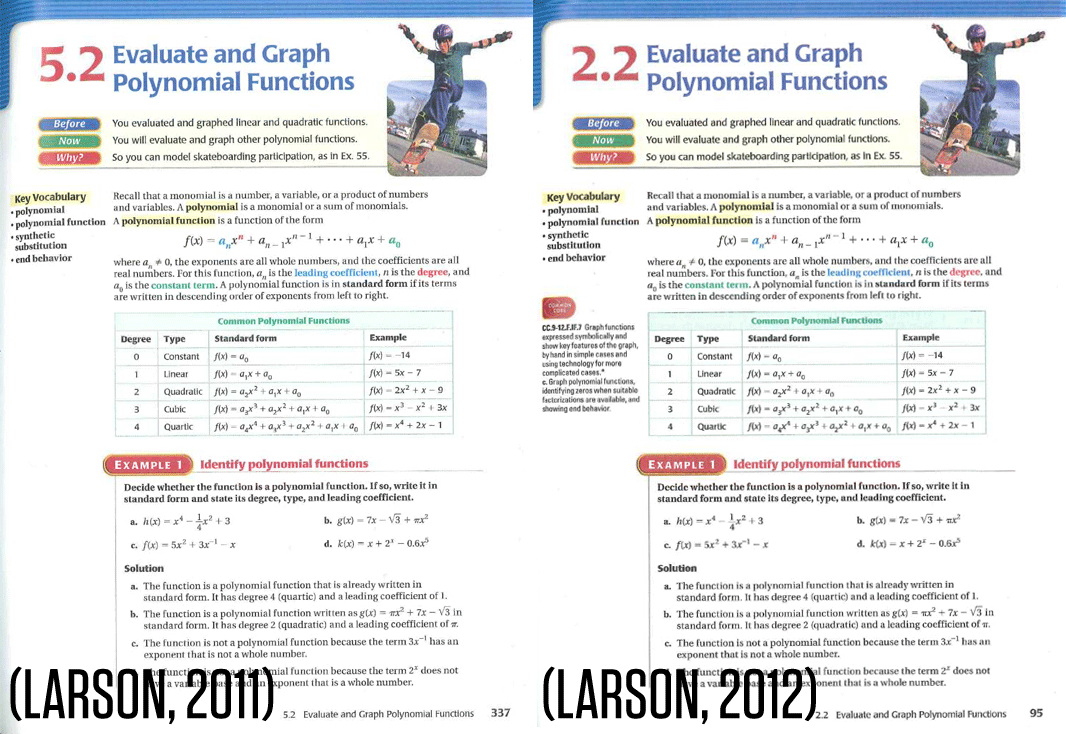
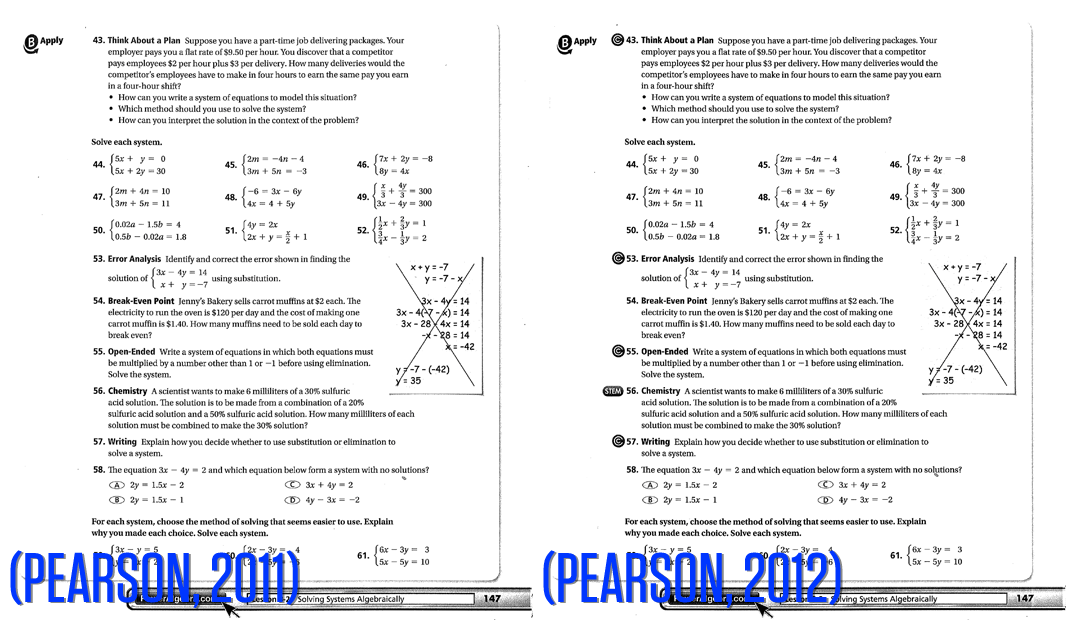
- Use stock photography and stock illustrations sparingly. The world of stock art is glossy, well-lit, and hyper-saturated and looks nothing like the world our students live in. It is hard to feel engaged in or perplexed by a world that looks like a distortion of your own.
- Set a low floor for entry, a high ceiling for exit. Write problems that require a simple first step but which stretch for miles. Consider asking students to evaluate a model for a simple case before generalizing. Once they’ve generalized, considered reversing the question and answer of the problem.
- Use progressive disclosure to lower the extraneous load of your tasks. This is one of the greatest affordances of our digital platform: you don’t have to write everything at once on the same page. While students work on one part of a problem, there’s no need to distract them by including every other part of the problem in the same visual space. Once they answer the first part of the problem, progressively disclose the next. This technique has far-reaching applications.
- Ask for guesses. People like to guess, speculate, and hypothesize. Guessing is engaging. Before disclosing all the abstractions of parabolic motion on the basketball court, just show a video and ask the question, “Do you think the ball will go in?” Once they’ve answered, continue the rest of your unit, lesson, or problem, now with more engaged learners. They’ll want to know if they’re right or not so be sure to pay off on that engagement later by showing them.)
- Make math social. More engaging than having a student guess whether or not the ball goes in is showing her how all of her classmates guessed also. Summarize the class’ aggregate responses with a bar chart. Students will enjoy seeing each others’ short answers and opinions but we can also use the same social interactions to engage them in pure math. Have your students a) select three x-y pairs and b) check if they’re solutions of x + y < 5. If everyone in the class sees the results of everyone else’s investigation, a visualization of linear inequalities will emerge on the class’ composite graph.
- Highlight the limits of a student’s existing skills and knowledge. New mathematical tools are often developed to account for the limitations of the old ones. You can’t model the path of a basketball with linear equations – we need quadratics. You can’t model the growth of bacteria with a quadratic equations – we need exponentials. Offer students a challenge for which their old skills look useful but turn out to be ineffective. That moment of cognitive conflict can engage students in a discussion of new tools and counter the perception that math is a disjointed set of rules and procedures, each bearing no relationship to the one preceding it.
What would you add? What would you subtract?
Featured Additions From The Comments
- When possible, reveal information only when requested. Current word problems will have 3 numbers given and they will all be used and nothing more is necessary. Knowing what is necessary to solve a problem and what is possible to measure is key to real-world application problems. [CalcDave]
- Once the problem has been completed, explain the cultural and historical context of this problem, if it exists. [David Wees]
- Go crazy. You know how high 5 cups would be? What about 5,000? You can factor this trinomial? Try this octnomial. What would happen if we composed these functions 100 times? 200? Asking these sorts of questions empowers students by making them aware of just how robust the abstractions they’ve earned are. At the same time, they humble students who think that they deserve a cookie for directly measuring the height of 5 cups. [MBP]
2012 May 19: Here’s a predecessor of this document that I totally forgot I wrote.