Category: uncategorized

Total 483 Posts

Eric The Sheep

Last Wednesday at UC Berkeley in Alan Schoenfeld’s class on mathematical thinking and problem solving, Kim Seashore wrote the following paragraph on the board:

Eric is standing at the end of a line of fifty sheep, waiting to be sheared. He is hot and impatient. Each time a sheep is sheared and Becky, the sheep shearer, turns to put the wool away, Eric sneaks around the next two sheep in line.

“What question am I going to ask next?” Seashore asked us. We thought for a moment and then shared out responses. Here are a few:

  • How many sheep will be behind Eric when it’s finally his turn to be sheared?
  • How many sheep were sheared before Eric?
  • How many kilograms of wool will the sheep yield?
  • How many sweaters can you make out of them?
  • What’s the significance of skipping two? Why two instead of three?
  • Will the other sheep get mad?
  • What if the 49th sheep had the same idea after seeing Eric skip ten more sheep and started skipping three every time? Who gets sheared first?

“Great,” Seashore said. Then she had us categorize those questions:

  • Which can we answer?
  • Which can’t we answer?
  • Which need more information to be answered?

Then she asked us to work for awhile on a question that interested us and was answerable. One person took up “how much wool?” and she asked him to be explicit about his assumptions. After ten minutes we grouped ourselves and explained our work to other people.

A Few Notes On This Scene

  • “What question am I going to ask next?” isn’t the same question as “What question interests you here?”
  • Why fifty sheep? How was that number chosen? Fifty sheep was short enough that some students determined how long Eric would wait to be sheared by simulating the entire problem. What is gained or lost by describing a line of 1,000 sheep?
  • Asking students to generate their own questions is risky. Seashore encouraged us to pursue our every whim even though the “kilograms of wool” question was going to involve very different mathematical thinking than any of the others. I don’t know how she planned to reconcile that difference. ¶ My approach is to sample the room for questions and take +1’s for each. (ie. “Is anybody else interested in Sam’s question?”) This reveals a hierarchy of student interest which we handle in order. ¶ Meanwhile, I am in contact with teachers who ask their students to generate questions only to coerce them down to the one they (the teachers) originally wanted to pursue. This interaction will only pay off negative dividends, as far as I can tell. These classes would be much improved if the teacher would simply ask a concise question that she knew in advance would be of some general interest to her students. Most questions asked in math class are neither concise nor of much interest to the students so we’re already way ahead of the game.
  • Abstraction was nine tenths of the work. In answering, “how long will it take Eric to get sheared?” I had to represent the problem with variables and build a model out of them. This was, by far, the hardest work of the problem. Moreover, no one I spoke with chose the same independent variable that I did.
  • Your textbook would abstract the problem for your students.
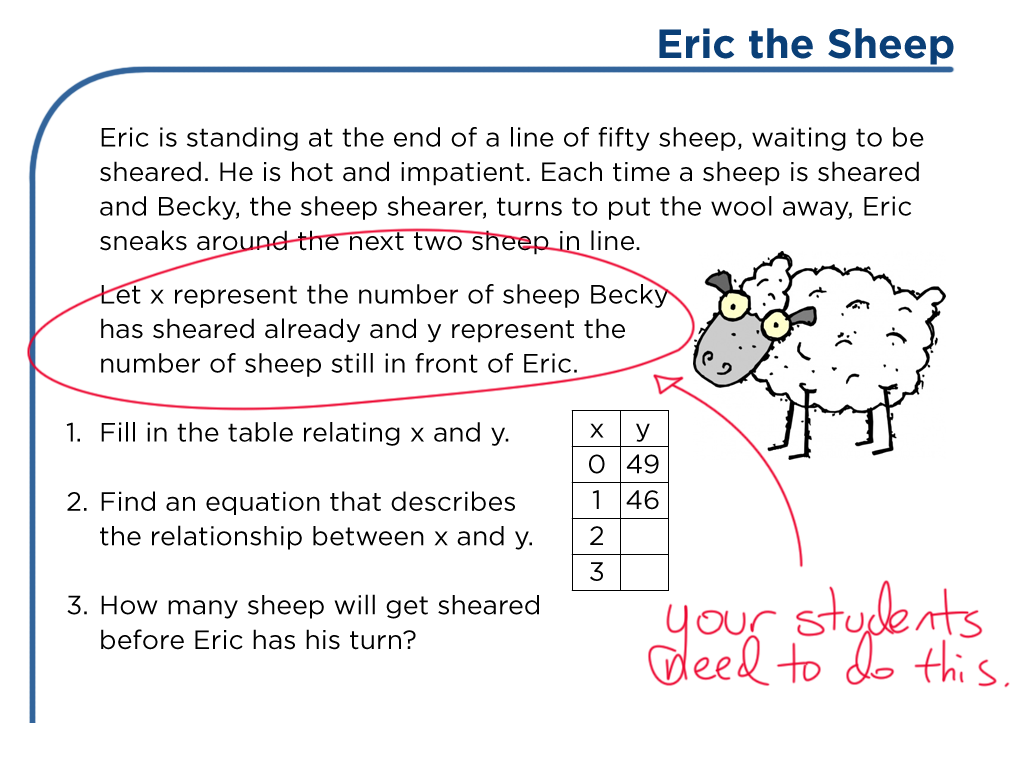
Be less helpful.

2011 Sep 20: Bowen Kerins locates the original text of the problem, which mercifully leaves the hard work of abstraction to the student.

Featured Comment

Paul:

A line of 50 sheep makes me wonder why I would ever have to use variables to represent the problem.

A line of 1,000 sheep makes me wish I had an easier problem โ€” one I could actually act out.

What number of sheep will motivate me to model a simpler case and look for patterns? What number of sheep will force me to generalize and move from concrete models to abstract thinking, without stepping over the boundaries of the story?

Shearing a line of 1,000 sheep? Eric will be waiting a very long time.

Puzzling, Ctd.

A response to my last post from the MathTalk forum:

Compared to an exploratory curriculum for kids who are not distracted by hunger and not shut down by years of failure, the Khan academy videos pale. But compared to the status quo, it seems to me to be a contribution. And used as supplementary material, they seem wholly a win.

This is almost exactly right. You want to put a million videos on YouTube explaining math? The world is all the better for your contribution. But don’t mistake your contribution for a solution to a larger problem. Don’t mistake your contribution for a solution to a larger problem and then embed it in a student’s compulsory public education.

My own work has received a fraction of Khan’s accolades and funding and I still feel the need to disclaim every few days that applied math isn’t the only math worth studying and video doth not a complete curriculum make. Once Gates puts a few million dollars behind your collection of YouTube videos, I imagine the pressure becomes unbearable to claim it’s the solution to a problem way outside of its jurisdiction.

Comments closed.

Puzzling

Los Altos Patch on LAUSD’s expansion of Khan Academy to more classrooms:

The fact that we may not have seen a statistically different result between the pilot classes and the non-pilot classes might be a little bit puzzling, but it is by no means a reason to discount the program altogether,โ€ said Seither. Seither has a child who was in the pilot program. He added that a childโ€™s newfound enthusiasm for math and focus cannot be directly measured.

Seriously, I am puzzled. I would have guessed Khan’s approach to lecture and practice would juice achievement scores on standardized tests while tanking students’ enthusiasm for math. Clearly, I need to keep a loose grip on my assumptions.

BTW: I was interviewed by World Magazine for a piece on Khan Academy (paywalled, but accessible through the first link on this page) where I’m billed as a critic of Khan Academy. A “critic” is defined, in these matters, as someone who doesn’t reflexively throw money or praise at Salman Khan.

World Magazine:

Khan Academy has some critics. Dan Meyer, a former math teacher at San Lorenzo Valley High School, thinks Khan Academy is ideally suited for teaching standardized tests, but doesn’t show the bigger picture of how math applies to the real world. He says Khan’s lectures and multiple choice questions teach students how to get the right answers, but do not spark a deeper interest in math.

“Math should be developed in an environment where you can dig in, mess around, and play with the numbers,” Meyer said. When he taught 9th-grade remedial algebra, each class would focus on solving a problem: One day he put up a picture of a giant pyramid of pennies a man had created over many years, and students were curious as to how many pennies were in the pile. He then taught arithmetic sequences and other topics necessary so that students could figure out how to solve the problem themselves.

Other teachers share Meyer’s concern about Khan Academy’s lack of context. Both Patel and Donahue plan to add a project component to their classes, where students can watch Khan’s videos to learn certain skills and then use them to answer practical questions.

Meyer doesn’t think Khan should be used in class to replace a teacher. Unlike having a teacher in the room, Khan’s videos cannot make eye contact with students, pause and answer questions, or have a relationship with students. Still, he sees the benefit of Khan Academy as a supplementary tool in math classes if a student misses a day of school or needs extra help with a certain topic. He also believes that it would be helpful in situations where high-quality teachers are not available.

Comments closed in advance. I don’t need another food fight.

Reality Is Relative

Al Cuoco, responding to Sol Garfunkel and David Mumford’s op-ed in the New York Times which called for “a math curriculum that focused on real-life problems”:

This issue of viable and engaging contexts is complicated for a couple reasons. Many of the students in my high school classes came from situations that many of us would find hard to imagine; the last thing they cared about was how to balance a checkbook or figure the balance on a savings account. But they loved solving problems. For another thing, reality is relative.

Also, Deborah Loewenberg Ball on real-world context:

So I do think, on the question of context, it’s worth remembering that mathematics itself is a context and that puzzle-like problems are often both very engaging for kids and good equalizers because kids looking at those diagrams aren’t shaped by some of those same inequities about kids’ experiences.

Featured Comment:

Paul Wolf:

A facilitator at one of the workshops I went to this summer, Laura Kent, said that context is โ€œanything that gives the students access to the math.โ€

Mathalicious Hangs Out A Shingle

Karim Logue, friend of the blog and proprietor of Mathalicious, has opened up shop. He’s attempting to go at it alone, creating and selling interesting, high-quality math curricula on his own label, an experiment I’ll be watching with a lot of interest. Going in his favor is the fact that he has a sharp eye for applied math and a strong hand with slides, worksheets, photos, and videos. I’ve been previewing his fall line and it’s super. He’s offering my readers a 20% discount on the annual subscription with the code “dy/dan” between now and September 30. So check him out. Check out the freebies and then spring for the costies. Your kids will thank you.