I’m a subcontractor of a subcontractor of Pearson Foundation on this project.
I’d been waiting to mention it until after we finished negotiating our long-term contract but I’ve been on a short-term contract long enough to feel icky writing about the publishing industry without disclosing that it keeps the lights on at Meyer Manor.
I don’t check the imprint before I criticize a textbook. Pearson basically owns all of them anyway and since they’re all printed on paper, they all share some of the same fundamental flaws. In any case, no one I work with has ever sent me a note asking me to back off. They hired me because of my opinions on curriculum design, not in spite of them.
More:
Those are the basics, the essential disclosure. If you feel invested in my story, though, here are some more personal details including a) how the offer came up, b) why I picked this project, and c) what it all means for the curricula I post here:
How the offer came up
I don’t like to think or talk about how drastically a single 11-minute talk altered my professional landscape. I remember talking to The Jose Vilson afterwards. He was really kind about the talk and I was like, “Yeah, but this isn’t anything I haven’t written about a million times, right?” I’m still befuddled by the reception, so I’ve been treating every workshop I’ve been asked to facilitate, every talk I’ve been asked to give, and every person who’s asked to meet up with me, as if it’s the last one ever. TEDxNYED put a gust of wind in my professional sails and for that I probably owe David Bill a Christmas ham for the rest of his life, but I am trying hard not to squander that momentum and stagnate.
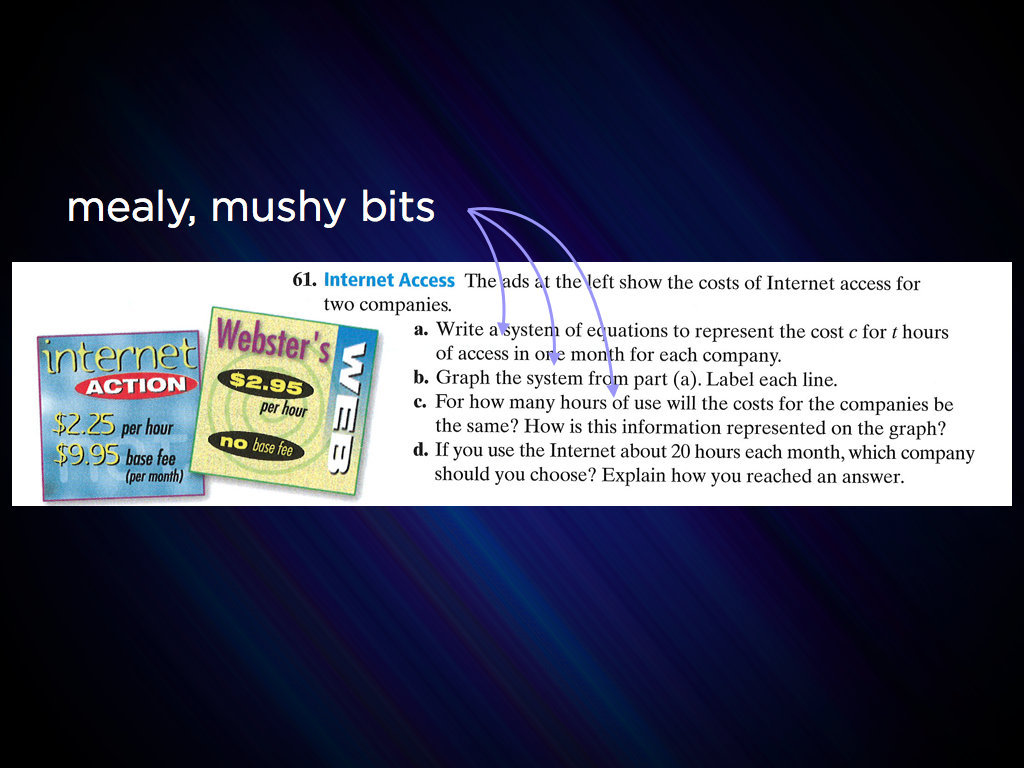
Having called out the publishing industry in front of what is now, in the YouTube era, a very large stadium, I was equally befuddled by the reception from editors. I took calls and meetings with the three majors and several smaller imprints. They all expressed awareness of a problem. In many cases, the problem they were aware of was “the industry is bleeding and digital is coming after us like a shark.” Meanwhile, the problem that interests me is “print media makes math applications boring and hard for students.” Still, it seemed like we could help each other out.
A reader asked in an e-mail about the irony of going to work for an industry I criticize. I replied that I didn’t see the irony. “They’re hiring me to fix things I don’t like about their product,” I said.
Why I picked this project
There were several interesting offers but time is short and I’m still enrolled in a very challenging doctoral program so I took on the Pearson project for several reasons:
-
The people involved are top shelf. Phil Daro chaired the math side of the Common Core State Standards and he’s the project lead. The international design group includes a bunch of people whose baseball cards I’ve been collecting since I was a new teacher. Basically, this project puts me in a position to learn a whole lot from a whole lot of very interesting people. That, plus the advice I receive from Jo Boaler and Pam Grossman at Stanford, has me sitting on an embarrassment of intellectual riches.
-
They get my vision, they appreciate it, and they offer great criticism. I’ve submitted maybe a dozen tasks already. They’ve accepted some. They’ve waved off others. We’ve debated some. Those discussions have always been productive. They’ve also welcomed my thoughts on what the platform itself should look like.
-
I don’t have to make problems I don’t care about. I don’t have to draft pages on pages of factoring exercises. They want me to make tasks I want to make.
-
The scale of the project is huge. A lot of people I admire have a lot of concerns about the scale of this project. Me? I want as many students as possible working on tasks I find worthwhile.
-
The headquarters are thirty minutes away. The subcontractor’s, not Pearson’s. Some of the other projects would have had me traveling around the country and there are a lot of reasons why I need to do less of that right now.
Those are the biggest reasons.
What it all means for the curricula I post here
Currently I license all my writing and curricula CC-BY which means anyone can do anything with it (including sell it) so long as my name is attached. The terms of the licensing of my work to Pearson are still under negotiation but I don’t want to do work I can’t write about or share freely here. So I’m offering Pearson an exclusive commercial license for my tasks. I’ll still make those tasks freely available to you but they’ll be licensed CC-BY-NC, which means no one but Pearson can use them commercially. I hired an attorney to protect those particular interests.
The biggest difference, I suspect, will be more math problems and better math problems. I’ve had to upgrade the Flip camera and the point-and-shoot and I have to make a lot more tasks now. Fingers crossed. Hopefully we’re all walking away winners here.
2011 Aug 08: Edited “Pearson” to “Pearson Foundation”