Category: uncategorized

Total 483 Posts

For The Next Ten Days Only: Create Your Own Graphing Story At GraphingStories.com

Never heard of a Graphing Story? Here’s one I made earlier this week:

Height v. Time from Dan Meyer on Vimeo.

What’s fun is meeting people who tell me they’re still using Graphing Stories, which is a lesson that in Internet years is basically old enough to cash Social Security checks. What’s awful is that people are still using the same set of ten videos, one of which is so ridiculous I can link to it but I can’t bear to watch it ever again.

The fact of the matter is that teachers and students have great ideas for their own graphing stories. The other fact is that the tools for creating them are just out of reach of many of those same people. Tools shouldn’t impede creativity, so here’s the plan:

You handle the creativity. I’ll deal with the tools.

I’ve partnered up with the good folks at BuzzMath to create a very simple workflow for you.

What You’ll Need

  1. Fifteen seconds of video of something happening.
  2. A graph that describes what’s happening. (Use this template.)

What You’ll Do

  1. Point your browser to www.graphingstories.com.
  2. Upload your fifteen-second story.
  3. Upload your graph. (Take a photo of it. Scan it. Whatever)
  4. Wait for an e-mail with a download link.

I’ll be creating all the graphing stories manually, on a first-come-first-served basis, one story per person. After ten days, I’ll cut off submissions and get down to work.

The result? A massive collection of graphing stories spanning all kinds of interesting dimensions (height, speed, distance, pain, happiness, etc) that we can all download and use in our classrooms.

So get to work. Tell your students. Tell a friend. Reblog and retweet this thing. Let’s make it huge.

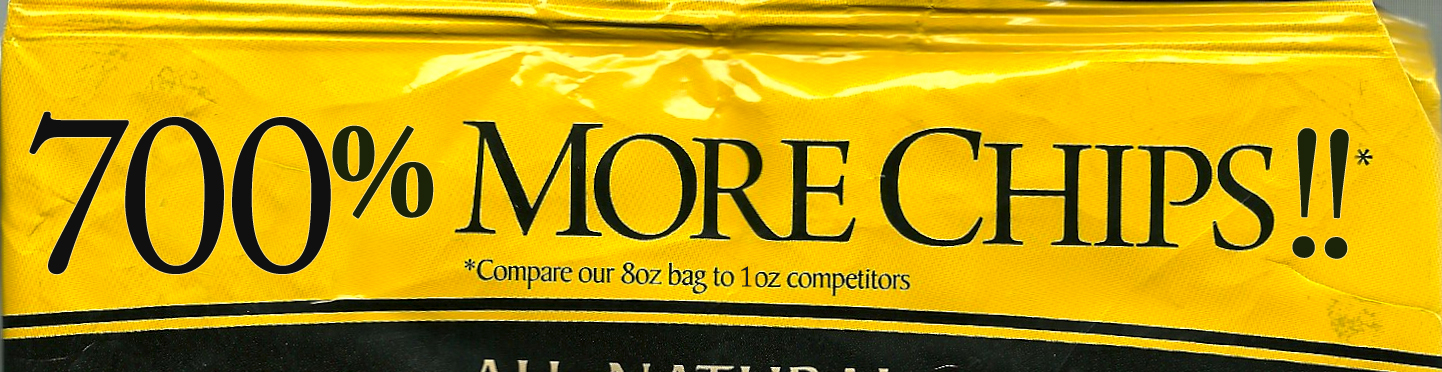
Truth In Advertising

This is my favorite brand of pita chip โ€“ no contest. I lose myself for hours staring at the bag. It’s like, “Wait. What? You’re telling me eight is 33% more than six? Bigger bags have more chips?!

Stacy, honey, if you’re gonna play this game, you need to play to win:

2011 May 01: Pwolf submits another entry.

A Phrase I Try To Avoid, Ctd.

Batnastard:

I have found that when I pose an interesting, accessible problem, abstract or concrete, the students get completely absorbed and forget themselves, and never ask โ€œwhen will I use this.โ€

When students ask that question, nine times out of ten they aren’t really asking that question.

A Phrase I Try To Avoid

I understand what it means. I know it’s code for something that basically everybody understands. But I’m not comfortable with the implication that if the mathematics won’t help you build a deck or make payroll or beat the odds at a card table that it’s “fake-world math” (or, even more unfortunately, “fake math“) and without value. Mathematics, as it’s studied by mathematicians, is challenging and satisfying work that’s accessible to anyone with a pencil, some scratch paper, and a curious mind.

I’m happy to work in this niche, with these “applications of math to the world outside the math classroom.” It’s important that when our students ask if mathematics has any practical or explanatory power in their lived experience that we can answer “yes” without our assigned curriculum undermining us. And if it’s printed on paper, there are a number of ways it’s doing exactly that.

I have some leverage here and I’m happy for the opportunity to help out with this problem. But I’m not confused that it’s the only problem.