Category: uncategorized

Total 483 Posts

Mathematics v. MTV

H. Wells Wulsin:

Mathematics educators now vie with a multitude of digital entertainment options to capture adolescents’ interest. To compete more aggressively for students’ attention, mathematics software should adopt the very strategies that have made these other media so successful.

Wulsin offers four recommendations:

  • Presenting examples in high-resolution video. “Video lets students watch the sweat beading on the athlete’s temples, see the whoosh of wind in the skydiver’s hair, hear the rev of the daredevil’s motorcycle. A photograph or cartoon cannot beat video in its fidelity and power to captivate.”
  • Connecting to students’ interests. “Monitoring a breeding bunny population would show the process of exponential growth. Baseball batting averages could introduce percentages.”
  • Showing appealing faces. “These videos could occasionally feature famous sports or entertainment figures. What if Michael Phelps calculated the volume of an Olympic swimming pool or Beyoncé computed the time delay needed for speakers at an outdoor concert? Why not let Danica Patrick figure the monthly payment on an auto loan?”
  • Holding students’ attention. “Make students laugh through physical comedy or corny one-liners. Introduce them to interesting people with magnetic personalities.”

This is a decidedly mixed bag of tricks. The first two of those recommendations are superficially useful but wrong on substance. The other two recommendations suggest students are like small animals – either raccoons, easily engrossed by pretty shiny things, or puppies who can be counted on to swallow a vitamin if it’s packed inside a lump of peanut butter. Both students and educators of students ought to be offended.

And then he misses one of the biggest reasons why MTV is more appealing to students than math:

Narrative.

Without narrative, all of Wulsin’s efforts are doomed. If Wulsin’s mathematical task lacks a compelling, clear premise in its first act, obstacles, conflict, and tension for your classroom heroes to resolve in its second act, and a cathartic resolution in its third act that leads naturally and necessarily to more mathematics in its sequel, he’s screwed. I don’t care if he recruits LeBron James to tell knock-knock jokes in hi-def about the area of a basketball court, his students won’t care.

[via]

2011 Apr 19: Updated to add a direct link to the article. (Thanks, Coquejj.)

2011 Apr 19: Wells Wulsin responds in the comments.
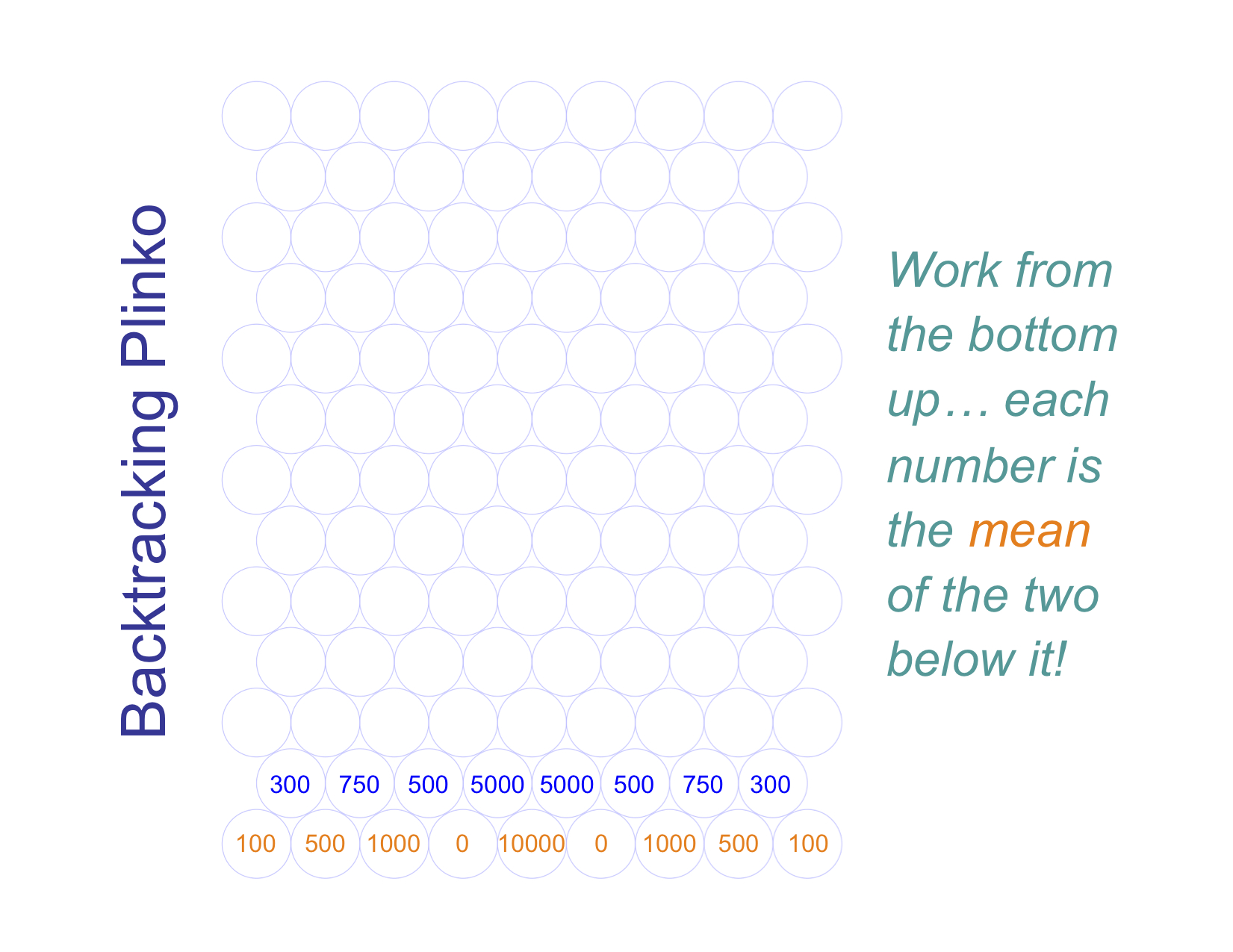
The Mathematics Of Game Shows

Judging from his slides, it looks like Bowen Kerins produced a corker of a presentation at NCTM last week, running through the math inherent to game shows across several genres and decades. Among other revelations, he’ll help you calculate the best location for dropping your Plinko puck.

2011 April 19. Dave likes the problem:

In the past, I’ve definitely understood the idea of compelling WCYDWT problems, and been drawn to know the solution. This was almost on a new level. There was nothing as important in my life as solving the Plinko board, right now. It’s like math crack.

How To Steal Like An Artist (And 9 Other Things Nobody Told Me)

Austin Kleon, in the middle of an amazing presentation on creativity, work, and the Internet:

6. The secret: do good work and put it where people can see it.

If there was a secret formula for getting an audience, or gaining a following, I would give it to you. But there’s only one not-so-secret formula that I know: “Do good work and put it where people can see it.”

It’s a two step process.

Step one, “do good work,” is incredibly hard. There are no shortcuts. Make stuff every day. Fail. Get better.

Step two, “put it where people can see it,” was really hard up until about 10 years ago. Now, it’s very simple: “put your stuff on the internet.”

I tell people this, and then they ask me, “What’s the secret of the internet?”

Step 1: Wonder at something. Step 2: Invite others to wonder with you.

Job Posting: Google Curriculum Fellow

Google is hiring again for the position I filled last school year. If the listing looks interesting to you (and I can’t really speak to the particulars of the project anymore) and you’re interested in a year-long sabbatical from the classroom, I highly recommend the experience. The management was awesome. You’ll have a better sense of where programming fits into math and science education. Plus, you’ll get to develop some professional muscles that you likely haven’t exercised while teaching. Like creating project specs from scratch, collaborating daily with engineers, forcing your body to urinate even though a bell hasn’t told you you’re allowed to, and trying to figure out what you’re supposed to do with the hours between 5PM and 11PM every day.

The Eager Replacements

Tom Hoffman:

I always felt like teachers like the one portrayed in the article — who understand and relate to their students, who are past the basics of classroom management, who are committed to teaching over the long haul, but are pedagogically not very sophisticated — are the key test for urban school administration and professional development. In the long run, you have to be able to reach those people, they have to be your foundation, or you are screwed. The idea that you’re going to fix your school system by laying these people off first, is, like Russo says, “particularly goofy.” As is the idea that giving these folks financial incentives will improve their instruction.

The weirdest single moment of the Michelle Rhee Q&A I attended last week at the Graduate School of Business came after she reported enthusiastically that nearly 1,000 teachers “were being moved out” at the end of this school year. (That’s a euphemism couched in the passive voice, for anyone keeping score.) Someone behind me asked where her successor planned to find their replacements and whether or not her own policies have had the unintended effect of discouraging recruitment. Her answer was “more merit pay.”

The results of this experiment will be in shortly, right?