Category: uncategorized

Total 483 Posts

Why We Do Comments Here

Cassidy73:

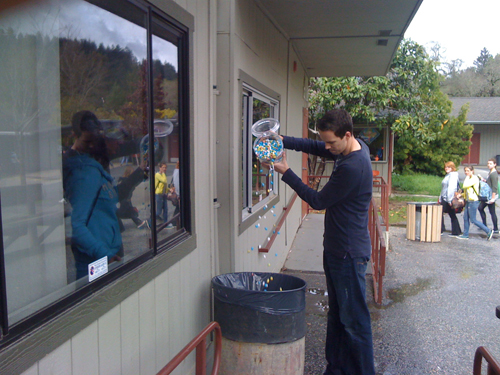
My immediate thought when I first watched the video was to recreate the scenario in my own room which has a drop ceiling. Once the students are set on their solution, we move the tile and find a bag of chocolates shaped like golden bars for the class to enjoy.

Awesome.

Blogging So I Don’t Have To

I’m drafting a longer post right now on a recent classroom exercise. (Teaser!) Meanwhile, here’s some stellar work from around the edublogosphere:

Scott Elias writes up what you need to know when you’re done with teacher school, a list that rings true to my own experience, especially his advice to “be interested.”

No, that’s not a typo. I don’t want you to worry too much about being interesting because that’ll take care of itself. And, let’s be honest, you just can’t force that. So start out your first year in the classroom by being interested – really interested. And please, for the students’ sake, show them that you’re interested in more than just your content area. You’ve got a passion (presumably) so don’t be afraid to let it come out in who you are in the classroom.

Megan Golding and Nick Hershman invigorate two of the most contrived content standards in all of the high school mathematics (as far as I’m concerned) – combined rates for Megan, ie. “How long does it take Timmy and Marsha to mow the grass if it takes Timmy 2 hours on his own and Marsha 1.5 hours on her own?”; systems of equations for Nick, ie. “A train leaves Philadelphia at noon, etc.”. These concepts are incomprehensible to students as words on a page but enjoy the difference when Megan and Nick first a) visualize the problem with multimedia and then b) access student intuition. I love, also, what Nick says about making the WCYDWT media:

As I’ve been editing them I can’t shake the feeling of being frequently rewarded when a calculation adds a meaningful piece of info into the scene or turning pixels roughly into meters and determining a subjects’ speed by calculating the difference in location over time. The math feels really useful. It’s hard to get that by having them watch the video. I had it by making it.

Sam Shah opens up his unit on area under the curve by giving his students a visual question and then asking them to simply get their hands dirty:

What was interesting to me was how hard it was for them. Not the estimating, or the making of triangles and rectangles and other smaller pieces. What was hard for them was being asked to do something that they didn’t know how to do. It happened multiple times that kids were sheepishly telling me that they didn’t know how to start, that they were doing it wrong, that they didn’t know the right way. They were telling me this to assuage some part of their psyche that was telling them that they had to be right. I told them to STOP BEING CONCERNED ABOUT KNOWING THE RIGHT WAY and just TRY SOMETHING! Then they did.

This last link has nothing to do with anything except for the fact that I’ve listened to this mashup track featuring Lil Wayne and The Office (called Office Musik) about a million and a half times tonight. Not safe for a) work or b) people who don’t have awesome taste in music and tv.

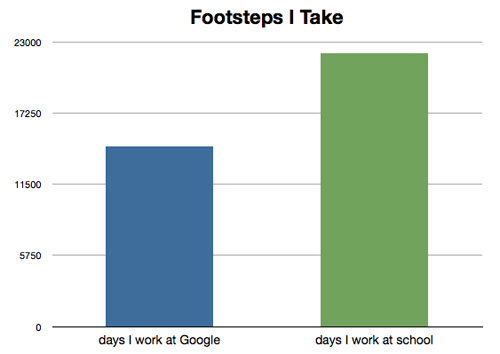
Working At Google v. Working At A Public High School

I carried a pedometer in my pocket all day every day from January 1, 2010, up until March 6, 2010, when I lost it somewhere in the New York City subway system. My 2010 Annual Report will be all the worse but I could at least salvage one interesting infographic:

Posted without comment, though if you’re into this kind of commentary, you can find more spread throughout this thread.

Easy. Fun. Free.

Here is one of my private assumptions about education innovation that could use some public criticism:

If [x] is going to change teaching practice at scale, then [x] needs to be easy, fun, and free for both the teacher and her students. [x] needs to be all three of those things at the same time.

Realize that if you’re a teacher and you’re reading a blog post, you’re automatically seeded in the top 10% of innovative educators. You’ll try anything once. Let’s also go with Jack Welch and assume that 10% of educators are hopelessly and/or willfully incompetent.

Convince yourself, then, that 80% of teachers exist on a sliding scale of innovation and are basically up for grabs. Those who don’t want to try [x] aren’t necessarily bad educators. They may have made a rational calculation that [x] isn’t easy enough, fun enough, or free enough to adopt.

There are implications here, some obvious, some subtle:

  • “Good” doesn’t matter. This is a little sad. But most of those 80% already have [y], which they consider “good enough.” They won’t pick up [x], however superior it is to [y], unless it is easier or more fun. This puts the burden on the reformer to make something easy, fun, and free that is also good. Good is the Trojan horse of education innovation.
  • You’ll have to package [x] for Internet distribution. Because it’s the only way to distribute at scale for (nearly) free.
  • Learning should always be fun, though I’m not talking about “fun” as it exists in “unlimited rides and deep-fried Oreos at Six Flags.” Rather I’m talking about the profound sense of satisfaction and accomplishment inherent to good learning. Just to be clear.
  • Learning isn’t always easy but learning tools should be. Just for instance, last week, I saw groups of students clicking the same download link over and over again in Safari not realizing that they had already downloaded the attachment. The download window was open but obscured by the browser. Anecdotes like this make me skeptical of Scott McLeod’s argument that computers are to teachers what checkout registers are to grocers. Many of you have vastly overrated the ease of educational computing.

The field of easy, fun, and free innovations that are also good for students isn’t exactly crowded but, for the record, I have bet on two horses. I expect these picks to strike certain readers as simultaneously naive, deranged, or self-obsessed but these innovations, more than any other I’ve used or observed, are ones that sell themselves:

  1. Google Reader.
  2. What Can You Do With This.

No further comment.
TEDxNYED

I’m taking my first trip to New York City today and speaking at TEDxNYED tomorrow. Rumor has it they’ll feature a live feed on the website and the schedule indicates I’ll be speaking somewhere around 17h00 EST, if you’re interested. Some of these other people might have something to say also.