Dina:
If you’ve got a dozen well-trained educators on this blog asking double the amount of critical questions about this cute little NAEP Excel doppleganger, most of which questions completely debunk not nuanced “implications,” but the very parameters of one’s x (math curriculum being assessed) and y (use of technology) values– I mean, come on. The *X and Y* values?!? Doesn’t that indicate on its face that we should throw out the whole damn graph?
She’s right, though the questions undergirding this sketchy data still intrigue me:
We all suffer from confirmation bias and earlier I wondered how the hardcore edutechnophiles would rationalize findings that the US fourth graders who used the most classroom tech performed the worst on standardized math exams?
My best attempt to crawl inside their heads:
Standardized exams are inaccurate assessments, moreover, they assess irrelevant skills.
Do I have that right?
Standardized Exams Are Lousy Assessments
I can’t spend much time on this assertion. Exam validity varies from state to state, content area to content area, and I can’t speak for the fourth grade assessment, but if California’s Algebra and Geometry assessments are any indicator, the ground just fell out beneath you. They’re extremely challenging and extremely fair assessments of prescribed coursework.
Standardized Exams Assess Irrelevant Skills
I can’t cozy up to that first objection but I spend a lot of free time wondering if we’ve prescribed the wrong coursework, especially after the concluding paragraph from Roger Schank’s recent post on math education at The Pulse:
I know this is a hopeless fight, but algebra really matters not at all in real life and the country will not fall behind in any way if we simply stop teaching it. That is not a fact, it is just a former math major’s, UT graduate’s, and Computer Science professor’s, point of view.
There is truth to this, I’m positive. There are studies to be conducted and evidence to be found concluding that, along with the current buffet line of alternative education options, we’ll move to an a la carte mathematics curriculum, even while textbook manufacturers, math teachers, their unions, and parents fearful of the global boogeymen dig in their heels and pull.
Careful, Though
Depending on the strength of your biases, that last one is an ugly rationalization, one which says the only tasks which matter are the ones which involve technology.
It’s worse than, “When you have a hammer, everything looks like a nail.” It’s, “When a hammer is your favorite tool, the tasks which don’t involve nails are pointless.”
There is a very rich, very nuanced conversation to be had here about the math students need (one which I am trying, and failing, to resolve internally with my foundering Feltron Project) and then there is a separate conversation, one which I will find very boring.
The Rationale Which Few Will Cop To
It will impress me a great deal if one of the usual tech proponents steps up to suggest that the implementation of technology in a majority of these classrooms simply sucked, that tech use in math classrooms simply isn’t “there” yet. That’d be totally reasonable and somewhat courageous given the forum.
Courage Aside
It’s obvious to me that this discussion will go nowhere – idealistic tech coordinators and their traditional colleagues permanently gridlocked – if we don’t first resolve the question, “Just what exactly are we supposed to teach here?” and then select some best practices, everyone agreeing to be cool in advance if those practices involve wikis or no. 2 pencils, ’cause we’re sure to find both
But these emotional appeals to decency and child welfare, my criticisms of which have clogged this blog for the last time for at least a week, treat education’s sore throat with a colonoscopy, demonizing a whole lot of decent educators without much result.
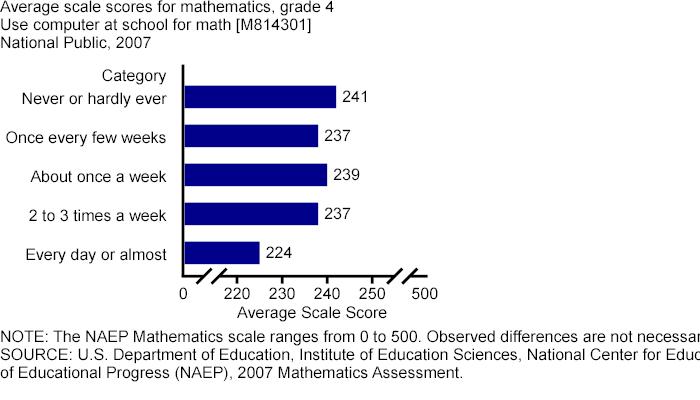
How does the tech-by-any-means-necessary educator rationalize these findings?
I have my guess tucked into a sealed envelope, scheduled for posting later this evening. Until then, speak your mind.
[This li’l storm cloud via Jon Becker via an e-mail from Scott McLeod.]
Okay. okay. I feel like we’re getting somewhere w/r/t lesson and resource sharing online.
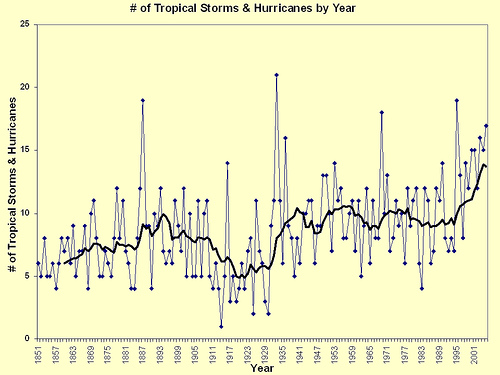
Swing by Ben Wildeboer’s hurricane investigation. I’ll cop to a lot of personal preference in this arena but no matter who you are or what you prefer, you’ve gotta notice what an advance this is on the traditional model.
[The usual explanations] didn’t cut it for my students. 15-year olds don’t have great appreciation for the subtleties and complexities of meteorological research. They wanted answers.
I’m feeling it, y’know? The tension. Will they find answers? Will they?! HOW!?!
Y’know: multimedia. The stuff that makes good teaching great, even when your students are teachers.
Obviously it doesn’t hurt Wildeboer at all that:
but, otherwise, a great, shared lesson plan really is this simple:
Present it as a multimedia story.
Which isn’t at all to say it’s easy, just that the ROI is spectacular when done right.