Dodging My Tech Coordinator

a/k/a Linear Fun #4: Hit ‘Em

She wants her laptop cart back so I’m ducking her calls, trashing her e-mails, employing idle freshmen to shield me as she walks past.

I don’t know how this happened. I reached for those laptops to show my tech detractors I could, to inoculate myself against charges of Ludditism the next time we went to the mattresses, debating the relevance of the read/write web to math education.

“But Some Of My Best Friends Are Laptops.”

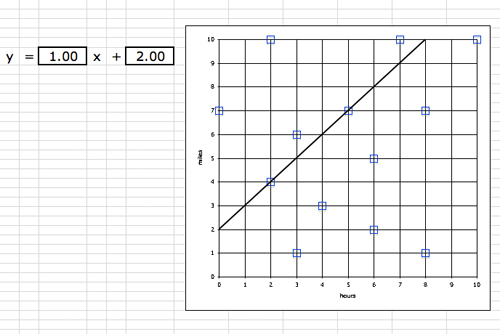
But then, after our first investigation into the flight data, after they selected their own data sets for regression analysis, after we investigated the data from the Department of Motor Vehicles (which y’all positively killed in the comments, thanks) I roughed up an interactive activity in Microsoft Excel:

Punch in a slope and y-intercept. Do your best to hit a set of targets. Get ready to give me several sentences explaining both.

There were positive, zero, negative, rational, and impossible slopes.
This was, like, the fifteenth extension on the mobile lab return deadline I begged off my tech coordinator and I realized this laptop thing was no longer an affectation. I wasn’t posing. It was real, more or less.

The Lonely Criterion

If you’re a tech proponent, coordinator, evangelist, or whatever, I’d like to break my complicated, conflicted, highly emotional experience (seriously: who am I anymore?) into small pieces for you.

  1. I had to accomplish a specific instructional objectiveWe can debate the merits of my state’s content standards, fine, but you can’t ask me to defy my employers, simultaneously setting my students up to fail in their next class, all so BJ Nesbitt won’t think I’m a lousy teacher. I mean, if that’s integral to the master plan, we have some work to do.. My students would a) model some part of their world with a linear equation, and b) explain the significance of the equation’s parameters.
  2. Microsoft Excel (coupled with a web browser) was the best tool to accomplish those objectives. And by “best” I’m balancing more factors than I have time or eloquence to describe but a) student engagement (are their brains working hard?), b) student enjoyment (are they having fun?), c) seat-hours expended (could I use our in-class time better?), d) planning hours expended (could I use my out-of-class time better?), and e) assessment scores (how well can they demonstrate mastery of the objective?) certainly round out the top five.

That is my uncomplicated flowchart, my lonely criterion for working technology into my classroom or not. I can’t imagine it is uniquely mine.

Your Job, Simplified

See, this is great. You don’t have to email your entire faculty a link to Mike Wesch’s latest call to educational actionFor serious: if I never saw another stony-faced child staring grimly at the camera, holding a hand-scrawled sign denouncing her out-of-touch, digital-immigrant teacher for not letting her SMS her iPod playlist to her Facebook group (or whatever) during class it would be too soon.. You don’t have to throw statistics at me. You’ve convinced me that my students need different instruction this century than they did in the last โ€“ check. got that. โ€“ yet you’ve satisfied only one-tenth your job description.

See this is the bummer. Now you have to immerse yourself in my content standards and use tech to help me satisfy the same instructional objectives in some way that’s a) more engaging, b) more fun, c) less time-intensive for my students in-class, d) less time-intensive for me out-of-class, or e) sturdier upon assessmentReally, if you can show me gains along any of those vectors without losing the others, you’ll be my valentine..

But this is also a bummer because, assuming your background wasn’t in every content area your school offers, you have to build a robust network of prolific educators pushing every content area in every direction but down.

And that’s the final bummer for y’all School 2.0 sectarians I’ve hectored these last fifteen months: unless I’m missing several platoons of math teacher bloggers, we’re stuck with each other.

‘Cause I’m starting to enjoy these Internets of yours, and finding a place for them in my classes.

2015 Nov 9. This might be the most belated update ever on this blog. Ms. Mac asks why there isn’t a Desmos Activity Builder-enabled version of this task yet. (Note to my past-self: you now work for an edtech company. Take the day off while you process that turn.) There should be. She made one.


It’s 3AM In The Edublogosphere

It’s been on the ‘tubes for a few months but I only just caught A Vision of K-12 Students Today, written and directed by BJ Nesbitt, via Stephen Downes who’s also coming at it late.

It’s risible (which probably explains why it’s only now crossing my desk) but in too many valuable ways to ignore it outright.

Specifically, if you commissioned a satire of the lamest elements of the edublogosphere โ€“ the sensational handwringing, the naked pleas to “please think of the children” (as if pottery teachers who don’t assign their students to podcasts equivalently don’t care about them) โ€“ you couldn’t do better than Nesbitt.

Tellingly, of the three State of the Educational Union addresses burning up the Internet today โ€“ Nesbitt’s, Mike Wesch’s A Vision of Students Today, and the Fisch/McLeod joint, Did You Know 2.0 โ€“ Nesbitt deploys the fewest statistics and invokes the loudest appeal to emotion.

Right here, I can’t avoid the comparison to Hillary Clinton’s equally risible Children campaign ad.

They both paint from the same palette of moral black and white. They both exploit children to promote an adult’s agenda. They both seek progress (hopelessly) through posture and intimidation. They both explain, respectively, why I won’t elect Hillary Clinton and why I find it difficult to engage the School 2.0 sectarians, however pure of intent they may be.

Knocking Them Down At ASCD

Dina Strasser and Patrick Higgins both rock recaps of sessions at the ASCD… which stands for “Association for Supervision and Curriculum Development,” a title which hits just about every one of my sweet spots. annual conference.

Dina took requests and reviewed a session called Decriminalizing Homework, during which Dr. Cathy Vatterott launched cherry bombs into the crowd (quoted from Dina):

  1. Eliminate grading homework.
  2. Homework that cannot be done without help is not good homework.
  3. A building which has a range of homework weights from 10 percent to 89 percent of a subject grade is “just stupid,” Vatterott stated flatly.

Meanwhile, Patrick, whose unease in his position as technical overlord at his school has inspired some precious reflection recentlyDay 72: No eats lunch with me anymore., attended Brain-Friendly Presentation Skills. I’m prepping my first speaking engagement since August, on entirely new material, and Patrick’s notes were useful:

One of the most powerful things she did was move us. Not the kind where we were emotionally moved, but rather we physically moved around the room. In the 90+ minutes we were there, we moved over 15 times. We conversed, we shared information and discussed the topics in the handout on our own terms, but in ways that she dictated.

The presenter swerves across a fine line and then back again, though, when she implores her audience to “simply walk around the room and touch something blue,” strategies for “engagement” only one degree removed from dosing out amphetamines to dozing attendees.

Pay close attention to the suggestions involving collaborative reflection. Ignore anything that looks like the presenter’s buying her audience’s engagement on the cheap. That’s what engaging content is for.

How Assessment Oughtta Be

Off his students’ distraction, TMAO pulls his unit assessments back in, tells his students not to worry, they’ll do it some other day when they’re better prepared for the challenge, except, one by one, they ask him for another shot.

Now nearly every hand is in the air, delivering the line with increasing rigor and strength, taking their tests and working now for real. One kid chokes on the words; another giggles. They do not receive a test. These are serious words spoken by serious people, people who want to do serious work, I say. Another student tries to wait me out. I ignore her and her short-lived rebellion, and eventually the hand hits the air: โ€œI am ready to step up.โ€

Ascendรฉte, Jaguar.

I swear if I saw the same scene in a movie I’d double over laughing. This guy is the real deal, though.

Who Does Florida Think It Is?

a/k/a Linear Fun #3: Driving Across America

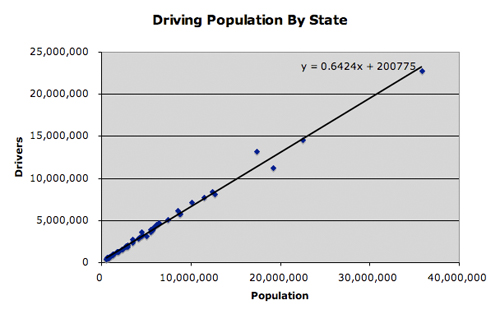
Plot total drivers vs. total population (using this table) for every state in the US and you get this graph:

Okay, that dot that’s below the line? That’s New York. That one’s easy. Fewer licensed drivers than you’d expect for the population ’cause only cabbies drive there or something.

But that dot that’s above the line? That’s Florida, and me and my classes will be damned if we can figure out why they’ve got more than their fair share of drivers.

Anybody got anything for us on that?