Adaptive Learning Is An Infinite iPod That Only Plays Neil Diamond

I was in a small room recently with some futurists who were very excited about adaptive learning. The reasons for their excitement wouldn’t surprise you. “Prussian factory model of learning, learn at your own pace, et cetera.” I admit it all sounded very appealing and when I tried to articulate my frustration with their model, I didn’t get far at all. I sounded like just another rent-seeking teacher trying to preserve the outdated model that cuts his paycheck.

Futurists and math educators talk past each other. If I could jump into any futurist’s head and encode any particular understanding there to make dialog easier, it would be this:

Adaptive learning is like an iPod with infinite capacity and infinite capability to play any song ever recorded or sung, provided those songs were written by Neil Diamond.

If all you’ve ever heard in your life is Neil Diamond’s music, you might think we’ve invented something quite amazing there. Your iPod contains the entire universe of music. If you’ve heard any other music at all, you might still be impressed by this infinite iPod. Neil wrote a lot of music after all, some of it good. But you’ll know we’re missing out on quite a lot also.

So it is with the futurists, many of whom have never been in a class where math was anything but watching someone lecture about a procedure and then replicating that procedure twenty times on a piece of paper. That entire universe fits neatly within a computer-adaptive model of learning.

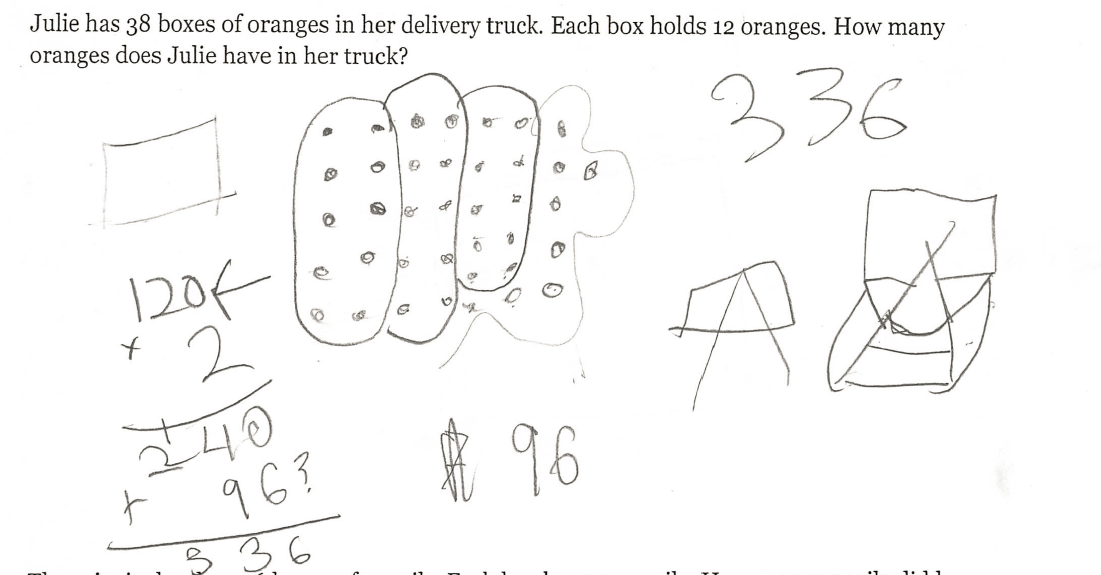
But for math educators who have experienced math as a social process where students conjecture and argue with each other about their conjectures, where one student’s messy handwritten work offers another student a revelation about her own work, a process which by definition can’t be individualized or self-paced, computer-adaptive mathematics starts to seem rather limited.

Lectures and procedural fluency are an important aspect of a student’s mathematics education but they are to the universe of math experiences as Neil Diamond is to all the other amazing artists who aren’t Neil Diamond.

If I could somehow convince the futurists to see math the same way, I imagine our conversations would become a lot more productive.

BTW. While I’m here, Justin Reich wrote an extremely thoughtful series of posts on adaptive learning last month that I can’t recommend enough:

Featured Comments:

Kent Haines:

Can I offer another analogy for these technologists? Adaptive learning is like a guitar teacher who teaches you how to play harder and harder pieces of music but never teaches you how to improvise. So you can play a piece of music that is placed in front of you, but you’ll never be able to pick up a guitar and just play with a couple of friends. I would contend that the improvisor is better prepared to understand and even make music. I’ll bet Neil Diamond can pick up a guitar and jam.

Randall Munroe Explains Modeling With Math

Randall Munroe, creator of the webcomic xkcd, from a TED talk that’s making the rounds:

What I love is that math lets you take some things you know and just by moving symbols around on a piece of paper find out something you didn’t know that’s very surprising. I have a lot of stupid questions and I love that math gives the power to answer them sometimes.

If you want to understand the Common Core’s fourth math practice standard, “Model with Mathematics,” you could do a lot worse than studying the mental feats Munroe performs in every single post of his What If? blog.

Featured Comment

Jason Dyer:

I think the bit immediately prior is worth quoting as well, even if it’s a bit harsher:

And I love calculating these kinds of things, and it’s not that I love doing the math. I do a lot of math, but I don’t really like math for its own sake.

Jim Hays:

Like on Mythbusters, Monroe is rarely content to stop with answering the question as stated: he generally keeps going bigger, faster, taller, or hotter until something explodes.

The Most Interesting Use Of Educreations

140514_1

Before this last week’s OAME conference in Toronto, I’d only seen one use of Educreations: students record themselves teaching through a lesson or a problem as a kind of summative assessment. This assignment has been recommended to me in 100% of the tablets-in-education sessions I’ve attended. (Chris Hunter called the students “Khanabees,” which is clever.)

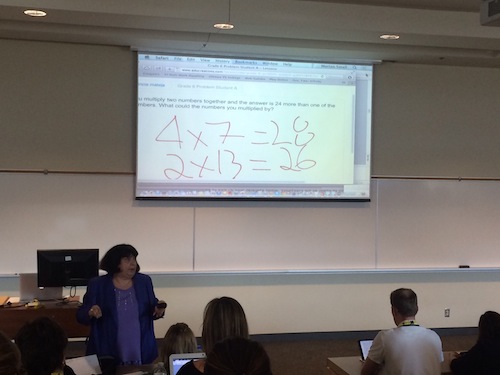
In her session at OAME, Marian Small used Educreations to show student thinking in its raw, unrehearsed form, full of loops and self-references, which for some purposes is more interesting than the polished Khanabees presentations.

The premise of her talk (PDF of her slides) was that the job of teaching comprises two very different, very difficult tasks:

  1. promoting student thinking through interesting questions,
  2. responding to that thinking in productive ways.

So her session was simple, but engrossing.

  1. She had students talk through and work out on an iPad interesting questions that they were seeing for the first time. (Here’s an example.) The iPad recorded their real-time sketches and markings and paired it to the their voice.
  2. She asked us what we’d say next and analyzed and critiqued our responses, highlighting their differences and categorizing them as either “scaffolding,” “redirecting,” “probing,” or “extending.”

An hour flew by.

This approach to representing student work has advantages and disadvantages relative to both scans of student work and videos that show the student and teacher. Rather than outline those differences myself, I’d rather take your thoughts in the comments.

If you’re into Talking Math With Your Kids or Math Mistakes, this approach to student work is worth investigating.

Featured Comments

Kate, referring to Small’s two bullet points above:

That is the most beautiful job description I’ve ever read.

Ryan Muller:

I am not a teacher, but as a technologist/researcher, it strikes me we can, at least in the short run, have a lot more pedagogical insight with humans looking at a few these than machines crunching context-poor big data (even though I’ve argued the case of the latter before on this blog).

Wade Roberts, co-founder of Educreations:

Android is the next logical platform for us to support, but we don’t yet see sufficient demand to justify the cost of development. We’re monitoring Android tablet growth within schools, but iPad is still over 90% of school market. It is already possible to replay our videos on Android, however.

And:

We’re incredibly excited about this use-case. People are often surprised when I tell them that just over half of the 5 million videos on our platform have been created by students.

[3ACTS] Money Duck

Previously

Many, many thanks to everyone who helped me sort out some thoughts on this lesson in our previous confab post, including but not limited to Fawn Nguyen, Robert Kaplinsky, Bowen Kerins, Dan Anderson, and Max Ray, and the many participants I pestered at OAME2014 this last week.

Here’s the download link at 101questions.

Act One

Show this video.

Ask: “What would be a fair price for the Money Duck?”

You guys were right. In the end it makes more sense to pose the student as the seller. It’s more productive and more interesting even though its easier to empathize with the buyer initially.

Act Two

Ask: “What information would you need to decide on a fair price?”

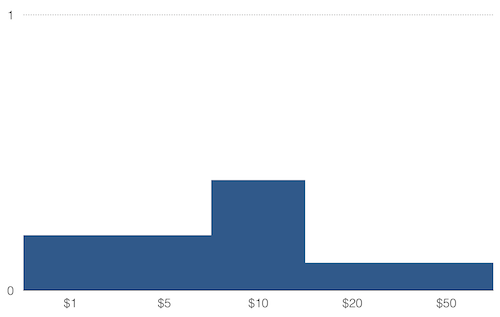
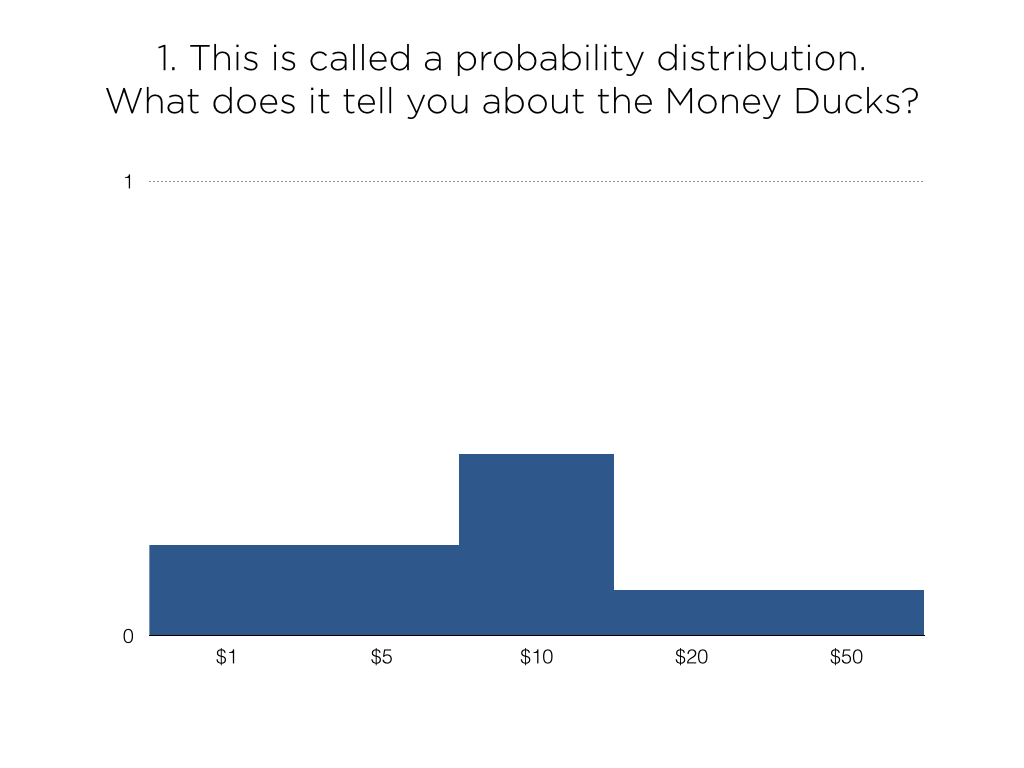
Now we’re going to introduce the probability distribution model.

150510_10

It’s unusual so we’re going to do several things in order:

  1. We’re going to ask for speculation about what it means. Then we’re going to tell them what it means. (A: It shows every possible event in the space of events along with their likelihoods.)
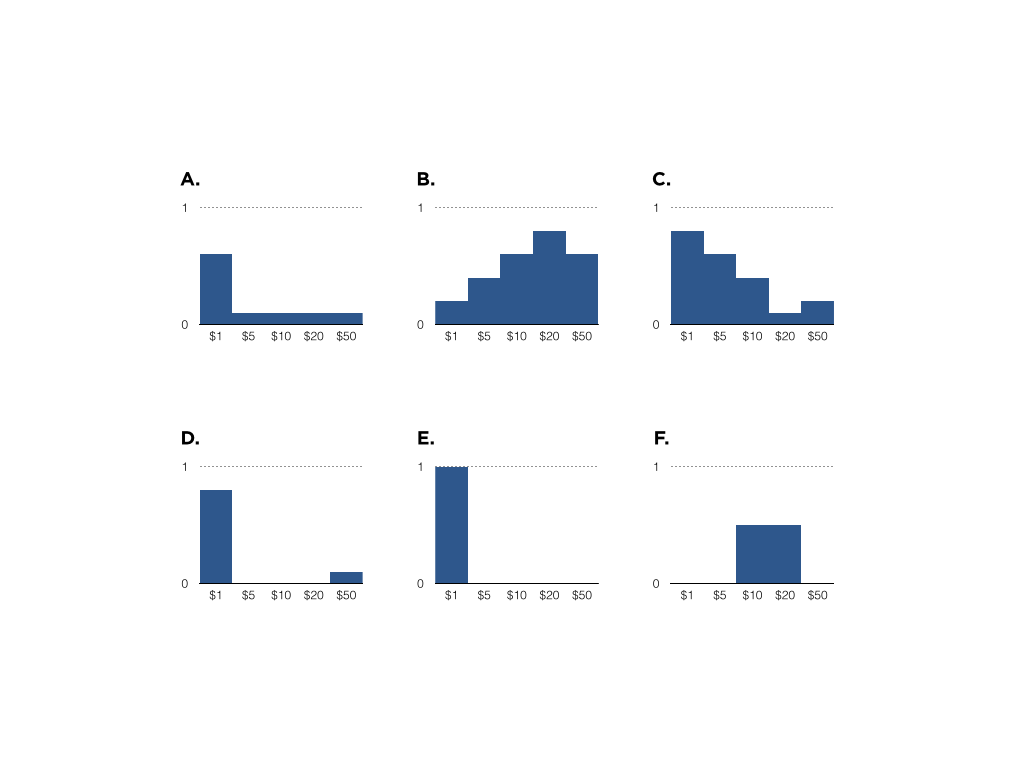
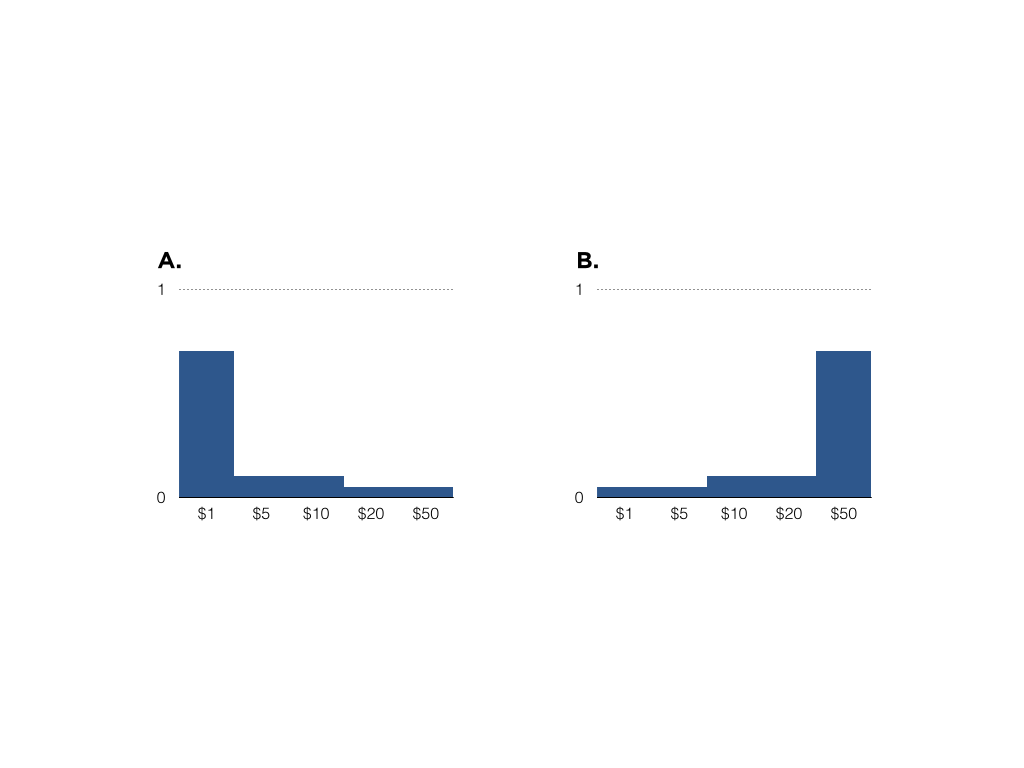
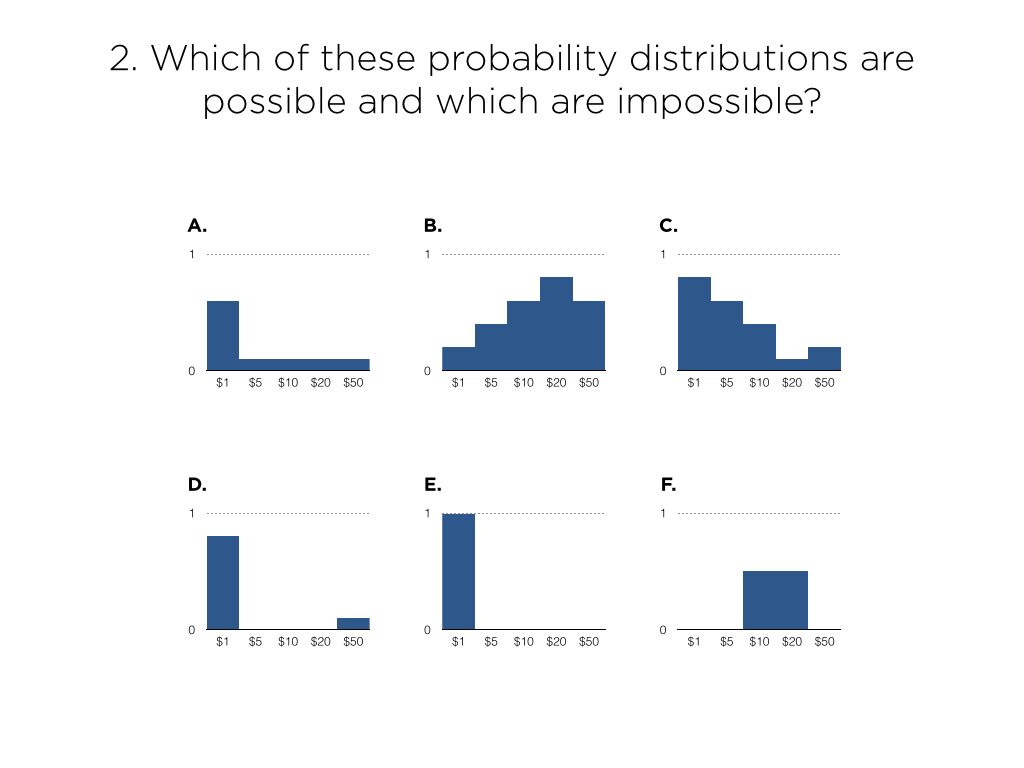
  2. We’re going to show more contrasting cases. (See: Schwartz, 2011.) Impossible cases and possible cases. We’ll ask them which are impossible and why. Then we’ll tell them which are impossible and why. (A: The probabilities have to add up to 1. Each rectangle here has to stack up and reach exactly the 1 line.)
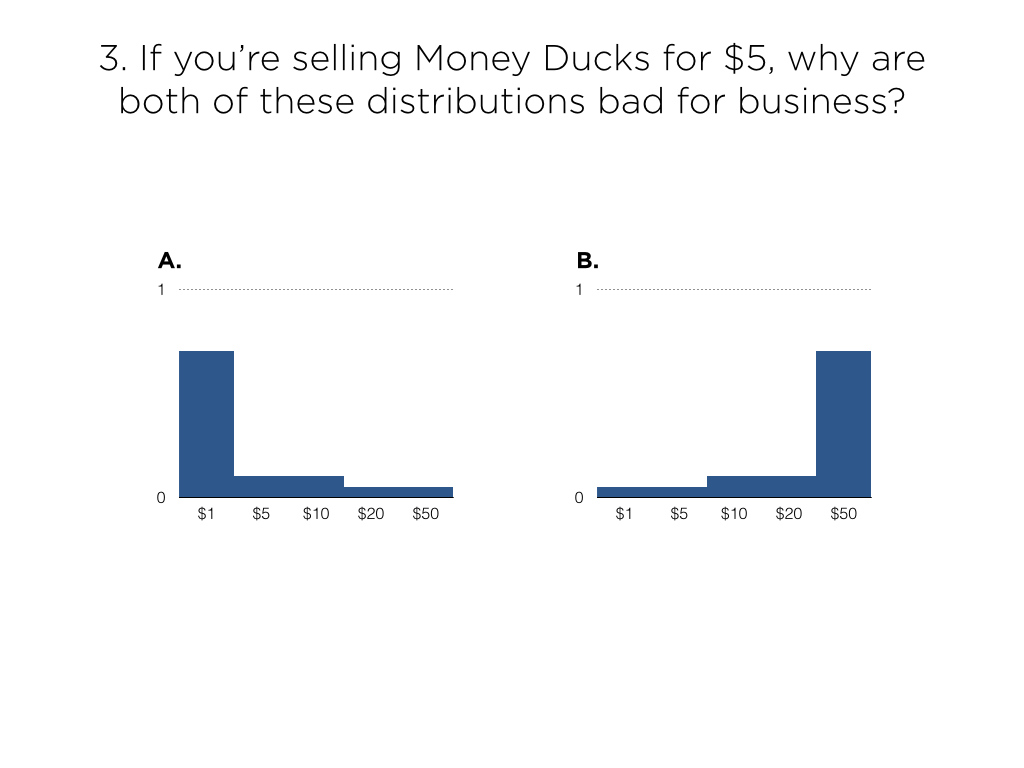
  3. Now we’ll ask the students, “If you’re selling the Money Ducks for $5, why is each of these distributions bad for business.” (A: The first distribution means word gets out that you’re cheaping your customers and eventually no one will buy your ducks. The second distribution means you’re losing loads of money.)
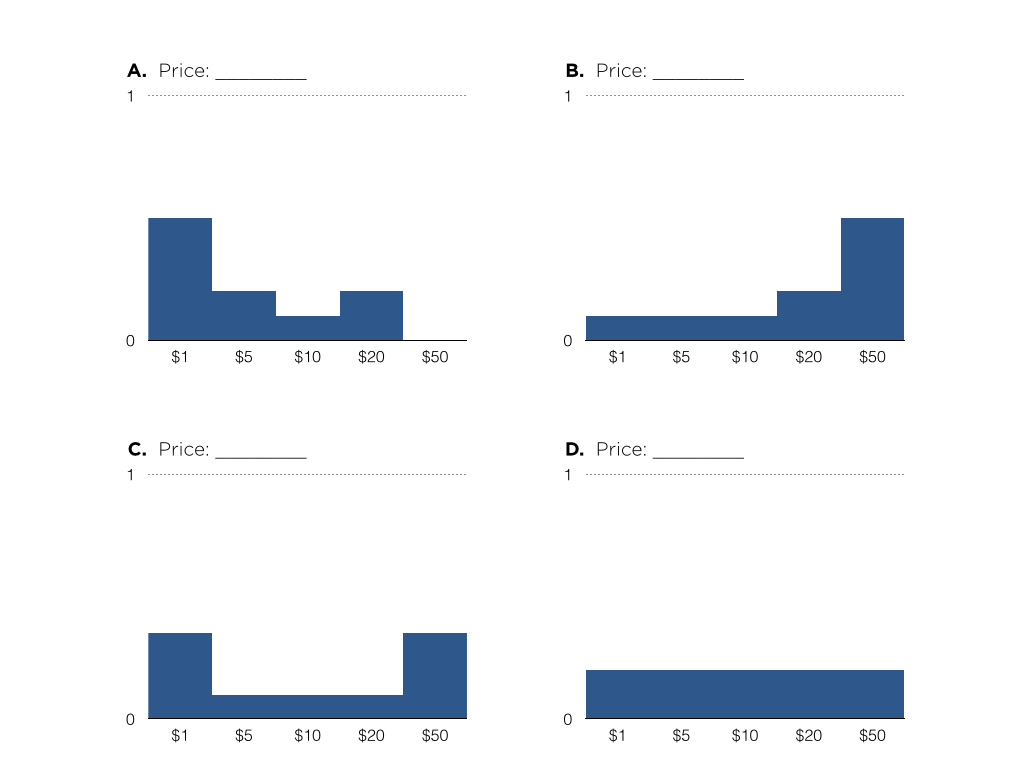
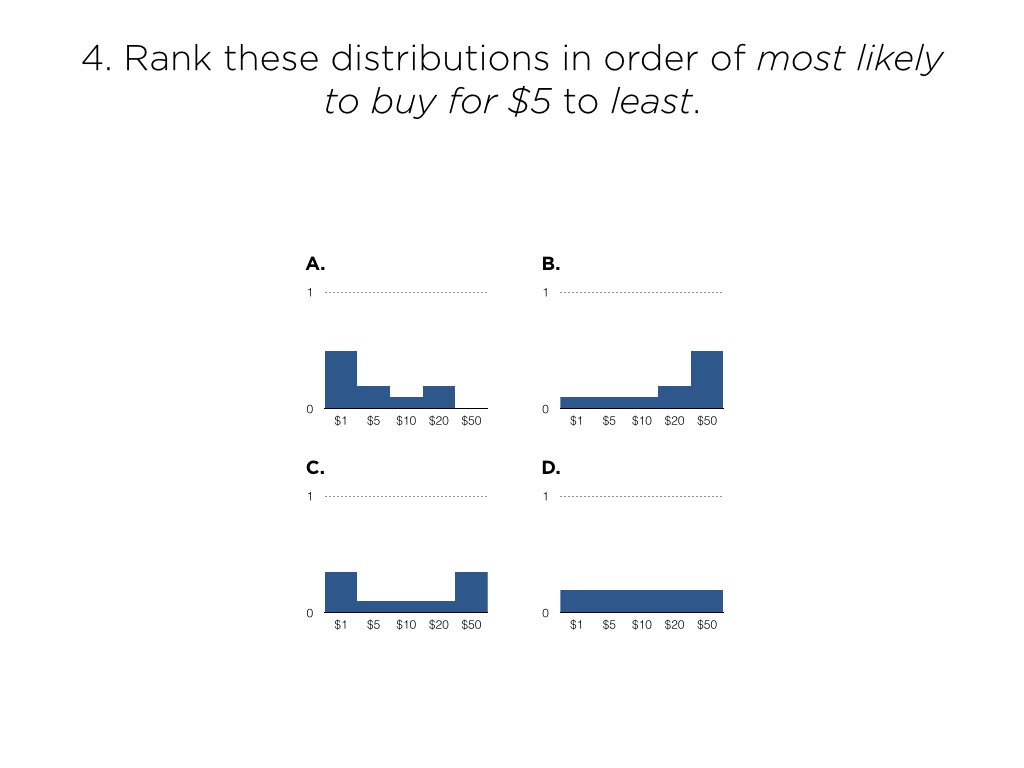
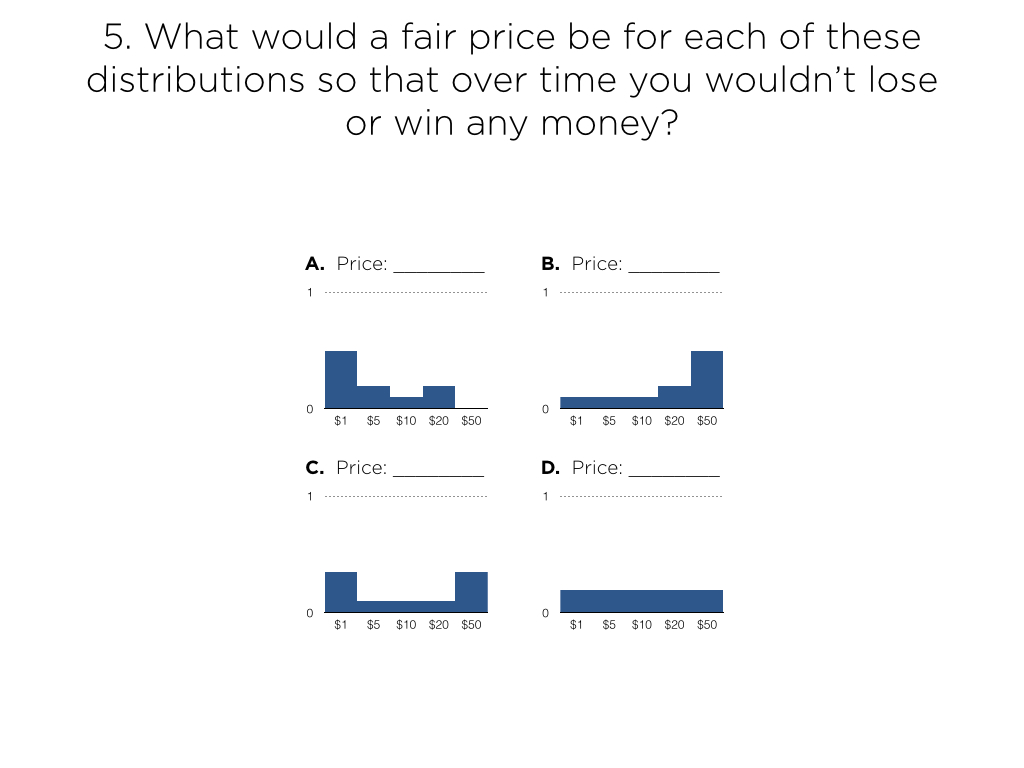
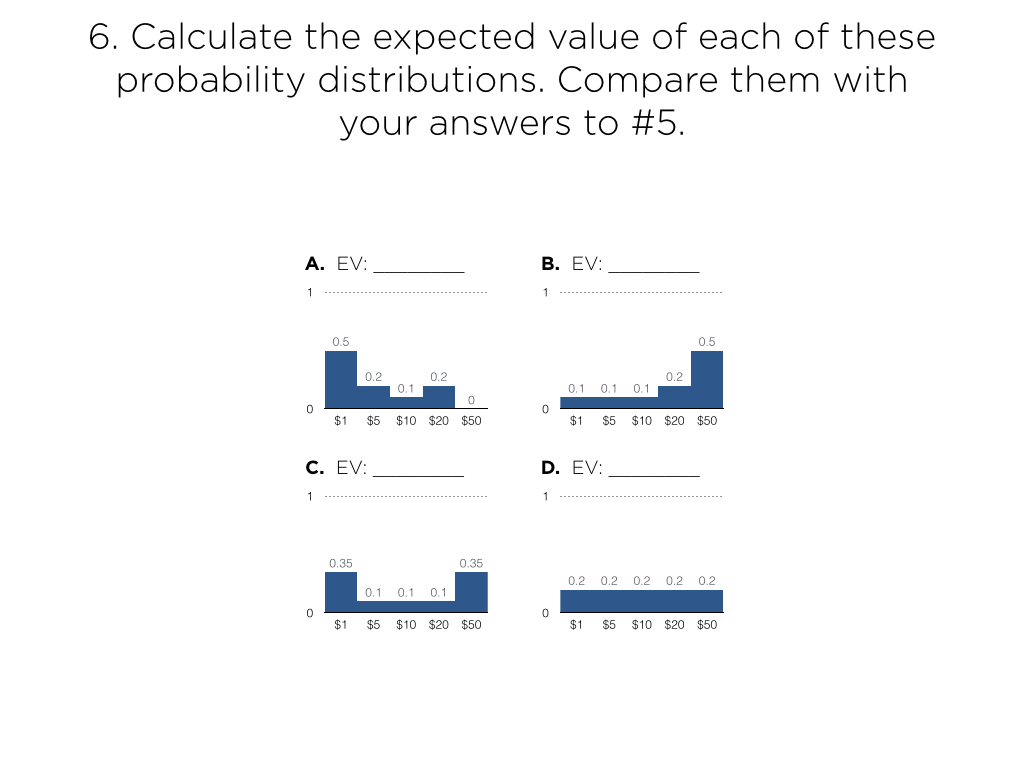
  4. Show the students four distributions and ask them to make up a price for the distributions that would be fair to both buyer and seller, that wouldn’t result in money lost or gained.

After laying all this informal groundwork, we’re ready to transition from qualitative descriptions to numerical and define expected value.

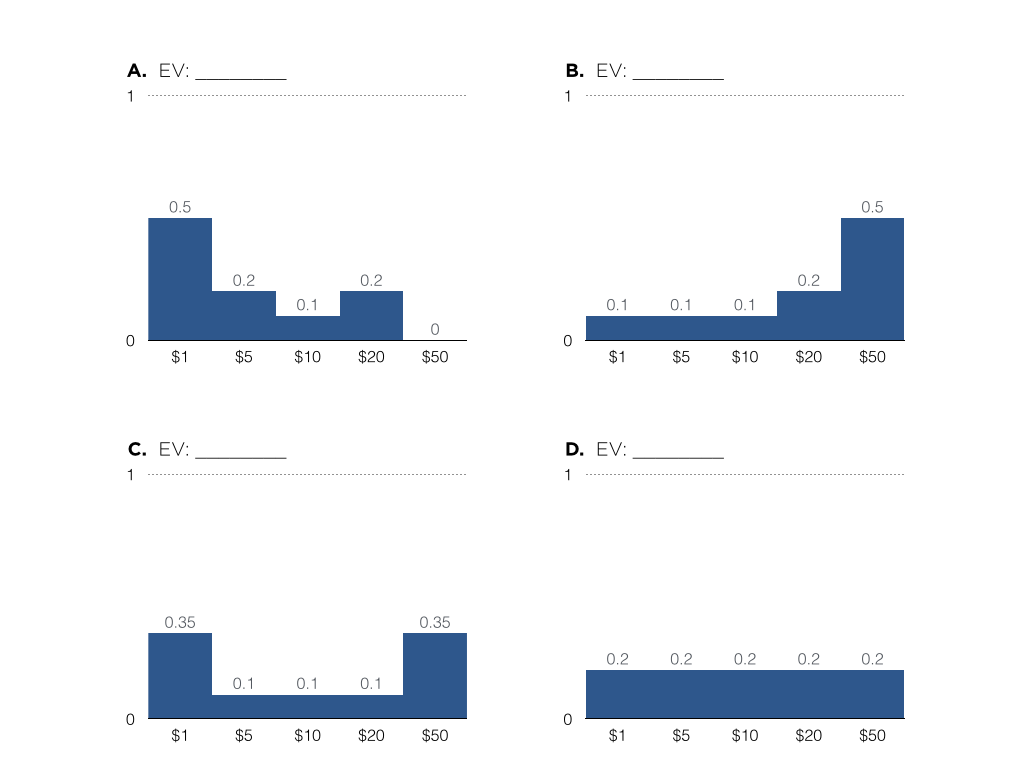
  1. We ask them to calculate the expected value of the distributions from #4 and compare those values to their prices. If their intuitions were sound and their calculations correct, their intuition will support the validity of the expected value model.

Act Three

There’s no act three here. We don’t know the probability distribution of the Money Duck (I asked) so we can’t validate. That’s okay.

Sequel

Let’s show the students the actual price of the Money Duck and ask them to determine a probability distribution that would give them a $3 profit per Money Duck as a seller. Answers, happily, can vary.

BTW. The bummer-world version of this problem reads like this:

A carnival game is played as follows: You pay $2 to draw a card from an ordinary deck of 52 playing cards. If you draw an ace, you win $5. You win $3 if you draw a face card (Jack, Queen, King) and $10 if you draw the seven of spades. If you pick anything else, you lose your $2. On average, how much money can the operater expect to make per customer?

2014 May 12. You should definitely read Dan Anderson’s experience running this lesson with students.

2014 May 19. Also, Megan Schmidt had some interesting results with students particularly w/r/t the question, “Which distributions are impossible?”

[Confab] Money Duck

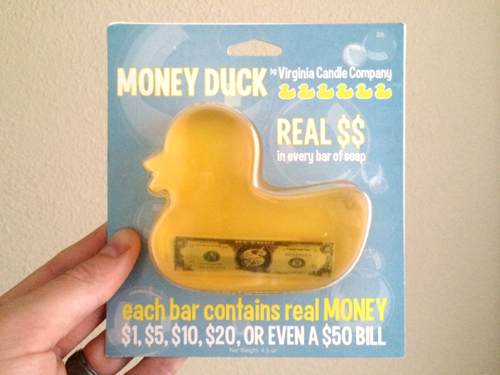
Confab time! Let’s make some magic here. This is a Money Duck. It’s soap.
140426_1

My sense is this is an object with a lot of potential for a math teacher. I’d like to know how you’d harness that potential.

A particular question I’m wrestling with is whether or not to put the student in the position of:

  • the buyer, asking “Is the Money Duck worth its price?”
  • the seller, asking “How should I price the Money Duck?”

Over the next few days I’ll update this post with comments I’ve solicited in advance from some of my favorite curriculum designers. I’d love to add your thoughts to the pile.

Featured Task Designers

Featured task designer Fawn Nguyen:

I’d be more interested in having students be sellers rather than buyers. Buyers’ incentives seem more qualitative: soap quality, residue, allergy, shape, smell.

Being sellers, students could do a lot with cost analysis given production constraints.

Possible task:

  1. Show the picture. It’d be cool to have time lapsed video of soap breaking down under a shower stream or, to not waste water, one could actually document soap usage over time.
  2. Ask students how much they’d be willing to buy it for.
  3. Decide on a central measure of their answers to use (mode or median?) or go with a small range of values. (I actually surveyed my algebra class: out of 36 kids, 13 said they’d be willing to pay between $4 and $6, while 15 were willing to pay $7 to $10 for a bar.)
  4. Students are now sellers of the soap. How much should they price it knowing what people are willing to pay?
  5. Give constraints: cost of raw material, time to make, number of workers, etc.
  6. If 5,000 bars were made, what is the distribution of the bills in them? What about 106 bars?

Featured task designer Robert Kaplinsky:

Thinking about it, I would position the student as the seller of the money duck for two main reasons. Ultimately, knowledge of the quantities of each denomination would be needed by both the seller and buyer. Unfortunately, the buyer would most likely never have access to that information (since I assume that it is not like a lottery where they divulge the odds of winning) and would have to guess whereas the seller could reasonably have that information.

In terms of determining the selling price:

  • The seller thinks: profit + cost of “real money” + production cost.
  • The buyer thinks: amount buyer would regularly pay for soap + amount of money buyer could win + amount buyer would pay for the novelty of having a money duck soap – minus whatever margin they are hoping to profit.

I think that the seller’s situation is much more manageable. We can have Act Two information to determine the profit and production cost. The math will come from determining the cost of the “real money.” As for the buyer, there are many assumptions that will not fall as conveniently into Act 2. There may be disagreement as to what a buyer would pay for soap, the novelty cost, and profit margins. Accordingly, I think it is much easier to do the seller situation.

Featured Comments

Bowen Kerins:

My favorite question here would be to set a price for the duck and ask the seller’s question, what distribution should I use for the bills? But only after the kids have determined that an equal distribution is profitable for the buyer.

Mr K:

My thought is that the kids will gravitate to the “Should I buy it” question, and the real learning comes from shifting them around to the sellers side of the problem.

Dan Anderson:

I’d set up many sets of two types of groups, producers (sellers) and consumers (buyers). The producers would determine what distribution of the bills (ha) go in the ducks and then set a price based on that info. They make up 20 “ducks” with their distribution. The consumers would go up to a producer and be given the odds of each type of bill and the price of the duck. It’d be up to them if they’d like to buy that groups ducks.

Jennifer Potier:

how about using the money duck to construct a survey. Survey students as to what odds (probability) of winning any prize would encourage them to muy multiple money ducks.

Kevin:

I presented the Money Duck to my grade 4/5 class this morning with the question: “What is the most that you would pay for a Money Duck bar of soap?” Group conversations were animated as was the class discussion.

Questions that students raised included: “How likely would it be for the package to have 10, 20 or 50 dollars?”, “Is the money planted in the middle of the soap? If so, would someone break the soap to get at the money?” [in which case the soap didn’t matter at all in the pricing] and “What is the quality of the soap?” [If it was a good quality soap many were willing to pay more]. Some students started taking the seller’s point of view and gave ideas how they could increase profits.

The discussion lasted nearly half an hour. Incidentally, the average price the students were willing to pay was $5. (Figuring that the soap itself was worth 3 or 4 dollars, and then factoring in the minimum prize of 1 dollar).

Clearly this idea has potential at multiple grade levels.

Katy Engle:

How many money ducks would I have to buy to be guaranteed to score at least one duck with a $50 bill inside?

Jason Dyer:

From what I’ve heard, nearly all of the ducks are $1 ducks. It’s like buying a lottery ticket – you expect to lose, but it can be fun for some people anyway.

Bit from an Amazon review of a different money soap:

“I used to work at a warehouse for online gag gifts until it went out of business I had four boxes of these prob 200 bars or so and never got more than a five.”

I think legally they only need to have one duck in the entire country that has a $50 in it to claim there could be a $50, so that’s likely your odds.

Task Proposal

First, show this video.

Ask students to tell their neighbor how much they’d be willing to pay for the Money Duck. Find the high and low in the class.

Now there are a series of questions I’d like students to confront, including:

  1. What is a probability distribution and how do we represent it?
  2. What does an impossible probability distribution look like? Why is it impossible?
  3. If you’re a seller, what kind of probability distribution is bad for business and why?
  4. Rank these distributions in order of “I’d definitely buy that for $5!” to “I definitely wouldn’t buy that for $5!”
  5. What would a fair price be for each of these distributions so that over time you wouldn’t lose or win any money?”

I’m trying to progressively formalize a) this new, strange representation of probability and b) the calculation of expected value.

The first two questions assist (a), basically asking “What is this thing?” and “What isn’t this thing?”

The next three questions assist (b), applying progressively more nuance to the concept of expected value. First, the concept is either/or. (“Who gets screwed?”) Then it becomes ordinal. (“Rank ’em.”) Then numerical. (“Put a price on ’em.”)

Kids will struggle at different moments in this sequence, but that’s okay because the purpose of the sequence isn’t that they discover the concept of expected value. The purpose of the sequence is to make make my eventual formal explanation of expected value much more comprehensible. (See Schwartz on contrasting cases.)

So explain how mathematicians calculate the expected value of a distribution. Now let’s go back and calculate the exact expected value of the distributions in #5.

Here are those questions and screens packaged as a Keynote slideshow (also PowerPoint, if you must) and as a handout.

Now let’s show them the answer, what the Virginia Candle Company actually charges for the Money Duck.

Now every student should create a distribution that results in some profit at this price over time.

Fin.

Follow on with practice and assessment.

What would you change, add, or subtract from this sequence?