Speaking To New Teachers At Their Graduation

I was invited to give a few remarks to some newly minted math teachers at San Francisco State University last night. I had two things to say.

Hi there. It’s nice to be here with you as you get kicked out of the nest. It’s an honor, in fact. I’ve met a few of you. Smart, thoughtful people each one. And it makes my decision to become a math educator seem smarter that you would make the same call. That’s real.

I’d like to say two things briefly about what happens next and then I’ll be done.

I’ll quote the first from someone I met a few weeks ago in New Orleans. He said to me, “Your first year teaching is about growing as a teacher, sure, but it’s mainly about getting to know yourself.” That’s wise. You go through life looking for mirrors. Literal mirrors at first and then figurative mirrors. Surfaces that reflect at different angles revealing more and more about your appearance and your character. At a certain point, a lot of us try to position those mirrors so that they reflect back only our best angles. The most valuable people in my life refuse to let me position them. My best friends notify me of my worst angles and refuse to accept them.

That’s what your students will do for you. They’ll reflect back at you the spot on your chin you missed with the razor. They’ll reflect back the parts of you that are insecure and afraid and small. Eventually all that reflection takes a kind of marvelous toll and you either decide that teaching kids isn’t any fun or you realize that you aren’t the spot on your chin. That isn’t who you are. And then your students start to reflect back generosity and humor you didn’t know you had. I hope you enjoy that. My first three years teaching were basically a bonus adolescence. I could tell you stories. But that’s number one. Enjoy learning about yourself. Enjoy self-study. Apart from whatever my teaching was doing for the kids I taught, teaching showed me the angles where I needed lots of work. It made a better person out of me

Here’s the second. It’s tempting to compare the job of teaching to other jobs you could have taken, jobs your college classmates took, jobs taken by the people you grew up with. I struggled with this for a long time. Friends of mine made more money working fewer hours and their profession wasn’t ever ripped a new one on national television. (Except for the ones who went into financial services. I dodged a bullet there.) Overall, that wore on me. I asked around about med school prereqs. I filled out an application for film school here at SFSU.

In case you ever feel the same way, here are two helpful ways to look at the job of teaching. The first is that you don’t have to worry, as many of my friends still do, that their jobs don’t really matter to anybody except the family they feed. You don’t have to worry that you’re insignificant to other people. You’re in the profession of developing humanity, one class at a time. That’s no small credit you get to claim. I can’t imagine how hard it would be to doubt your job’s value to humanity for thirty or forty years.

The other reason to love teaching when people try to convince you not to is that teaching has the best questions.

Me, I came to realize that past a certain baseline income, what I need most in my life are good questions. Questions that aren’t so small they crack easily. Questions that aren’t so big — like rising inequality or climate change — they put me in a fetal crouch. I need questions between those two. Questions at just the right size. Questions that crack after weeks and months not hours. Questions I can roll around in my head on long road trips or standing in line at the DMV or in some boring lecture. Lately I’m in the market for a ten-year question. Something that’ll take me through my thirties. I know I’ll find it in teaching.

See, there’s profit in answering a good question. The profit isn’t cash. The profit isn’t even answers. The profit is more questions. The best questions yield more questions once they’re answered. And teaching has all of them. For me, teaching has all the best questions. And most of them are timeless. Questions about human learning will endure even after questions about typesetting and carriage manufacture and driverless cars have expired.

You’ve signed onto a job that’ll yield the best version of yourself, one that offers you endlessly fascinating questions and the growing awareness that a lot of little people’s lives would be less without you.

I couldn’t be happier for you and I couldn’t be happier for myself that I get to count you all as colleagues.
Great Classroom Action

140422_1

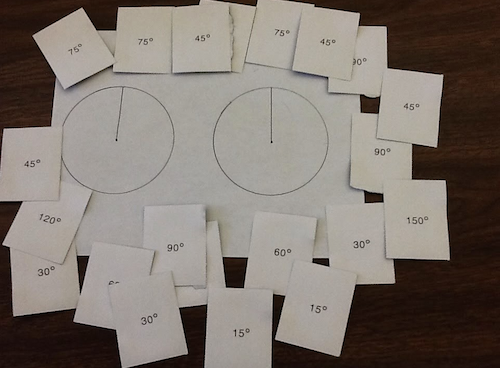
Joe Schwartz hosts a pie-eating contest:

The game consists of two circles (the pies) and a set of Angle Race cards. Partners take turns drawing a card and then using a protractor to measure off the right sized piece. Keep going until you’ve eaten your entire pie. Whoever finishes the pie first is the winner!

Joe improvises his lesson plan in two very interesting ways and he explains his thinking. That’s great blogging.

Matthew Jones gives us a nice picture of modeling in the elementary grades when he asks his students to help him put a new roof on the school gym:

Will any of them have to do this in the “real-world?” Who knows? Maybe, maybe not. But the pictures and slides set into motion a new enthusiasm about solving it because it was their school, it was their gym. It was something they know like the back of their hand. Maybe next time they’ll look up at the ceiling and remember how they figured out the area.

Kaleb Allinson and Sarah Hagan offer different but useful approaches to probability.

Here’s Sarah:

My students instantly wanted to play again. I had anticipated this, hence the double-sided bingo cards. Based on our first round of bingo, my students set out to create a better bingo card. One of my students decided to calculate the probability like I had. She accidentally left the BB combination off of her card. She was not happy about this!

And Kaleb:

I will have students make their own boards using geometric shapes that will convince someone to think they can win but that odds are still in the game owners favor. As an extension students can include winning different amounts of money depending on where you land so a player is more enticed to play.

Public Relations

I’m quoted this week in a piece by Vox’s Libby Nelson on the Common Core State Standards. This reminded me to empty out my collection of podcasts, vodcasts, and press clippings, for the benefit of my doting mother if nobody else.

Motion Math: Pizza!

I caught Motion Math’s latest game at their booth at NCTM. It’s pretty irresistible. Kids are in the pizza business. They get to name their pizzas whatever they want, create them with whatever ingredients they want, and sell them for whatever price they want. Then the game goes all Sim-like on the kid. Customers come in and start buying up pizzas. The student practices multiplication at the cash register. Eventually the day is done and the student tallies up her profit or loss.

The game builds in just enough market behavior to make it a fun introduction to running your own business but not so much market behavior you’re collecting W-9s from your employees or dealing with health inspectors. Customers get annoyed if you price your pizzas too high. You run out of pizzas if you price them too low. They request new ingredients, which you can go buy at the market.

It’s great math and great gameplay from one of my favorite game designers in math education. Highly recommended.

Featured Tweet

Featured Comment

Bowen Kerins:

This game is terrific, with plenty of variety and thoughtful math. There’s even work on unit rates available when a second vendor opens, and one is offering 20 sardines for $4 while the other offers 90 sardines for $20.

Waterline & Taking Textbooks Out Of Airplane Mode

tl;dr – This is about a new digital lesson I made with Christopher Danielson and our friends at Desmos. It’s called Waterline and its best feature is that it shares data from student to student rather than just from student to teacher. I’ll show you what I mean while simultaneously badgering publishers of digital textbooks. (As I do.)

Think about the stretches of time when your smartphone or tablet is in airplane mode.

Without any connection to the Internet, you can read articles you’ve saved but you can’t visit any links inside those articles. You can’t text your friends. You can’t share photos of cats wearing mittens or tweet your funny thoughts to anybody.

In airplane mode, your phone is worth less. You paid for the wireless antenna in your tablet. Perhaps you’re paying for an extra data plan. Airplane mode shuts both of them down and dials the return on those investments down to zero.

Airplane mode sucks.

Most digital textbooks are in airplane mode:

  • Textbooks authored in Apple’s iBooks Author don’t send data from the student’s iPad anywhere else. Not to her teacher and not to other students.
  • HMH Fuse includes some basic student response functionality, sending data from the student to the teacher, but not between students.
  • In the Los Angeles Unified iPad rollout, administrators were surprised to find that “300 students at three high schools almost immediately removed security filters so they could freely browse the Internet.” Well of course they did. Airplane mode sucks.

The prize I’m chasing is curriculum where students share with other students, where I see your thoughts and you see mine and we both become smarter and life becomes more interesting because of that interaction. That’s how the rest of the Internet works because the Internet is out of airplane mode.

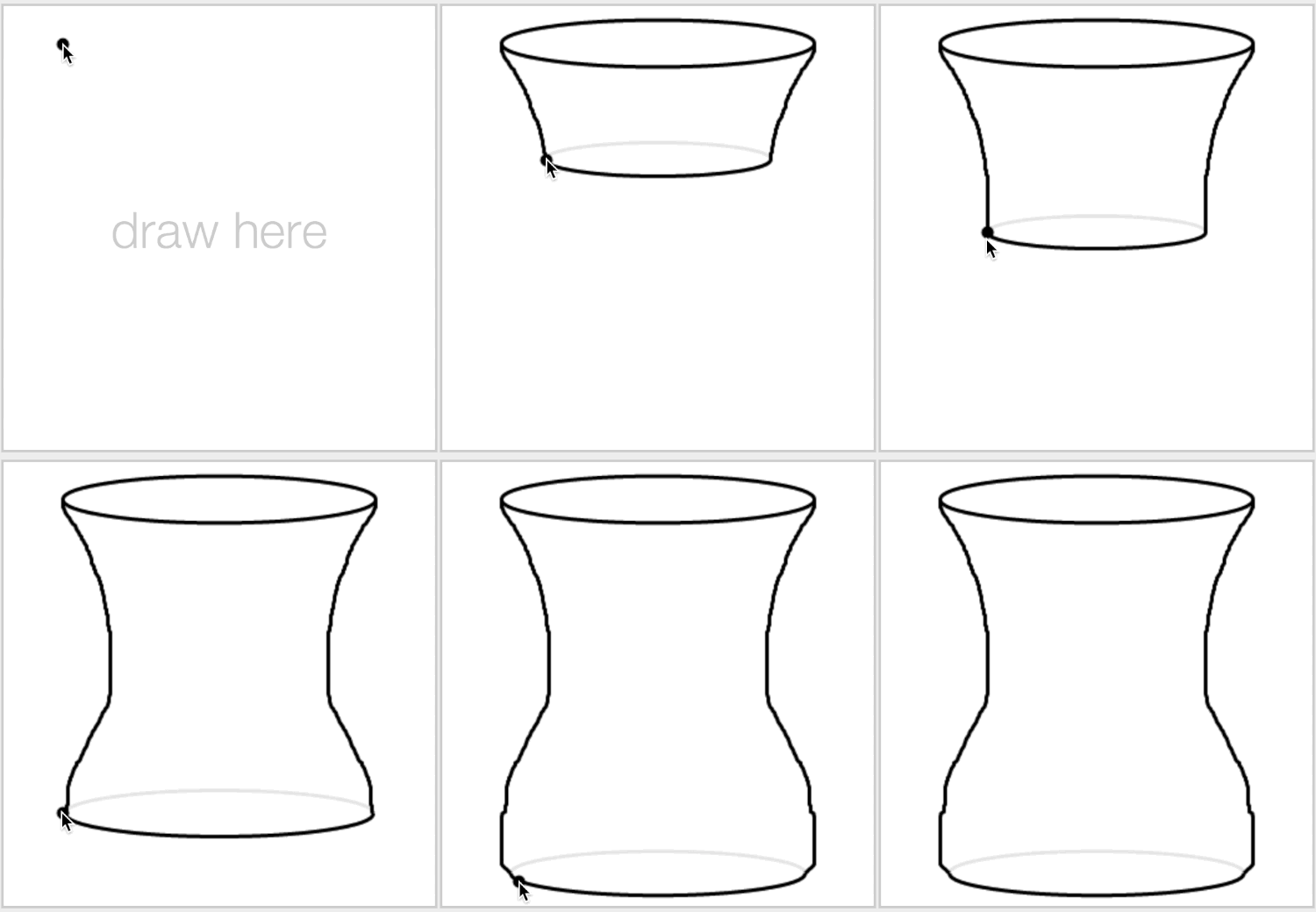
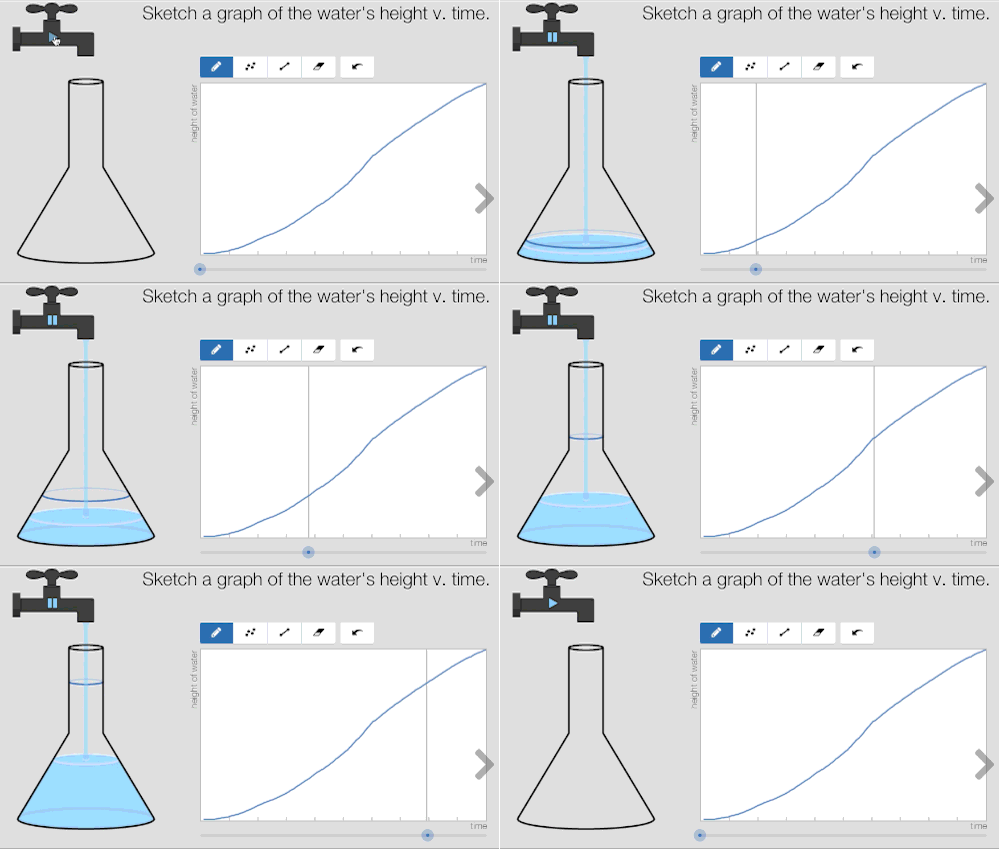
Here’s one example. In Waterline we ask students first to draw the height of the water in a glass against time. We echo their graph back to them in the same way we did in Function Carnival.

140416_1

But then we ask the students to create their own glass.

140416_2

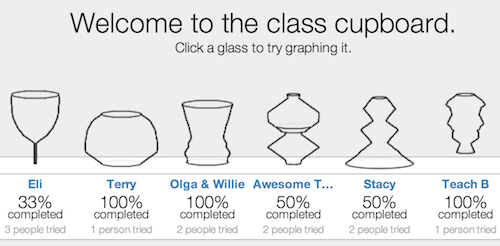
Once they successfully draw the graph of their own glass, they get to put it in the class cupboard.

140416_3

Now they see their glass in a cupboard right alongside glasses invented by their friends. They can click on those new glasses and graph them. The teacher sees all of this from her dashboard. Everyone can see which glasses are harder to graph and which are easier, setting up a useful conversation later about why.

We piloted this lesson in a local school and asked them what their favorite part of the lesson was. This creating and sharing feature was the consensus winner.

A selection:

  • Making my own because it was my own.
  • Trying to create your own glass because you can make it into any size you want.
  • Designing my own glass because I was able to experiment and see how different shapes of the glass affects how fast the glass filled up.
  • My favorite part of the activity was making my own glass and making my other peers and try and estimate my glass.
  • My favorite part of the activity was solving other people’s glasses because some were weird shapes and I wanted to challenge myself.

Jere Confrey claimed in her NCSM session that “students are our most underutilized resource in schools.” I’d like to know exactly what she meant by that very tweetable quotation, but I think I see it in the student who said, “I also liked trying out other’s glasses because we could see other’s glasses and see how other people solved the problem.”

I know we aren’t suffering from too many interactions like that in our digital curricula. They’re hard to create and they’re hard to find. I also know we won’t get more of them until teachers and administrators like you ask publishers more often to take their textbooks out of airplane mode.