Year: 2013

Total 117 Posts

Teacher Data Dashboards Are Hard, Pt. 1

Posted without comment. (Comments tomorrow.)

A study published earlier this year on teacher data dashboards, summarized by Matthew Di Carlo:

Teachers in these meetings were quite candid in expressing their opinions about and experiences with Dashboard. One factor that arose with relative frequency was an expressed concern that the Benchmark tests lacked some validity because they often tested material the teachers had yet to cover in class. A second factor that was supported across the focus group discussions was a perceived lack of instructional time to act on information a teacher might gain from Dashboard data. In particular, teachers expressed frustration with the lack of time to re-teach topics and concepts to students that had been identified on Dashboard as in need of re-teaching. A third concern was a lack of training in how to use Dashboard effectively and efficiently. A fourth common barrier to Dashboard use cited by teachers was a lack of time for Dashboard-related data analysis.

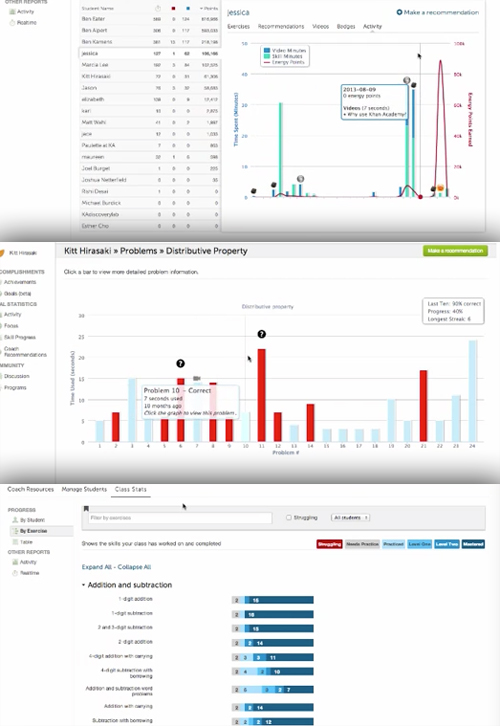
Khan Academy intern Josh Netterfield, in June 2013, on Khan Academy’s coach reports:

Currently over 70,000 teachers actively use KA in their classrooms, but few actually use coach reports. Already we’ve seen how the right kind of insights can transform classrooms, but some of the data has historically been quite difficult to navigate.

Stanford d.school’s 2011 analysis of Khan Academy [pdf]:

Generally speaking, the student data available on the Khan dashboard was impressive, but it also was challenging at times for the teacher to figure out how best to synthesize and use all the data — a key future needed if teachers are to maximize the potential of blended learning

Screenshots from a video of Khan Academy’s recent redesign of their coach reports:
130906_2

2013 Sep 12. Part two.

Dead On

Karen Head, on her “First-Year Composition 2.0” MOOC:

Too often we found our pedagogical choices hindered by the course-delivery platform we were required to use, when we felt that the platform should serve the pedagogical requirements. Too many decisions about platform functionality seem to be arbitrary, or made by people who may be excellent programmers but, I suspect, have never been teachers.

Related: What Silicon Valley Gets Wrong About Math Education Again And Again

[via Jonathan Rees]

2013 Sep 18. Karen Head comments:

Just to remind everyone of the context of my statement. We asked that certain parameters in the coding be changed (like the one governing how much we could penalize students for not doing an assignment) and were given the answer that the penalty number was “hard coded” into the program. The tech support person couldn’t understand why it was a big deal to us. To be fair, I couldn’t be made to understand why it was a big deal to change the parameter from a fixed number of 20 to a range of 0-100, but I seem to remember from my basic undergrad programming class that it isn’t a big deal to do this. Of course, in the end, I’m just an English teacher. :-)

[QOTD] Hans Freudenthal’s “Major Problems Of Math Education”

The tenth of Hans Freudenthal’s “Major Problems Of Mathematics Education“:

I am obliged to say something about calculators and computers. You would protest if I did not. I could refuse because I can prove I am incompetent. I know almost nothing about calculators and computers. It is a lack of knowledge that prevents me from tackling any minor problem of calculators and computers in mathematics education. It does not prevent me from indicating what in my view is a major problem.

Technology influences education. The ballpoint, Xerox, and the overhead projector have fundamentally changed instruction. But this is as it were unintentionally educational technology. Programmed instruction, teaching machines, language laboratories, which were intentional educational technology, founded on big theory, did not fare as well, to say the least of it.

Calculators are being used at school, and they will be used even more in the future. Computer science is taught and will be taught even more. How to do it – these are minor questions. Computer assisted instruction has still a long way to go even in the few cases where it looks feasible.

What I seek is neither calculators and computers as educational technology nor as technological education but as a powerful tool to arouse and increase mathematical understanding.

Thirty years ago.

New Orleans Workshop Offered April 9, 2014

April 9 is the day between the 2014 NCSM and NCTM conferences. If you’re the sort of group that’d like to do some professional development work around the Common Core’s modeling practice, I’m the sort of guy who’s offering that PD. At a discount, too, since I’ll already be in the New Orleans area. Please drop me a quick note at dan@mrmeyer.com