Category: information design

Total 51 Posts

Information Design: Syllabus

Course Description

Students will learn to take the data barrage and test it against the visual canon โ€“ graphs, bars, pies, stacks, and lines. They’ll invent their own visuals, improvising on the classics to deliver information and self-expression in the same package. They’ll visualize data so well and so often that by the end of the course they’ll wear glasses they can’t feel and which others can’t see, glasses of the strongest possible prescription, ones which make truth and untruth so obvious they’ll have to share it.

Illustrative Anecdote

Imagine an unparsed spreadsheet of effectively infinite length. One million monkeys with one million typewriters drinking one million triple-shot lattes couldn’t make this happen in their lifetimes. It’s the FAA’s tracking data on every flight arriving in and departing from the U.S.
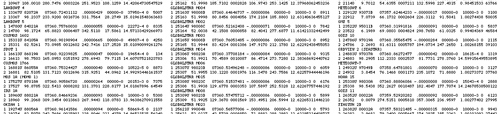
Yet force it through just the right visual sieve and patterns emerge. Within the patterns, something true.

Illustrative Quote

Demand for nonroutine analytic skills has increased sharply.

Levy and Murnane’s The New Division of Labor.

Assignment List

Suggested Reading

It’s something new everyday. Some of these have made already the rounds:

Required Reading

The information designers listed under Suggested Reading do sturdy, innovative work within the present canon of information design. Most take pie charts, Venn diagrams, or dot plots and spin them into something fresh. That’s our first semester benchmark: sturdy work within time-tested forms.

But there’s only one model for where we’re going, only one info designer who communicates and quantifies his personal obsessions through clear, unique design. It ain’t Tufte with his Sparklines. It ain’t Sagmeister neither.

Who Is Andrew Kuo?

I can’t imagine how many wrong turns it’d take for someone from the edubloc to find herself in Andrew Kuo’s neighborhood. He’s a degenerate, a gentleman, a music critic, and a design savant who casts off some of the ‘net’s freshest design work on his generic-themed Blogger blog (ranked somewhere in the 100,000 range) like it’s nothing big.

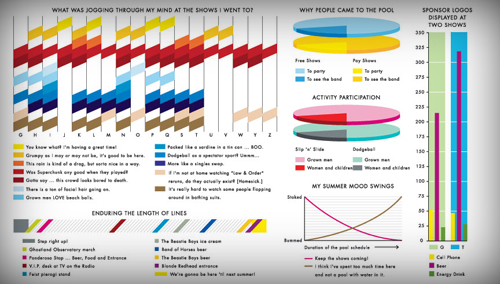
For example, his review of New York’s McCarren Park Pool Music Concert and its accompanying, dizzying infographic:
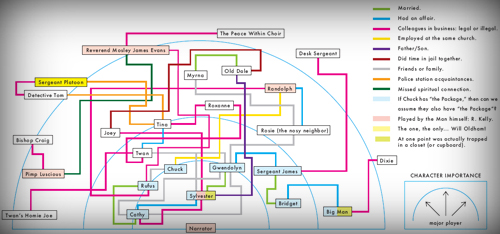
Or consider his character mapping of R. Kelly’s Trapped in the Closet opus, which lives outside the realm of recognizable infographics, but which imposes a preposterous sum of information onto a two-dimensional JPEG:
My students and I will pack lanterns and dried food for a week and go on a spelunking field trip inside his head, seeking out the source of the funniest and most functional infographics the 21st century has seen to date.

The Final Exam

Andrew Kuo is the final exam: take your deeply personal preferences and make them deeply accessible to anyone.

Andrew Kuo is why students will love this course: Information Design is nothing apart from their passions, likes, and dislikes.

Which math class on your master schedule can claim that?
So Hold Onto Something

This Is Bad

I have eight of my favorite people at my place for the new year, twenty-two more on the way, two game consoles hooked into digital projectors, a bathtub with beer on ice, great weather, but I can’t get my mind out of the classroom.

The Preoccupation

Among the ages I teach, math has changed very little in the last quarter century and certainly at nowhere near the pace of technology or (more importantly) my kids’ creativity.

So for the last year I’ve been building a course from scratch, connecting a lot of loose, fun material, grafting it on the back of your standard Algebra 1 curriculum, infusing the whole thing with visuals from start to finish, and then personalizing it, setting expectations such that, by the end of the course, every student will have the same skill set but entirely different work portfolios depending on personality and preference.

Furthermore, the course lives in the intersection of English and Math. It depends as much on articulate self-reflection as it does on mathematical computation.

My White Whale

I haven’t met another math teacher as consumed by information design as I am, as convinced that it can invigorate a subject that most students find irrelevant, and maybe that’s because I’m the crazy one here, playing a lanky Captain Ahab to a white mathematical whale.

Who Is Nicholas Felton?

But I don’t think so and here, at the year’s end, a guy named Nicholas Felton has offered me the single piece of tape which fastens together hundreds of techniques and web links and my mind won’t. shut. down.

So it’s about to get Very Busy around here. I’ll soon post a loose-limbed course syllabus which will precede an explanation of Nicholas Felton’s enormous (and most likely oblivious) contribution to math education which will precede our winter design contest, which will be at least as fun as the last one and certainly more challenging.

In all of these, your participation is requested.

Are you hot or not?

Back in college I lived in a townhouse with seven other guys. We had a house website with bio pages for the eight of us, head shots, etcWhich I can’t believe is still alive on the Internet.. We feuded with another house of guys across town, driving over at any idle hour just to turn off their power, toss a few hundred uncooked tortillas on their lawn, etc, the usual. You probably heard about us.

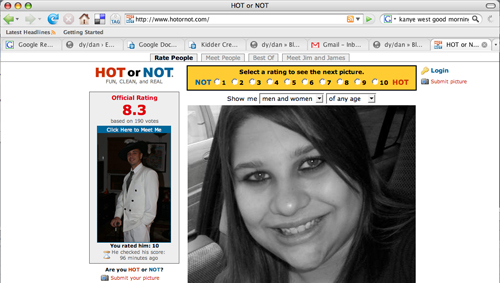
One day we threw all our headshots into some morphing software and got a snapshot of what our composite roommate would look like. We threw him onto a website called Hot Or Not where vanity- and charity-cases alike upload photos for others to rank on a ten-point scale. “We” pulled an eight and partied continuously for several weeks.

Until last week, I had no idea Hot Or Not was still around. It is and has drawn the attention of researchers from Columbia, Carnegie Mellon, and M.I.T. All these people feeding quantifiable preferences into Hot or Not’s servers, millions on the month, constitutes an ideal data set. Another apparent data set is Hot Or Not’s “Meet Me” service where you can meet someone but only if he or she wants to meet you also.

All that data and analysis, recently released, fascinated me for a 72-hour stretch last week. My job description, as I try to frame it these days, is to make some fraction of what excites me about life (and math, in particular) exciting to my kids. This one was difficult.

Mostly, it’s tough striking up a good conversation over questions which have already been answered. You’ve gotta tease them with clues without frustrating them, drifting just enough information past ’em without giving it all away.

Here’s how we built from nothing to something:

  • Discuss the question: “why do we date?” In my classes, answers ranged from the expected (someone’s fun to be around, cute, makes you feel happy) to the really expected (someone’s hot, horny, fertile, has money).
  • Focus for a bit on the “fertile” answer and how making babies is a biological imperative for every species.
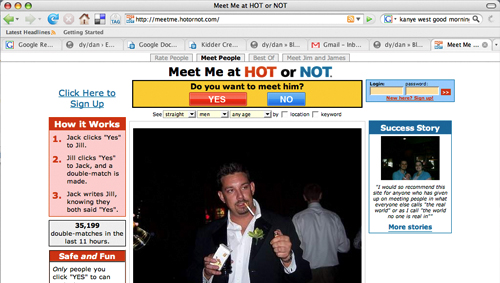
  • Introduce hotornot.com. These people upload photos of themselves, you rank one, another photo appears, and then it’s three hours later.
  • Ask: “Who do you think hands out more ‘hot’ ratings? Guys or girls?” In my classes, both genders selected themselves. (Which confounds me still. Anyone know why?) Turns out it’s guys by 240%. (Which seems like a lay-up to me, but there ya go.)
  • Introduce the MeetMe service. If you want to meet this guy here, you click “meet,” at which point your photo is sent to him and then if he wants to meet you, your e-mail addresses are exchanged, love is found, babies are made.
  • Ask: “Who do you think clicks the ‘meet’ button more? Guys or girls?” Guys again.
  • Ask: “Who do you think clicks the ‘meet’ button more? People with low ratings or high ratings?” Low. Turns out, for each ranking you slip (from a 6 to a 5, for example) you become 25% more likely to accept a date.
  • You assign the class a hotornot ranking. You arbitrarily assign ’em a 7, setting them up for what happens next.
  • You say, “How do you decide which invitations to accept? Do you accept a 3?” Everyone says no. “Do you accept a 6?” Some would only date their level and above. Others recognized that the rankings came from a community that didn’t, e.g., share their affinity for baldness, and would consider a 6.
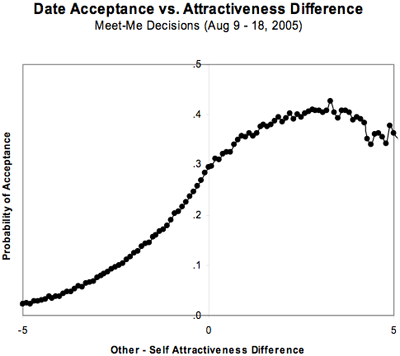
  • And finally, you show this chart-gem.
  • You talk about it. The x-axis is tricky. It’s the difference between you and the person asking you out. You point to the extreme left edge and say, “-5. How hot is that person?” Some will say “-5.” Others see that she’s a 2.
  • You gesture at the y-axis and say, “Is your probability of going out with this person low or high? Low. Obviously.
  • Ask: “What about this graph is expected?” You talk about how the graph rises, as you’d expect.
  • Ask: “What about this is unexpected?” And this is, of course, the kicker. Why does the graph take a dip at the end? Why would you decline to meet someone who was five ranks hotter than you? (Your thoughts are welcome in the comments.)

Total cost: ten minutes. In all, a really good way to kick off a period. If you’re feeling brave and you’ve got their trust, you can discuss the question, “how do 2’s find and maintain love?”

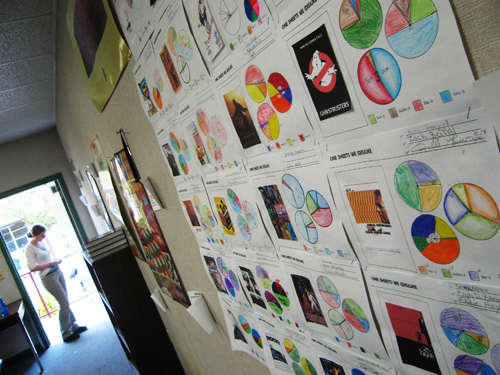
ID115: Pie Charts – Movie Posters

Similar to ID111 but with movie posters. Somewhere in between these two we practiced measuring and drawing angles.

I stressed that I wanted their reaction to the poster itself and not to the movie, which some students doubtlessly hadn’t seen.

I included two of my favorite one sheets. Reactions came back mixed and I lamented silently how NCLB has looted artistic appreciation in our nation’s public school for corporate fun and profit.

Fun questions to ask (again):

  1. Who loved the most one sheets?
  2. Who hated the most one sheets?
  3. Whose one sheet was the most hated?
  4. Whose one sheet was the most liked?

One Sheet Analysis Template (student carries this from desk to desk)
Personal Pie Graph Template (student makes her personal pie graph on this)
One Sheet Analysis Template II (this stays with each one sheet for students to mark)
One Sheet Class Analysis Template (this follows the one sheet from class to class)
The One Sheets We Used (formatting is left as an exercise for the reader)
Student Protractors (print ’em out on overhead transparency)