Category: what can you do with this?

Total 99 Posts

What Can You Do With This: Glassware

[Updated here with my response.]

Click through to view embedded content.

Two things:

  1. It isn’t “what question can you ask?” but “what can the students do with it?” What is your lesson plan here?
  2. If Jason Dyer doesn’t come around to tell me I’m doing this wrong, I’ll be very surprised.

[high quality: photo, video]

[BTW: I updated the original image because josh g. is exactly right.]

What Can You Do With This: Other People

Kate Nowak: Demon Mathematics

Kate posted a clip which exposes the profits oil companies make by working the rules of rounding to their advantage. It’s mathematically engaging and relevant and well worth dropping into some dead air at the end of class.

But I don’t know what the kids do with it.

Mostly, it runs afoul of the rule of least power which, for our purposes, means the medium has to hint at a question while leaving several square miles of pasture open around it for student exploration. This guy, in contrast, lays out an explicit thesis and supports it completely, leaving little room for inquiry.

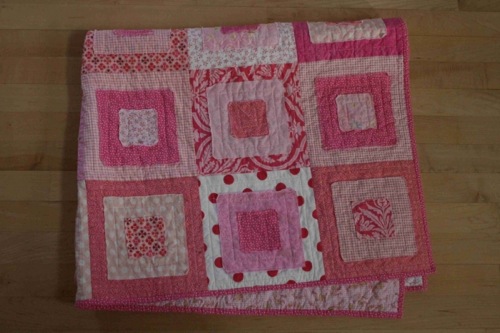
Denise Gaskins: Quiltometry

Your mileage will vary, obviously, with your class’ enthusiasm for quilting. I appreciate this, though, because it doesn’t just beg that wormy chestnut, “what shapes do you see here?”

Three notes:

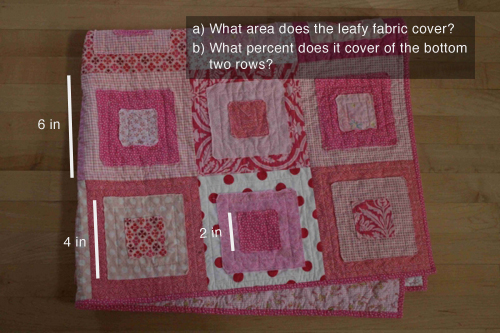
  1. Ask: “how many different kinds of fabric do you see in the bottom two rows?” a question which anyone, regardless of mathematical ability, can answer or guess at. (Similarly: the question “will the ball hit the can?” is a prelude to mathematical inquiry but isn’t, itself, strictly mathematical.)
  2. Then ask: “how much of each kind of fabric do you need to quilt the bottom two rows?” a question which is unanswerable without more information. This begs the very, very valuable student inquiry, “what information do I need here?” and the very, very cool lazy-student follow-up “what is the least amount information I can get away with knowing here?” ¶ From there you can go lots of fun places, some of which might involve the practicality of purchasing fabric in one-yard increments with a fifty-four-inch bolt width, something I would know absolutely nothing about.
  3. Textbooks ruin these problems:

    Be less helpful, etc.

[photo credit]

Flight Control / Lesson Plan

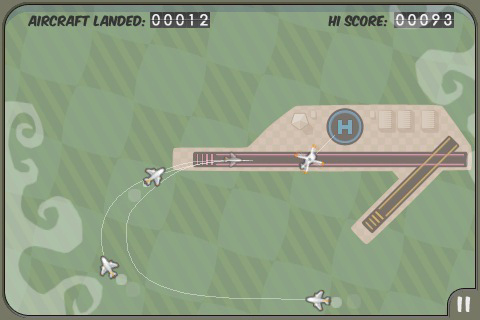
I love the iPhone game Flight Control for all the reasons I love a good lesson plan.

  1. It builds from a simple, visceral premise. “Land the planes. Don’t let any collide.” ¶ Which packs the same clear punch as “what is the combination?
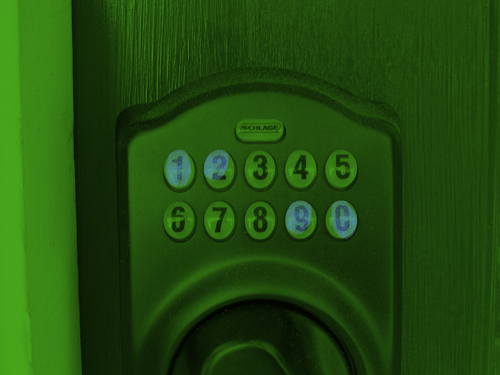
  2. Harder, differentiated challenges arise naturally from that premise. Which is to say, as you get better at the game, it doesn’t just double the speed of the planes or throw up concrete clouds or reverse the controls. It introduces different planes into the airspace, planes which move slightly faster. ¶ In the same way, a good lesson plan doesn’t adapt itself to faster learners by doubling the length of the same problem set or imposing artificial constraints like, “what if one of the buttons was broken?” It tells the learner, “okay, we dusted the lock for prints and found out that these four numbers get pressed a lot. What can you do with this?”
  3. Those new challenges necessitate new skills. In its early stages, Flight Control accommodates a player’s sloppiness but when you have three 757s approaching the landing strip and three helicopters holding in a pattern you have to keep your approaches extremely tight. ¶ The combination lock forces the need for permutations.
  4. Those new skills are assessed simply and clearly. A lesser game would assign separate point values for larger planes or include bonus multipliers. Flight Control assesses your skill along one simple metric: “How many planes have you landed?” ¶ After all the calculations in “Will it hit the can?” the assessment was simply “Were you right?”

Not every game or lesson can accommodate this aesthetic. Nor do I expect them to. But these are my favorite. These are my students’ favorite. And they are too few and far between. We need more.

My Lesson Plan: The Door Lock

Michael Caratenuto:

Personally, I think that this particular image lacks opportunities for inquiry. Perhaps if it was presented with other kinds of door locks leading students to come up with and answer the question, โ€œwhich is the most secure lock?โ€ [emph. added]

This is exactly right. The latest WCYDWT? installment has provoked the usual litany of Really Interesting Bite-Sized Questions, the sort of prompts that will play great in the Applications & Extensions & Assorted Mindblowers section of your lesson plan but which, on their own, aren’t a lesson plan. Those questions don’t provoke the kind of iterated, increasingly difficult practice that students need for skill development.

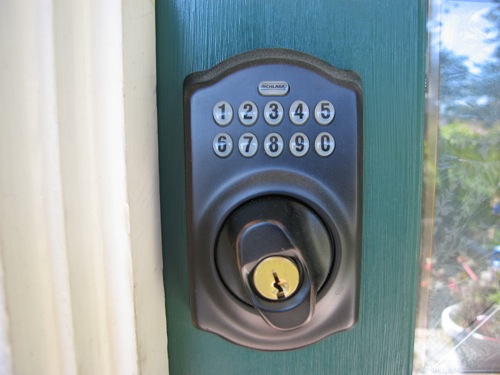
Again, this image on its own is insufficient. With some creative modifications, however, it will carry you through permutations. Here is that lesson plan in its broadest strokes.

Start with the image.

Tell them the code is 1 digit long. Tell them the code is 2 digits long. Tell them it’s as long you want it to be. I respected the rule of least power here, which meant that when I took this photo I tried to stay out of the way of your lesson planning. Have them write down all the possible codes for n=1, n=2, n=3, etc. The increasing obnoxiousness of the task will motivate a formula for the general case. That’s arrangements.

Tell them the lock is a 4-digit lock. Now turn on the blue light.

Ask them to list the possible codes. You can iterate this a bunch of times until they have discovered on their own this tool that mathematicians call a factorial.

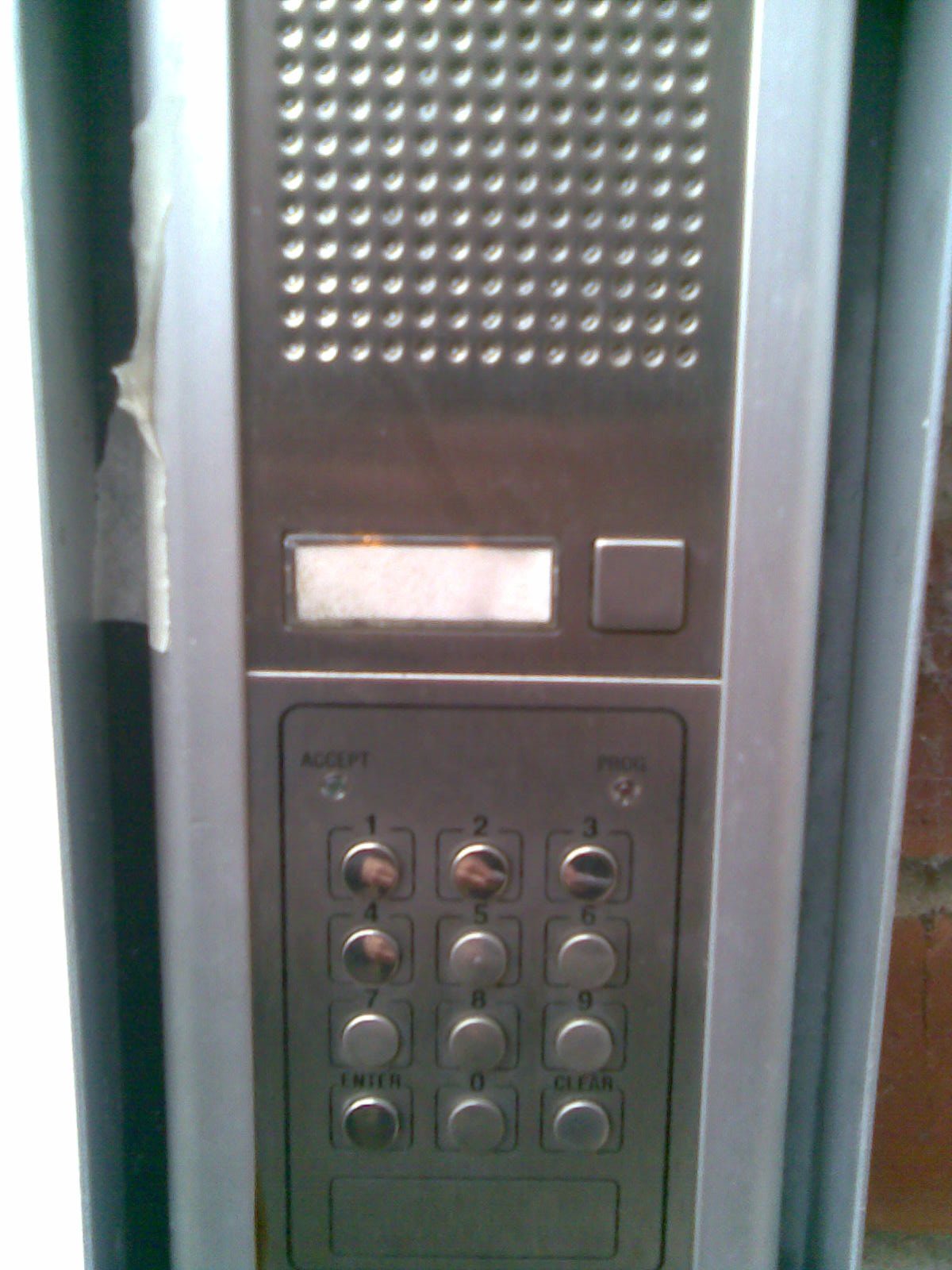
Remind them it’s a 4-digit lock. Then put up this image. It will be confusing, but only for a second. Ask them to list every possible code.

Iterate this with two and three buttons until they have generalized permutations. Then maybe you iterate the entire thing with another keypad lock.

Then maybe you dip into the comments of the original WCYDWT? post and help yourself to some very-interesting follow-up questions. I recommend Alex’s.

Let me close by saying how shocked I am at how little all of this costs.

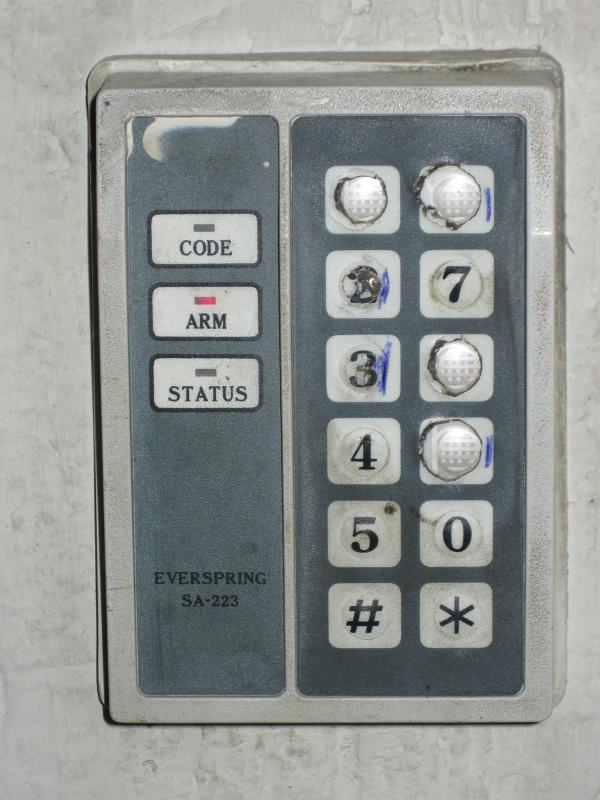
[Update: Bruce Schneier has a good follow-up on information leakage. Two photos.]

[Update II: due to the peculiarities of many car door locks punching in “123456” tests both “12345” and “23456.” Consequently, there is a number string 3129 digits long that will test every five-number comination.]

[Update III: more information leakage.]

[Update IV: more information leakage.]

What Can You Do With This: The Door Lock

Download high quality here. Here’s the pilot but I need to modify the prompt somewhat. Every math teacher reading this likely sees the mathematical potential in this image. Most could come up with a question right now like, “If this is a four-number combination lock, then how many combinations will you have to try to break in?”

Lately in these threads I get lists of those questions, which is great, but questions don’t constitute a lesson plan. So consider this the new prompt: what is the lesson plan? what will the students do? what is the best plan to provoke sustained, rigorous inquiry?

Let’s push this forward.

BTW: My lesson plan.