Category: tech enthusiasm

Total 120 Posts

The Math I Learned After I Thought Had Already Learned Math

True story: it’s possible to fly through your own secondary math education — honor roll bumper sticker on your mom’s minivan and all — but miss some of the Very Big Ideas of secondary math.

For one example: in our last post on simplifying rational expressions, the process of turning a lengthy rational expression into a simpler one, Bill F writes:

Another benefit of evaluating both expressions for a set of values is to emphasize the equivalence of both expressions. Students lose the thread that simplifying creates equivalent expressions. All too often the process is seen as a bunch-of-math-steps-that-the-teacher-tells-us-to-do. When asked, “what did those steps accomplish?” blank stares are often seen.

Past a certain point, those operations are trivial. But it’s only past a point much farther in the distance that the understanding — these two rational expressions are equivalent — becomes trivial.

For another example: I left high school adept at graphing functions. I could complete the square and change forms easily. I knew how to identify the asymptotes, holes, and limiting behavior of those thorny rational expressions. But it wasn’t until I had graduated university math and was several years into teaching that I really, really understood that the graph is a picture of all the points that make the function true. This was difficult for me because graphs don’t often look like a bunch of points. They look like a line

That’s one reason I’m excited about the Desmos Activity Builder and this activity I made in it last week, Loco for Loci!

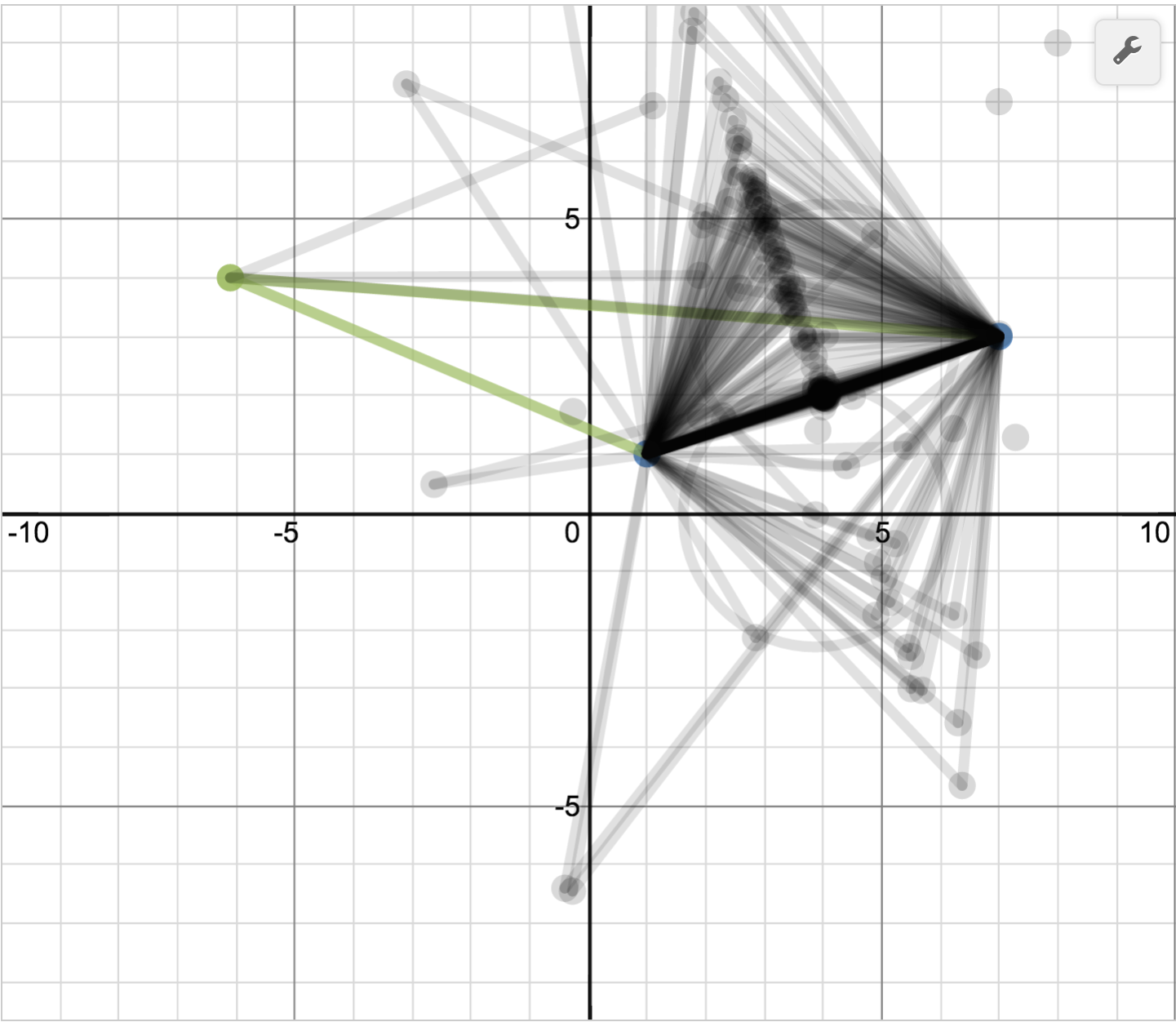
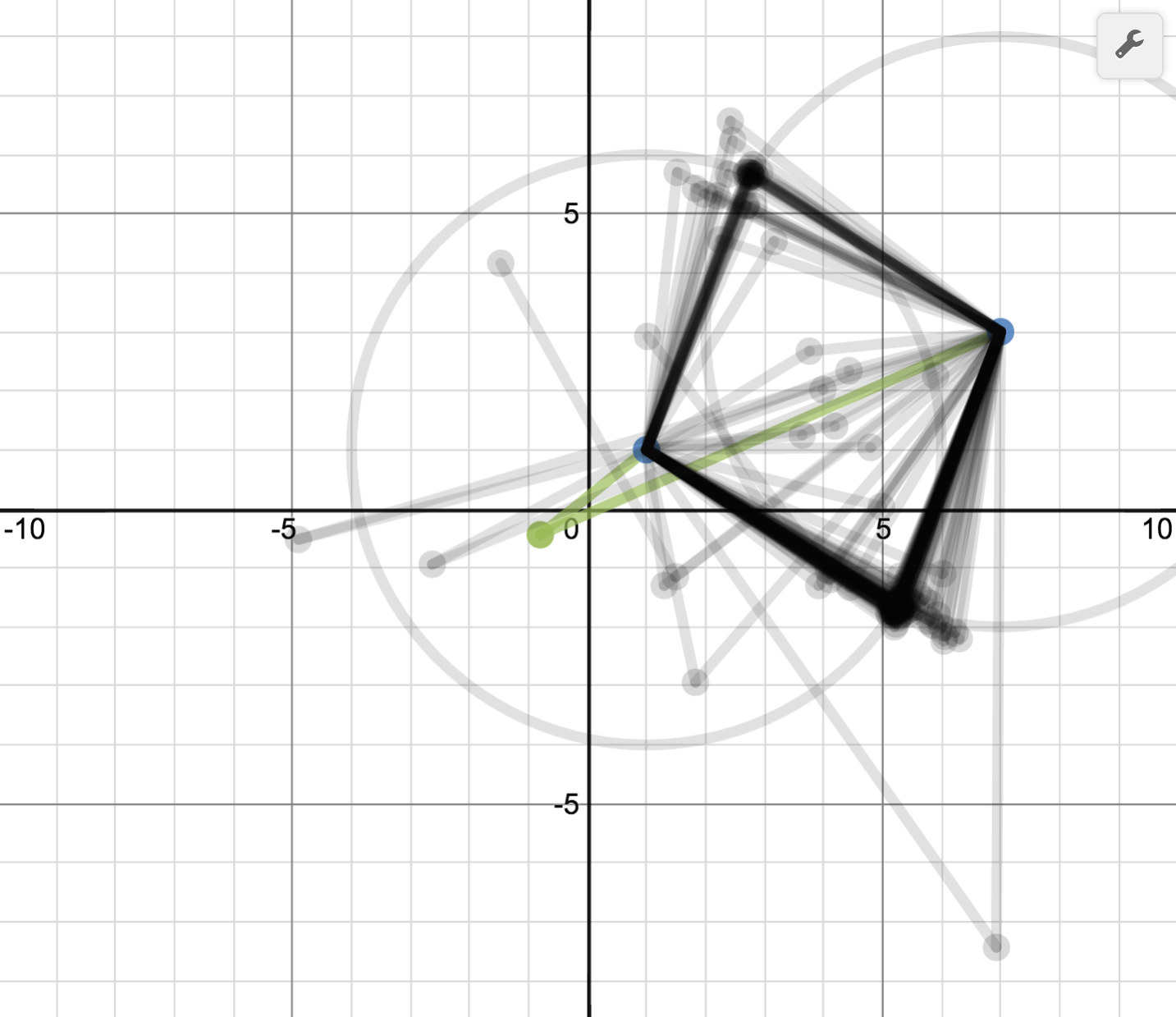
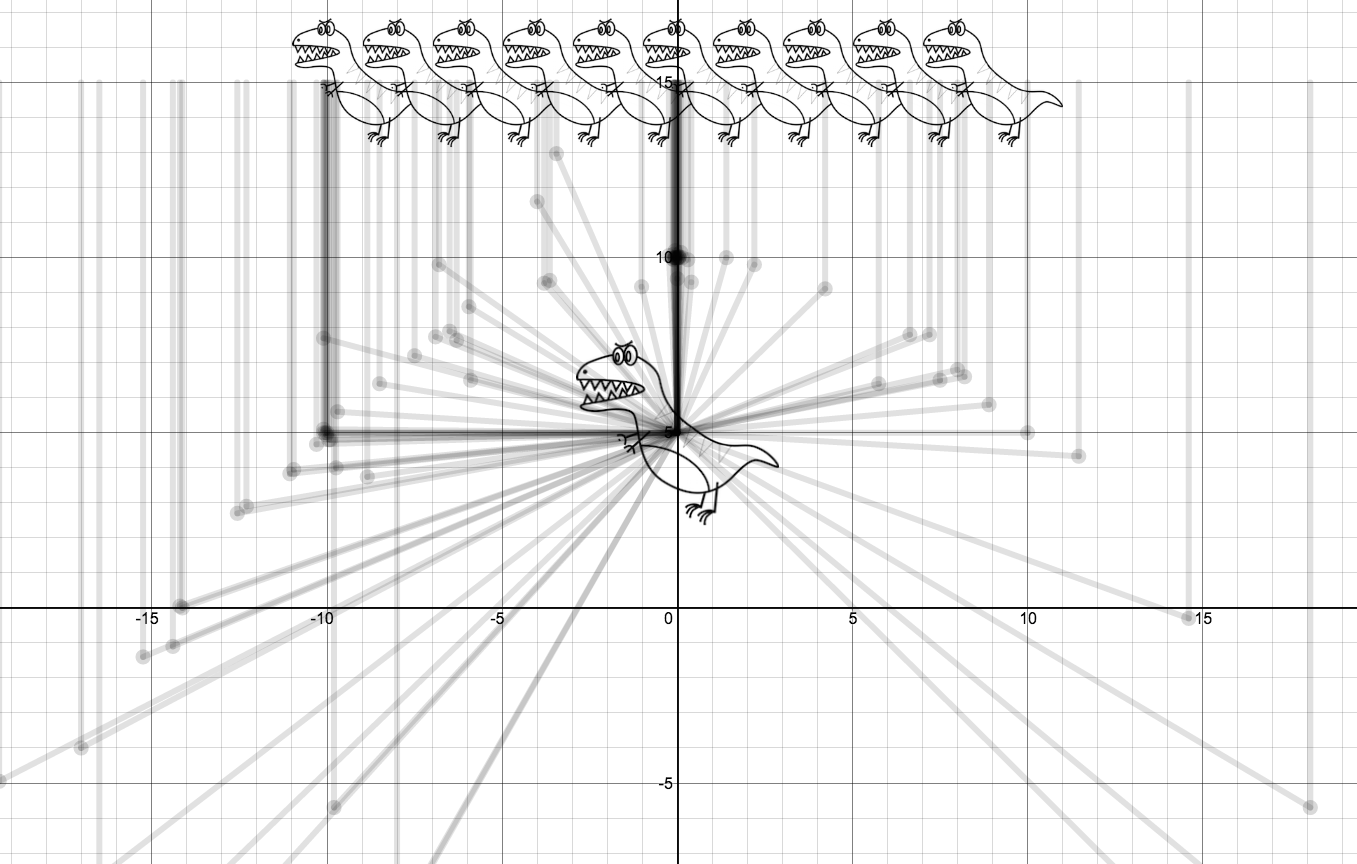
It asks students to place a point anywhere on a graph so that it makes a particular relationship true. Then it asks the students to imagine what all of our points would look like if we pictured them on the same graph. Then the teacher can show the results, underscoring this Very Big Idea that I didn’t fully appreciate my first time through high school — what we eventually think of as a continuous line is a picture of lots and lots of points.

Here is what happened when 300 people on Twitter played along:

“Drag the green point so that it’s the same distance from both blue points.”
150811_1lo

Trickier: “Drag the green point so that it’s five units from both blue points.”
150811_2lo

Whimsical: “Drag the green point so it is the same distance from a) the line of dinosaurs and b) the big dinosaur.” I really couldn’t have hoped for better here.
150811_3lo

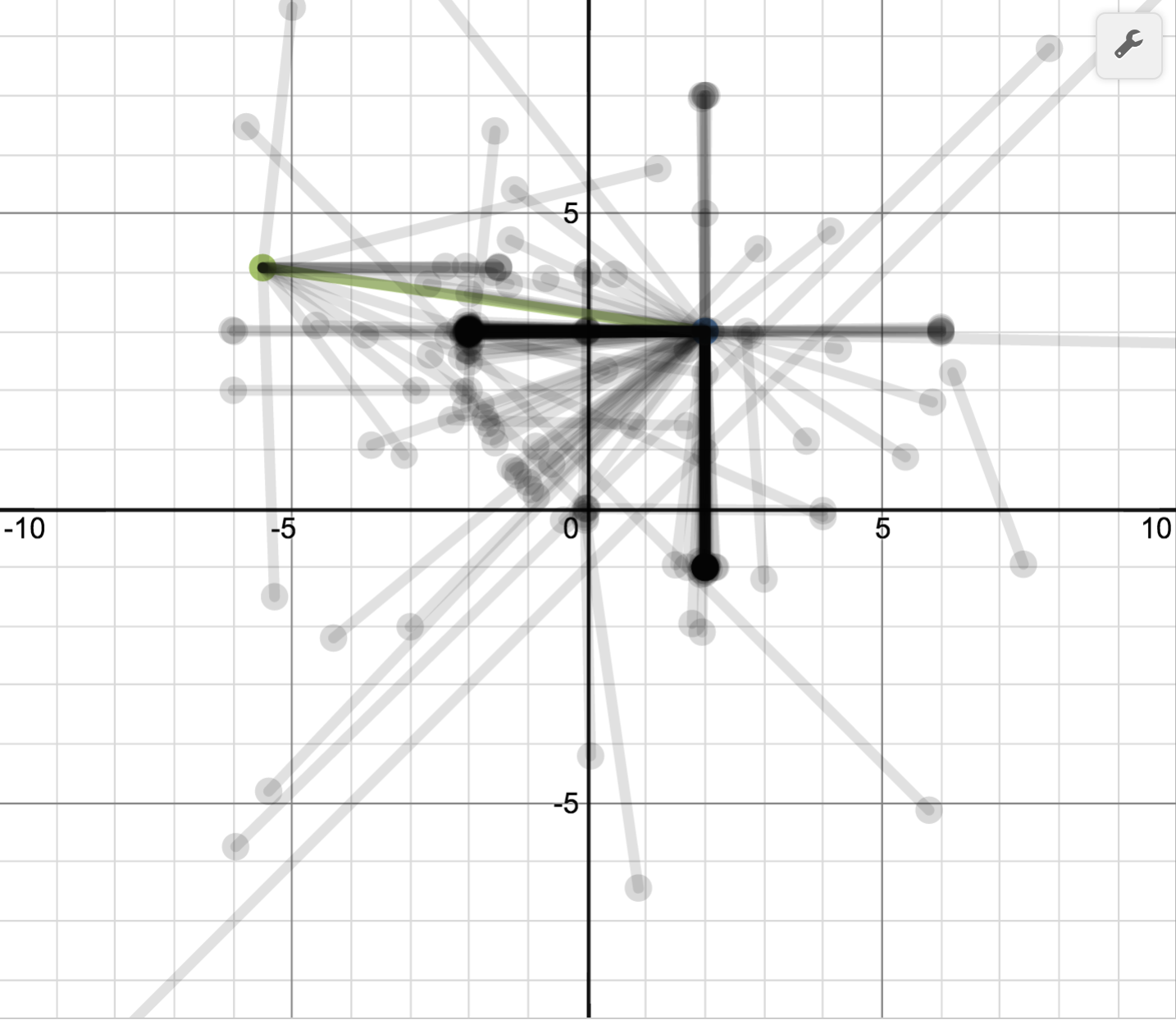
And then a couple of very interesting misfires.

“Drag the green point so that it’s four units from the blue point.”
150811_5lo

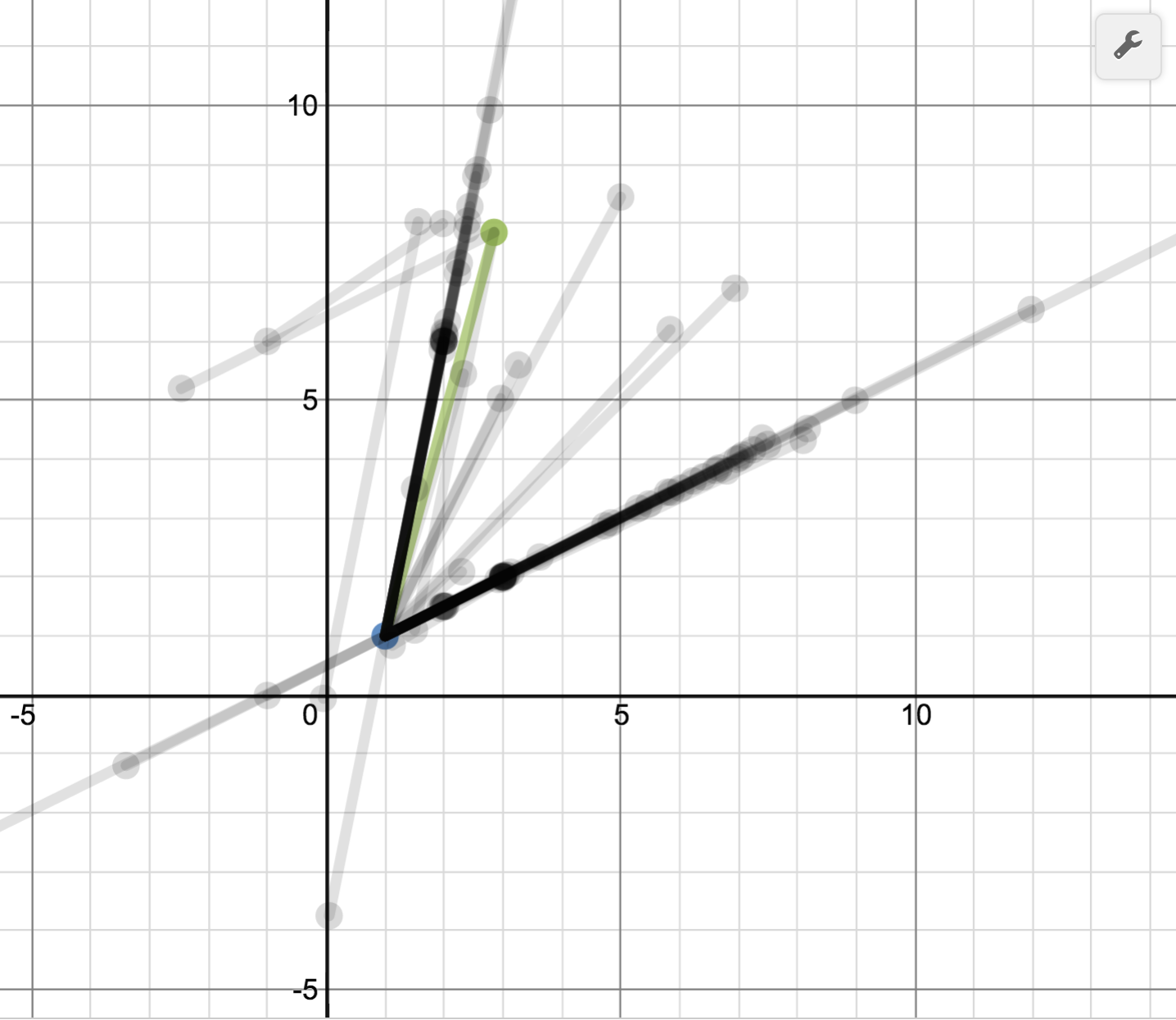
“Drag the green point so that a line segment is formed with a slope of .5.”
150811_4lo

You could run a semester-long master’s seminar on the misconceptions in that last graph.

Well.

Maybe more like ten quick seconds at the start of your Algebra class.

If you’d like to run this activity with your own students, here is the teacher link.

Questions for the Comments

  • Obviously, I didn’t invite hyperbolas and ellipses to the party. Which other loci should have received the same treatment?
  • Which Very Big Ideas did you only fully understand once you started math teaching?

Featured Comment

Jason Dyer:

I find this sort of gap fascinating [my inability to conceive of graphs as a picture of solutions –dm] especially because it is likely somewhere along the line you were at least told this fact (you might even be able to track exactly where). But it still didn’t stick! It’s as if being told just isn’t enough.

Bowen Kerins:

The description you give about graphs is something we have to hit early and often in CME Project, it’s one of the top 3 things to learn in the entire curriculum. It’s amazing how that can get lost in the shuffle, but it does, and where it gets lost is the algorithmic way of graphing a function or equation: the A does this, the B does that, etc – all of this ignores the deeper fact that under the hood, this is all a relationship between two variables x and y.

The other two of Bowen’s top three things to learn in Algebra, according to Bowen on Twitter, are:

  • Variables represent numbers, so test numbers to test ideas and build equations.
  • Rules for new stuff should respect existing rules.

Featured Tweets

Amazing, all the people unburdening themselves on Twitter of math they only understood once they began teaching. What does it all mean?
What Would You Do With A $1,000 Classroom Grant?

A reader asked me what classroom technology she should purchase with $1,000. My response:

I’d install whiteboards on every vertical surface in the room. I’d make sure I had a good document camera. And I’d probably purchase video capture equipment, a hard drive, and a microphone so I could record my lessons. That’ll probably get you close to $1,000.

I felt clever recommending old-school whiteboards with a new-school technology grant. But then I put the question out on Twitter and everybody suggested the same purchase:

https://twitter.com/myleneabizeid/status/542012326543917056

Crazy, right? What would you buy?

$1,000 isn’t nothing, but there are lots of organizations giving away that sum and more to teachers. I have it on some authority that The Mathematics Education Trust has trouble some years giving away their (fairly substantial) grants. “Not enough qualified applicants,” I was told. So get out there. Get some cash. Get those high-tech whiteboards.

BTW. I think we can trace some of this recent popularity of whiteboarding to Peter Liljedahl, an associate professor at Simon Fraser University. Liljedahl gave a presentation at the Canadian Mathematics Education Forum on whiteboards, which he called “Vertical Non-Permanent Surfaces,” which is why I’m looking forward to finishing graduate school.

We Should Wish PhotoMath All The Success In The World

PhotoMath is an app that wants to do your students’ math homework for them. Its demo video was tweeted at me a dozen times yesterday and it is a trending search in the United States App Store.

In theory, you hold your cameraphone up to the math problem you want to solve. It detects the problem, solves it, and shows you the steps, so you can write them down for your math teacher who insists you always need to show your steps.

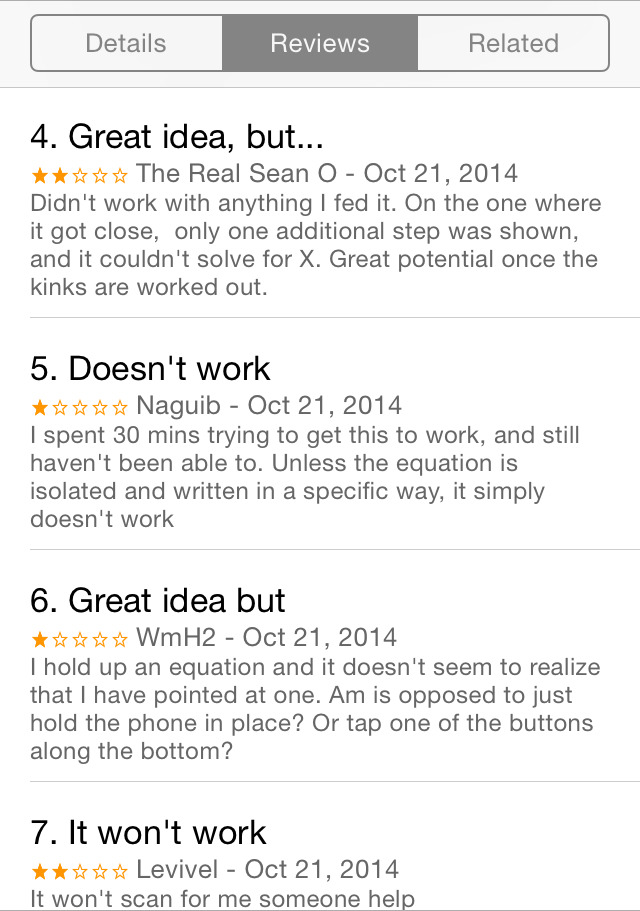
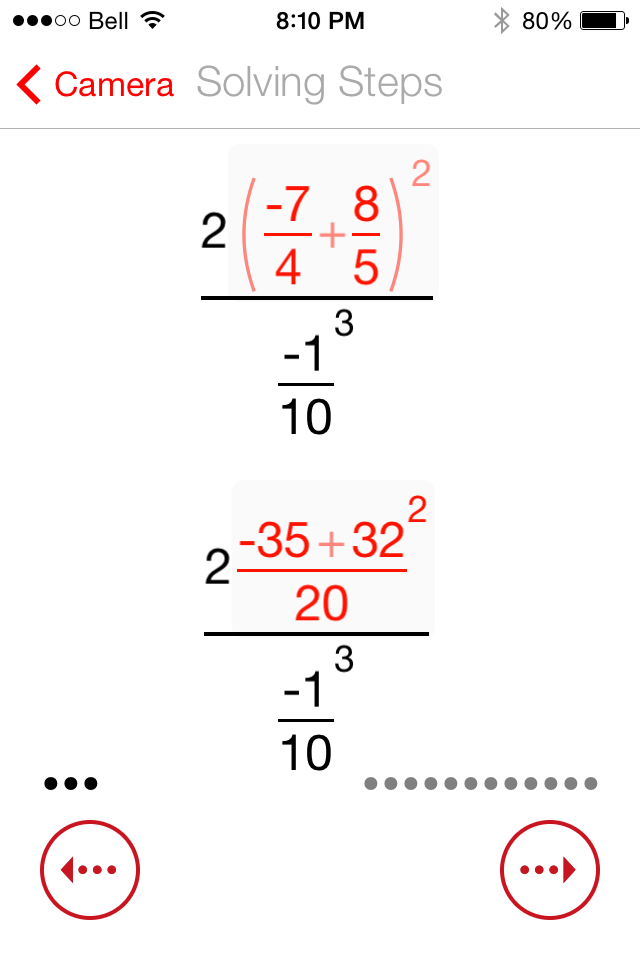
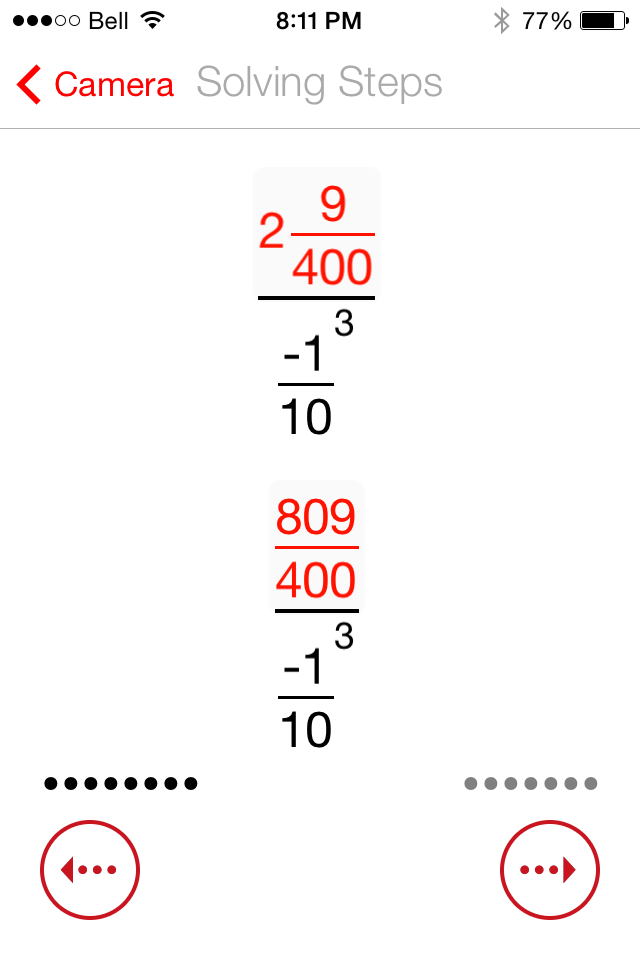
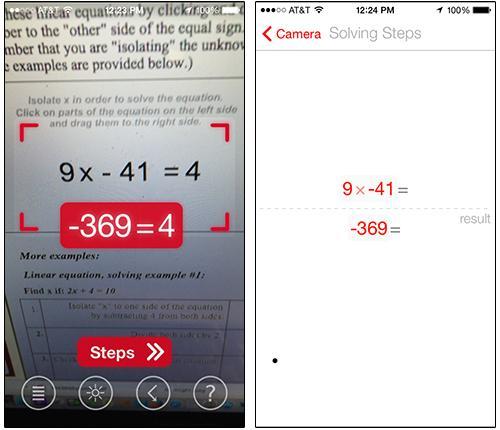
We should be so lucky. The initial reviews seem to comprise loads of people who are thrilled the app exists (“I really wish I had something like this when I was in school.”) while those who seem to have actually downloaded the app are underwhelmed. (“Didn’t work with anything I fed it.”) A glowing Yahoo Tech review includes as evidence of PhotoMath’s awesomeness this example of PhotoMath choking dramatically on a simple problem.

141022_3

But we should wish PhotoMath abundant success — perfect character recognition and downloads on every student’s smartphone. Because the only problems PhotoMath could conceivably solve are the ones that are boring and over-represented in our math textbooks.

It’s conceivable PhotoMath could be great for problems with verbs like “compute,” “solve,” and “evaluate.” In some alternate universe where technology didn’t disappoint and PhotoMath worked perfectly, all the most fun verbs would then be left behind: “justify,” “argue,” “model,” “generalize,” “estimate,” “construct,” etc. In that alternate universe, we could quickly evaluate the value of our assignments:

“Could PhotoMath solve this? Then why are we wasting our time?”

2014 Oct 22. Glenn Waddell seizes this moment to write an open letter to his math department.

2014 Oct 22. David Petro posts a couple of pretty disastrous screenshots of PhotoMath in action.

2014 Oct 23. John Scammell puts PhotoMath to work on tests throughout grade 7-12. More disaster.

2014 Oct 24. New York Daily News interviewed me about PhotoMath.

2014 Oct 27. Jim Pai asked some teachers and students to download and use PhotoMath. Then he surveyed their thoughts.

Featured Comment

Kathy Henderson gets the app to recognize a problem but its solution is mystifying:

I find this one of the most convoluted methods to solve this problem! I may show my seventh graders some screen shots from the app tomorrow and ask them what they think of this solution — a teachable moment from a poorly written app!

M Ruppel:

I we are structuring this the right way, kids (a) won’t use the app when developing the concept, (b) have a degree of comfort with doing it themselves after developing the concept and (c) take the app out when they end up with something crazy like -16t2+400t+987=0, and factoring/solving by hand would take forever.

Sander Claassen:

The point in this case isn’t how well the character recognition is. Or how correct the solutions are. Because it’s just a matter of time before apps like these solve handwritten algebra problems perfectly in seconds, providing a clear description of all steps taken.

The point is: who provides the equation to be solved by the app? I have never seen an algebraic equation that presented itself miraculously to me in daily life.

Kenneth Tilton:

ps. Photomath is just a “stupid pet trick” they did to market their recognition engine.

Five Reasons To Download Classkick

Before I get to the good, here’s the tragic, a comment from a father about a math feedback platform that I don’t want to single out by name. This problem is typical of the genre:

My daughter just tried the sine rule on a question and was asked to give the answer to one decimal place. She wrote down the correct answer and it was marked wrong. But it is correct!!! No feedback given just — it’s wrong. She is now distraught by this that all her friends and teacher will think she is stupid. I don’t understand! It’s not clear at all how to write down the answer — does it have to be over at least two lines? My daughter gets the sine rule but is very upset by this software.

My skin crawls — seriously. Math involves enough intrinsic difficulty and struggle. We don’t need our software tying extraneous weight around our students’ ankles.

Enter Classkick. Even though I’m somewhat curmudgeonly about this space, I think Classkick has loads of promise and it charms the hell out of me.

Five reasons why:

  1. Teachers provide the feedback. Classkick makes it faster. This is a really ideal division of labor. In the quote above we see the computer fall apart over an assessment a novice teacher could make. With Classkick, the computer organizes student work and puts it in front of teachers in a way that makes smart teacher feedback faster.
  2. Consequently, students can do more interesting work. When computers have to assess the math, the math is often trivialized. Rich questions involving written justifications turn into simpler questions involving multiple choice responses. Because the teacher is providing feedback in Classkick, students aren’t limited to the kind of work that is easiest for a computer to assess. (Why the demo video shows students completing multiple choice questions, then, is befuddling.)
  3. Written feedback templates. Butler is often cited for her finding that certain kinds of written feedback are superior to numerical feedback. While many feedback platforms only offer numerical feedback, with Classkick, teachers can give students freeform written feedback and can also set up written feedback templates for the remarks that show up most often.
  4. Peer feedback. I’m very curious to see how much use this feature gets in a classroom but I like the principle a lot. Students can ask questions and request help from their peers.
  5. A simple assignment workflow for iPads. I’m pretty okay with these computery things and yet I often get dizzy hearing people describe all the work and wires it takes to get an assignment to and from a student on an iPad. Dropbox folders and WebDAV and etc. If nothing else, Classkick seems to have a super smooth workflow that requires a single login.

Issues?

Handwriting math on a tablet is a chore. An iPad screen stretches 45 square inches. Go ahead and write all the math you can on an iPad screen — equations, diagrams, etc — then take 45 square inches of paper and do the same thing. Then compare the difference. This problem isn’t exclusive to Classkick.

Classkick doesn’t specify a business model though they, like everybody, think being free is awesome. In 2014, I hope we’re all a little more skeptical of “free” than we were before all our favorite services folded for lack of revenue.

This isn’t “instant student feedback” like their website claims. This is feedback from humans and humans don’t do “instant.” I’m great with that! Timeliness is only one important characteristic of feedback. The quality of that feedback is another far more important characteristic.

In a field crowded with programs that offer mediocre feedback instantaneously, I’m happy to see Classkick chart a course towards offering good feedback just a little faster.

2014 Sep 17. Solid reservations from Scott Farrar and some useful classroom testimony from Adrian Pumphrey.

2014 Sep 21. Jonathan Newman praises the student sharing feature.

2014 Sep 21. More positive classroom testimony, this entry from Amy Roediger.

2014 Sep 22. Mo Jebara, the founder of Mathspace, has responded to my initial note with a long comment arguing for the adaptive math software in the classroom. I have responded back.

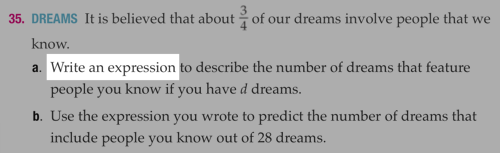
[Makeover] Central Park & These Tragic “Write An Expression” Problems

Previously: [Makeover] These Tragic “Write An Expression” Problems

tl;dr. I made another digital math lesson in collaboration with Christopher Danielson and our friends at Desmos. It’s called Central Park and you should check out the Walkthrough.

Here are two large problems with the transition from arithmetic to algebra:

Variables don’t make sense to students.

140728_1

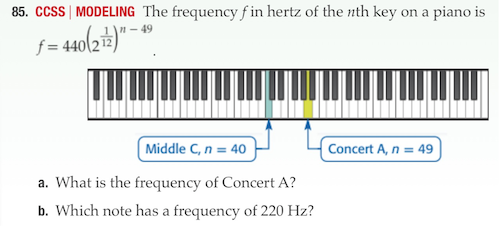
We give students variable expressions like the exponential one above, which they had no hand in developing, and ask them to evaluate the expression with a number. The student says, “Ohhh-kay,” and might do it but she doesn’t know what pianos have to do with exponential equations nor does she know where any of those parameters came from. She may regard the whole experience as one of those nonsensical rites of school math which she’ll forget about as soon as she’s legally allowed.

Variables don’t seem powerful to students.

In school, using variables is harder than using arithmetic. But what does that difficulty buy us, except a grade and our teacher’s approval? Meanwhile, in the world, variables are responsible for anything powerful you have ever done with a computer.

Students should experience some of that power.

One solution.

Our attempt at solving both of those problems is Central Park. It proceeds in three phases.

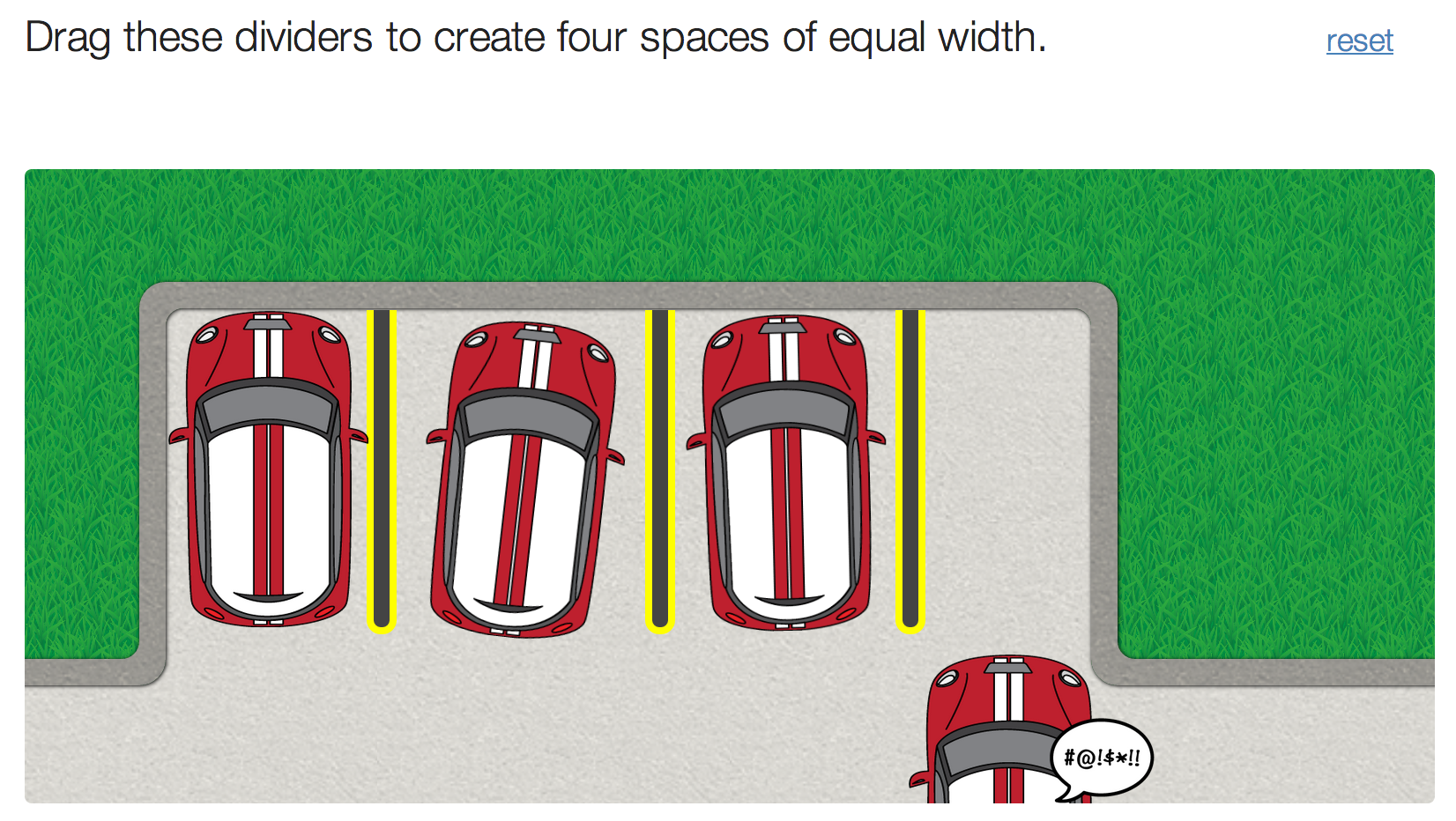
Guesses

140728_2lo

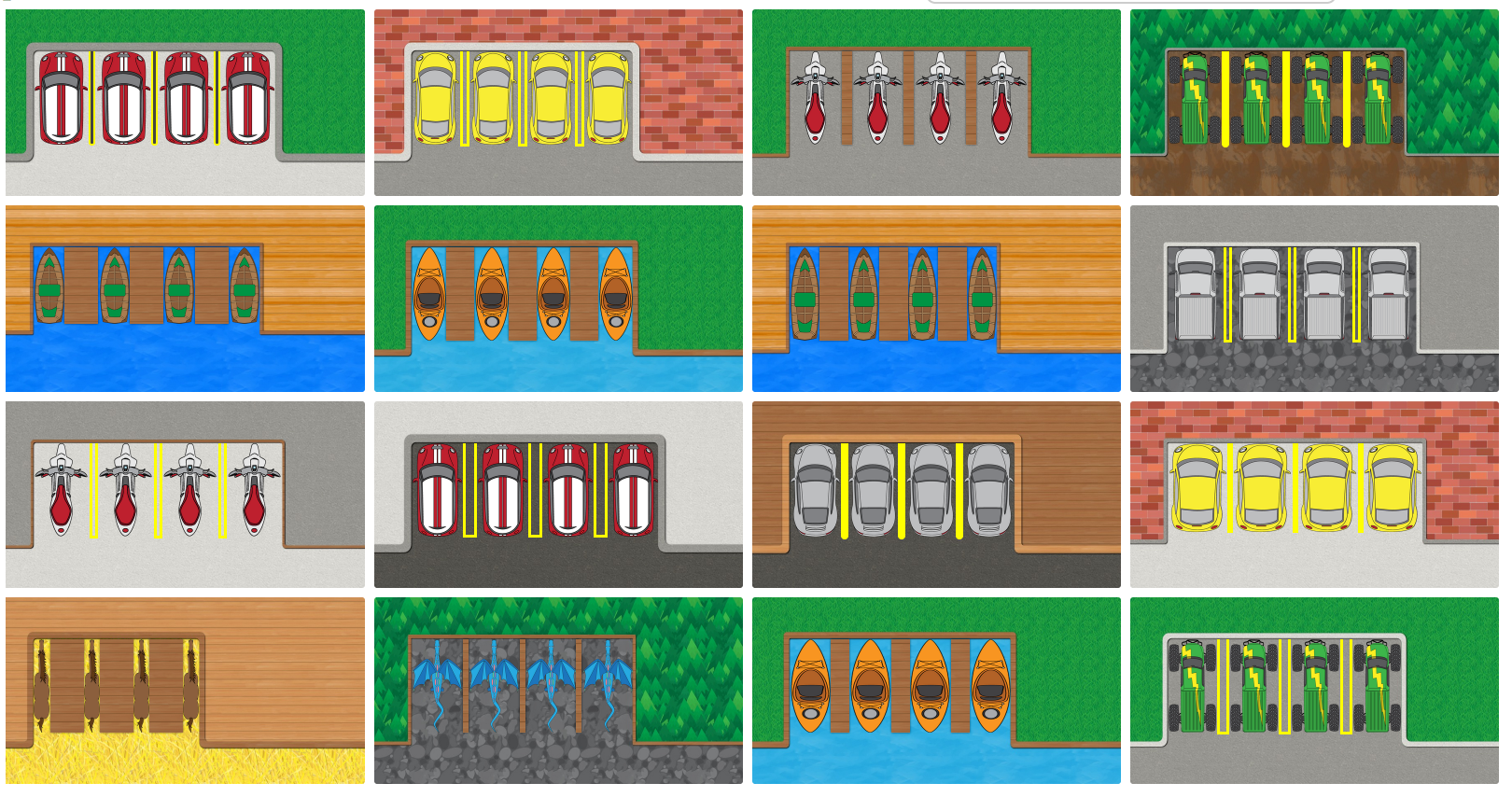
We ask the students to drag parking lines into a lot to make four even spaces. Students have no trouble stepping over this bar. We are making sure the main task makes sense.

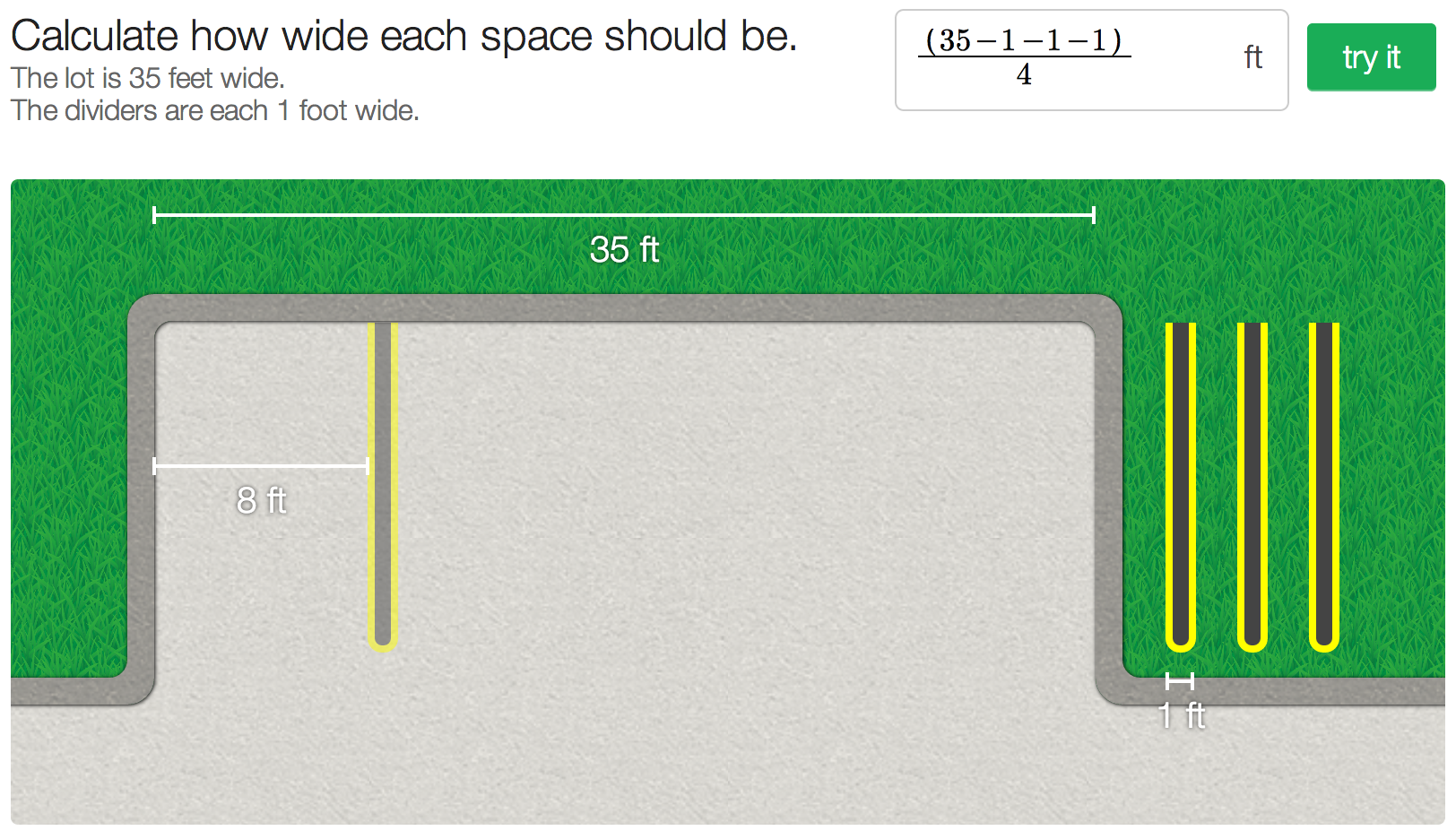
Numbers

140728_3lo

We transition to calculation by asking the students “What measurements would you need to figure out the exact space between the dividers?” This question prepares them to use the numbers we give them next.

Now they use arithmetic to calculate the space width for a given lot. They do that three times, which means they get a sense of the parts of their arithmetic that change (the width of the lot, the width of the parking lines) and those that don’t (dividing by the four lots).

This will be very helpful as we take the next big leap.

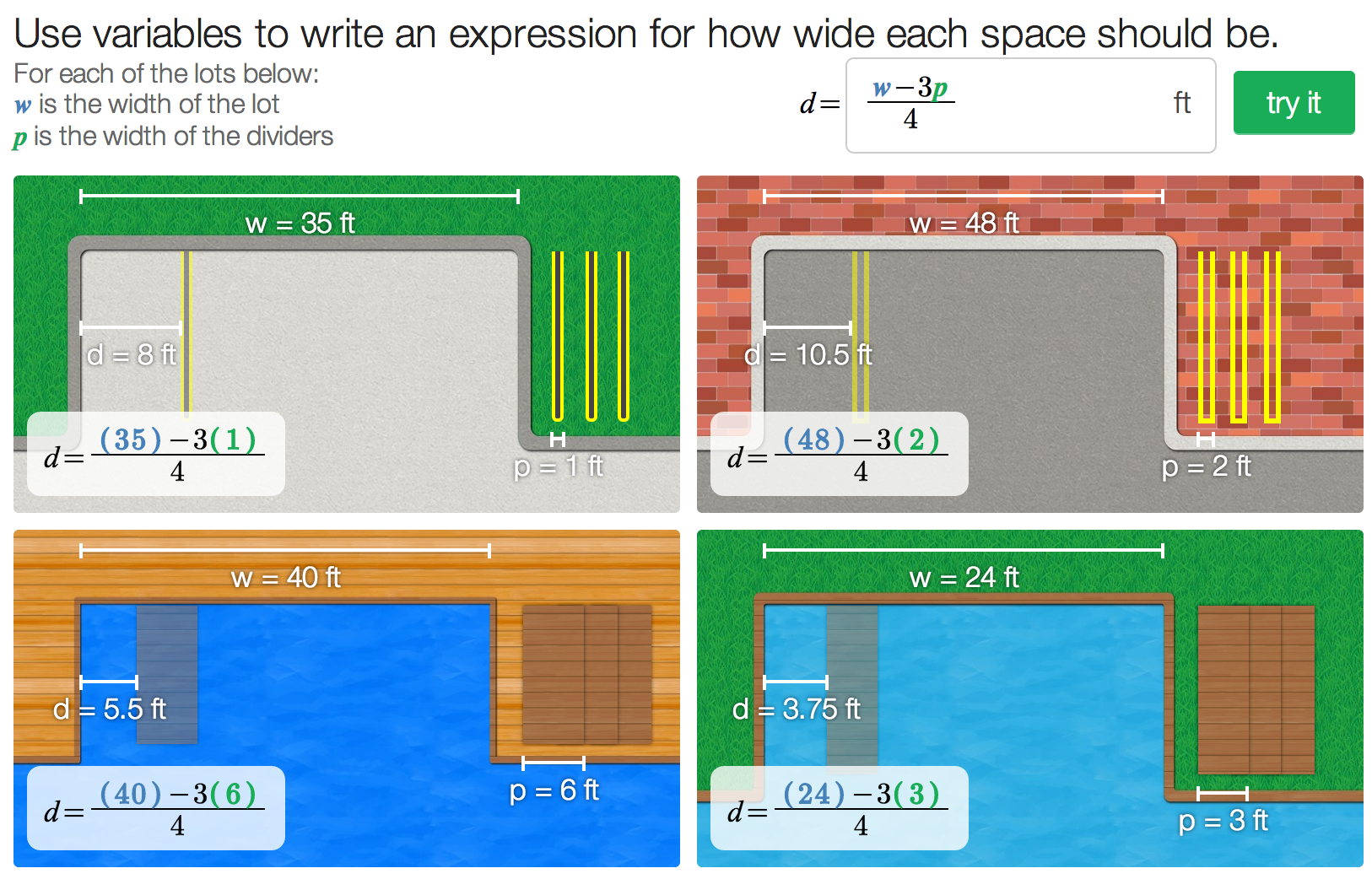
Variables

We give students numbers and variables. They can calculate the space width arithmetically again but it’ll only work for one lot. When they make the leap to variable equations, it works for all of them.

140728_4lo

It works for sixteen lots at once.

140728_5lo

Variables should make sense and make students powerful. That’s our motto for Central Park.

2014 Jul 28. Here is Christopher Danielson’s post about Central Park on the Desmos blog.

Featured Comment

Grant Wiggins:

In thinking further about your complaint about “Write an expression” I think what is also going on in this app is a NEEDED slowing down of the learning process. The text (and too many teachers) are quick to jump to algorithms before the students understands their nature and value. Look how long it takes to get to the concept of an appropriate expression in the app: you build to it slowly and carefully. I think this is at the heart of the kind of induction needed for genuine understanding, where the learner is helped, by scaffolding, to draw thoughtful and evidence-based conclusions; test them in a transfer setting; and learn from the feedback — i.e. the essence of what we argue understanding is in UbD.

Kevin Hall:

One reason I like this activity so much is that it hits the sweet spot where “What can you do with it?” and “What does it mean?” overlap.