[LOA] Abstracting Abstraction

or: Titles Guaranteed to Murder Your PageRank

As I mentioned previously, I find the verb “abstract” way more interesting than the adjective “abstract.” The adjective is often used critically and defensively (“Ugh. Algebra. Too abstract.”) whereas the verb represents a milestone in human cognitive development and a skill that grows more and more precious in the modern workforce. How many skills have a shelf life of thousands of years? (A: Not typesetting.)

So let’s define the verb:

Wikipedia:

Abstraction is a process or result of generalization, removal of properties, or distancing of ideas from objects.

American-Heritage Dictionary:

To take away; remove.

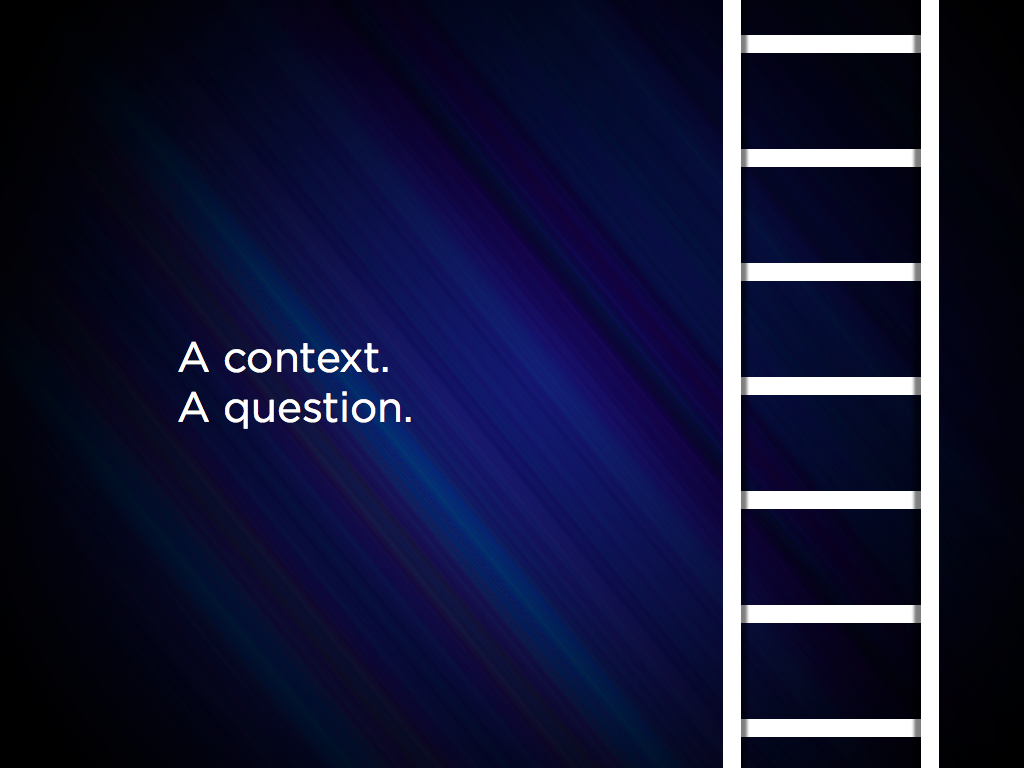
Let’s stipulate, then, that abstraction requires a context and a question.

If you’re going to remove stuff, there has to be stuff to remove. (A context.) If you’re going to remove stuff, you have to have some purpose that tells you to remove this stuff but not that stuff. (A question.)

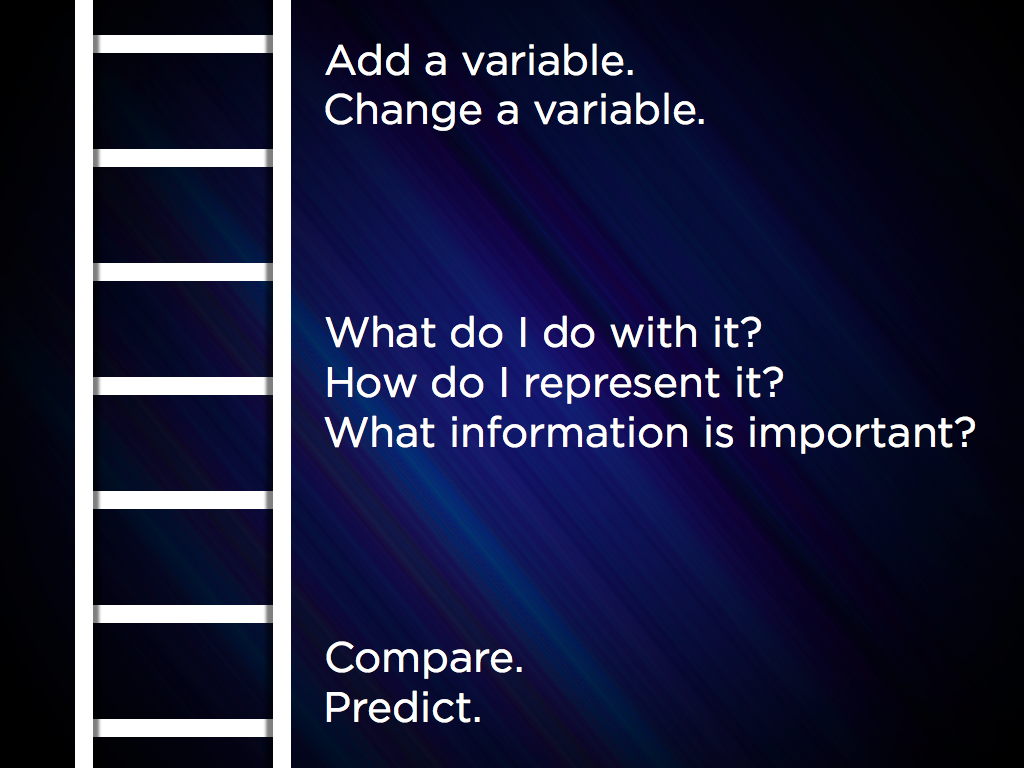
Then you’re on the ladder. As you go up the ladder you turn the context into something that excludes the noisy richness of the context but which is much more useful for answering your question. As I looked at all the times my students have abstracted in math class, I saw that the tasks and questions we confront and their order look a lot like this:

We debate the context on the level of experience and intuition. We make predictions. We compare different examples of the context until we understand which of its aspects are common and consequential to our question and which aren’t. We give those aspects names. We decide how to represent them. We decide what to do with those representations. And then we abstract other things in the same context.

If my mind were “light and deft and beautiful” as a monkey in a tree, I’d stop abstracting abstraction here, step down a few rungs on the ladder, and concretize this abstraction of the process of abstraction with an example. That’s next.

2012 Sep 26. William Carey passes along this succinct definition from Barry Mazur (2007):

This issue has been with us, of course, forever: the general question of ab-straction, as separating what we want from what we are presented with. It is neatly packaged in the Greek verb aphairein, as interpreted by Aristotle in the later books of the Metaphysics to mean simply separation: if it is whiteness we want to think about, we must somehow separate it from white horse, white house, white hose, and all the other white things that it invariably must come along with, in order for us to experience it at all.

[LOA] The Place Where Language And Math Make Friends

My response one year ago to a commenter who said I was always recommending that math teachers apologize for the abstractness of math:

Abstraction doesn’t make math harder. Abstraction makes math possible.

S.I. Hayakawa, 71 years earlier, in Language in Thought and Action:

The invention of a new abstraction is a great step forward, since it makes discussion possible

So that’s interesting.

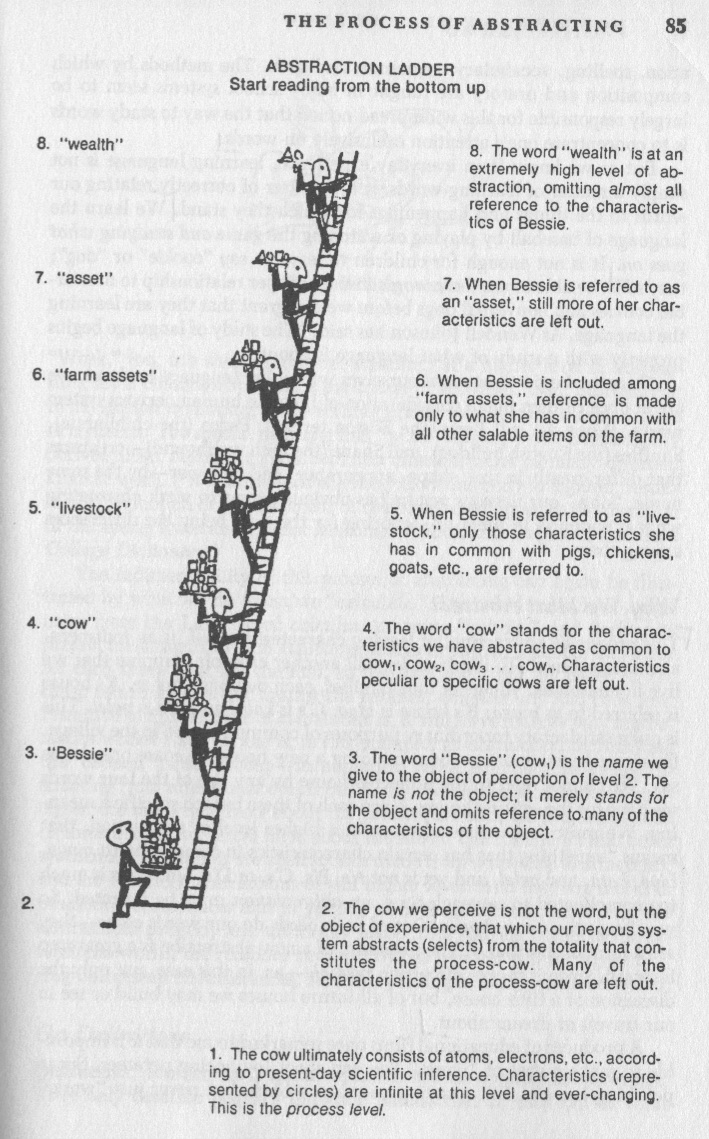
Here is a scan of the eighth chapter of Hayakawa, called “How We Know What We Know.” If this series ever turns into a dissertation proposal, odds are extremely high I’ll pull in one or more of the following excerpts:

Our concern here with the process of abstracting may seem strange, since the study of language is all too often restricted to matters of pronunciation, spelling, vocabulary, grammar and such. The methods by which composition and oratory are taught in many schools seems to be largely responsible for this widespread notion that the way to study words is to concentrate one’s attention exclusively on words.

Is it useful to draw a line from that excerpt to school mathematics instruction? Swap “pronunciation, spelling, vocabulary, grammar, and such” for “calculation and symbolic manipulation.”

We learn the language of baseball by playing or watching the game and studying what goes on.

I’m drawing a line to this post.

This process of abstracting, of leaving characteristics out, is an indispensable convenience.

As many commenters in the last installment pointed out, “abstract” is both a verb and an adjective, though it’s usually the adjective that people complain about. My working theory is that if we help students manage the verb better, the adjective will seem less threatening.

Hayakawa notes that the word calculate derives from the Latin word calculus which means “pebble.” Sheepherders would put a pebble in a box for each sheep that left the fold.

Each pebble is, in this example, an abstraction representing the “oneness” of each sheep – its numerical value.

Hayakawa gets explicit about mathematical abstraction:

Our x’s and y’s and other mathematical symbols are abstractions made from numerical abstractions, and are therefore abstractions of still higher level. And they are useful in predicting occurrences and in getting work done because, since they are abstractions properly and uniformly made from starting points in the extensional world, the relations revealed by the symbols will be, again barring unforeseen circumstances, relations existing in the extensional world.

… and the metaphor of the ladder:

The fundamental purpose of the abstraction ladder, as shown both in this chapter and the next, is to make us aware of the process of abstracting.

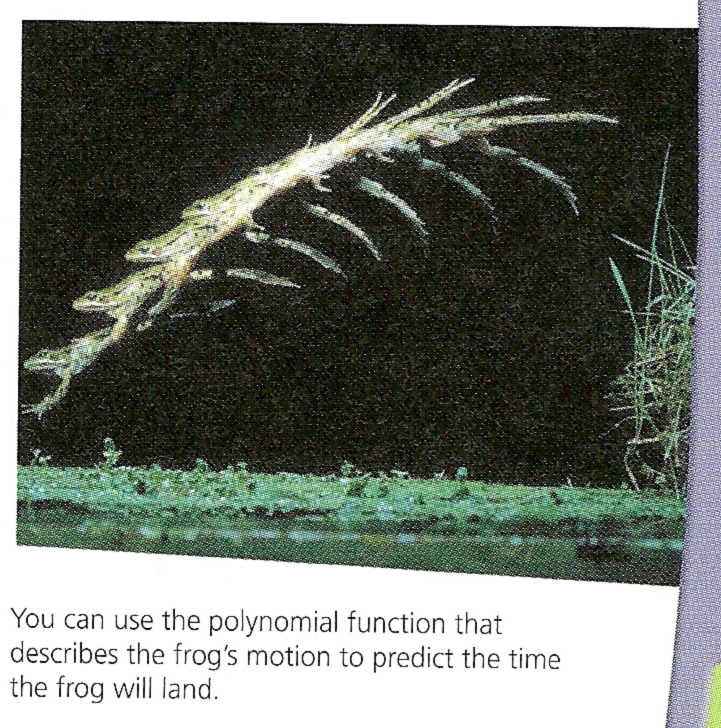
So here is another tentative thesis: secondary math instructors are generally less aware of the process of abstracting than their colleagues at younger grades. Students at the secondary level are generally assumed to be comfortable with mathematical abstraction so their teachers spend a great deal of time at higher rungs of the ladder. Secondary math curricula also tends to disregard lower rungs on the ladder, instead pointing weakly at concrete representations of other things. (eg. “Here’s a frog. You can use the polynomial function that describes the frog’s motion to predict the time the frog will land. Got that? Okay, now let’s do some work with polynomials.”)

But as the abstraction ladder has shown, all we know are abstractions. What you know about the chair you are sitting in is an abstraction from the totality of the chair. [..] The test of abstractions then is not whether they are “high-level” or “low-level” abstractions, but whether they are referable to lower levels.

Everything is abstract. Everything is more abstract than something lower on its ladder and less abstract than something higher on its ladder. The chair you’re sitting in is not concrete.

Hayakawa quotes Wendell Johnson who coined the term “dead-level abstracting,” a term which is so useful it’d get an entry in the official lexicon of this blog if this blog had an official lexicon:

Some people, it appears, remain more or less permanently stuck at certain levels of the abstraction ladder, some on the lower levels, some on the very high levels.

See earlier reference to secondary math instructors.

It is obvious, then, that interesting speech and writing, as well as clear thinking and psychological well-being, require the constant interplay of higher-level and lower-level abstractions, and the constant interplay of the verbal levels with the nonverbal (“object”) levels. [..] The work of good novelists and poets also represents this constant interplay between higher and lower levels of abstraction. [..] The interesting writer, the informative speaker, the accurate thinker, and the sane individual operate on all levels of the abstraction ladder, moving quickly and gracefully and in orderly fashion from higher to lower, from lower to higher, with minds as lithe and deft and beautiful as monkeys in a tree.

He would have helped me out a bunch if he had inserted “math teachers” between “novelists” and “poets,” or at least given us a spot in the tree next to the monkeys.

2012 Jul 25: My favorite author came to mind just now. In Shipping Out [pdf] David Foster Wallace abstracts over all the micromanaged comforts of a luxury cruise and finds existential despair at the top of the ladder. He does an excellent job shimmying up the ladder from ground-level to the stratosphere and back down again, sometimes within the same paragraph and all while keeping the reader along for the ride.

Featured Comments

Bruce James:

When my students complain that I’m smarter than them, I counter that I’m just at a higher level of misunderstanding.

Joshua Zucker:

I didn’t really learn to understand abstract-as-a-verb until I got it from the computer programming folks, via the How to Design Programs book (free at http://htdp.org if you’re interested). That process is one of the few times in my adult life when I felt like studying one thing made me significantly smarter.
[LOA] The Ladder of Abstraction, Part One Of Probably A Lot

It’s a familiar scene for a math teacher. You’re chatting with a stranger at a party or the guy giving your hair a quick trim or anyone else. Conversation comes around to occupations. You mention you’re a math teacher. No one has a neutral reaction to “math teacher.” You take the tension head-on and ask, “What did you think about math as a kid?” The majority opinion on childhood mathematics is often negative and you notice the same adjective crops up over and over again: “abstract.”

“I liked Geometry. Algebra was too abstract.”

“Math was too abstract. I liked working with my hands more.”

“I liked Algebra. Geometry was too abstract.”

I’m going to try to pound in some fenceposts around the terms “abstract,” “abstraction,” and specifically, “the ladder of abstraction.”

That last term has its deepest roots in the fields of language and rhetoric (Hayakawa, 1940) though Bret Victor recently knocked it out of the park with an interactive essay describing its applications in mathematics and computer science. This fencepost-pounding process may require only a few months and a few blog posts (if you’re lucky) or a few years and a dissertation (if I’m lucky). However long it takes, you should help me interrogate the term. Does it mean anything? Does its meaning have any implications for the workings of a math classroom? If we understand it, can we counteract the perception that math is too abstract, or at least understand that perception well enough to manage it?

I’ll finish this brief introduction by describing the personal appeal of the ladder of abstraction:

  1. Self-study. In the best classroom experiences I’ve witnessed or orchestrated, I could describe the students as “ascending the entire ladder of abstraction.” I want to know more about that.
  2. It ties a lot of good pure and applied math instruction together. I’ve done an excellent job pigeonholing myself as some kind of zealot for applied mathematics but some of my favorite experiences in the classroom haven’t involved any applied context at all. Common to all of them (and common to my applied math methods) is their origin at the bottom of the ladder of abstraction. I didn’t hoist students to a higher rung until they’d worked on the rungs below.
  3. There might be a dissertation & career in there somewhere. Implementing the ladder of abstraction in the classroom requires multiple media. Don’t misunderstand me. I’m not saying, “Good math instruction requires digital media – photos and videos, etc.” I’m saying that it’s difficult to fully exploit that ladder if you design a task using only one medium. (Paper, in particular, limits your tasks to exactly one rung on the ladder, depending on how strictly we define our terms.) The task I linked above – graph: 3x + 2y = 12 – required two media, none digital: 1) voice, 2) a collaborative writing surface. Tasks that work up and down the entire ladder of abstraction don’t require digital media, but holy cow does a digital platform make those tasks easier to implement. As I look ahead to (fingers crossed) finishing this PhD and getting a job doing I have no idea what, I think I could contribute some value to our field by helping people create tasks that ascend the entire ladder. Provided I understand it.

Thanks in advance for your help.

Kate On Khan, Khan On PBL

Kate Nowak prefaces her #mtt2k contribution:

Before y’all get out your flamethrowers and head to the comments, I’d like to say a few things. I’m neither vitriolic, panicked, nor bitter about Khan Academy. I think it’s a great resource and it’s an excellent place to see a demonstration of procedures. I send my own students to it during exam review time, and they report that it is helpful.

Where Khan and the Gates Foundation overextend their claims, though, is when they suggest that the Khan Academy can serve as standalone instruction in Mathematics. Enduring learning requires productive struggle and time to noodle out unfamiliar problems, posed by a teacher who knows what you’re ready for, and can provide expert scaffolding. Lecture-only instruction focused on mastering procedures is an impoverished substitute for doing Mathematics, and it doesn’t matter if that lecture is in person or in a video.

Well-put, all the way around.

For my part, I find it pretty difficult to talk with people about the uses and limitations of Khan Academy if either of the following conditions are true:

  1. that person believes teachers are frequently motivated by jealousy,
  2. that person’s own math education comprised ten years of lectures followed by procedures repeated ad nauseum.

Occasionally both conditions are true simultaneously and we’d be better off discussing less intractable issues than Khan Academy, like abortion or climate change.

BTW. As long as we’re here: Khan Academy frequently asserts itself as interested in more than lectures and procedures. Whenever a blogger points out that, “No, there’s not a whole lot of evidence for that,” a Khan Academy proponent named Jay Patel (who comments under various pseudonyms on this blog and others) will often link to this page in the Khan Academy customer portal, which cites as its project-based bonafides an activity called Simpsons Sunblocker. No problem there, except that Simpsons Sunblocker was developed by my team at Stanford – here’s the activity; have fun! – not Khan Academy, whose representatives tried to convince us we should do the activity only after the students watched a lecture about proportions and practiced those procedures. (Playing a game of basketball only after shooting hours of foul shots, essentially.)

I don’t care about credit. As I say at the end of this comment, I would love for Khan Academy’s deed to match its word on project-based or problem-based or anything-other-than-lecture-and-procedure-based learning, but I haven’t seen it.