Careful Now: 21st Century Edition

Linda links over with her own “Careful Now” admonishment, probably best expressed by this poster, which she recommends her readership paste above its school copiers.If anyone needs me to explain the joke, let me know.

She describes, but doesn’t elaborate on, a set of decent handouts she made in her early career, which she recently discarded. However, it isn’t hard to infer from these bullets …

  • In years to come will you be stopped in the street by an ex-student and they will bow down before you and thank you for all the exciting worksheets they gave? I donโ€™t think so!
  • Please challenge your students and teach them to think.
  • Please give your students a 21st Century Literacy skillset.
  • Please hang this poster next to your schoolโ€™s photocopier.

… that she finds worksheets unchallenging and unrepresentative of the skills kids need in the 21st century.

Let me say, first, that I think there is a decent heart here, something that may rightly rattle those teachers who content themselves cranking out worksheet after worksheet, passing them out after a rote opener, and then receiving questions at their desks.

But I think her post also reflects:

  1. the 21st-century-learning crowd’s total misapprehension of how students learn mathematics, particularly of how students who don’t understand mathematics at all learn mathematics, and
  2. the 21st-century-learning crowd’s haste to throw out old mediums along with their bathwater.This blog hasn’t always been above confronting (c) the tendency of enlightened 21st-century-learning educators to alienate those they should support.

Unsurprisingly, Linda teaches (or at least taught) English, which lends itself so well to a substituted set of 21st-century activities (eg. instead of printing an essay out in hard copy, blog it and let your classmates comment; instead of taking hard copy notes on Chuacer’s Canterbury characters, set up wiki pages for each) that she’s developed a familiar myopia.

I mean, it’s gotta be that easy for other subjects, right?

But no. Set aside for a moment the hair-pulling difficulty of entering equations and math notation into a blog interface. Math is skill-based in a way that few subjects are. And skills demand practiceFeel free to notice, at this point, the disproportionate number of math teachers blogging. It isn’t (entirely) because words scare us..

Aside from that: worksheets are only a medium, empty pieces of paper, and anyone advocating that we chuck an entire medium in the name of progress would do well to justify it.

For example, what quality of paper prevents challenging exercises from adhering and allows only the lame, rote stuff to stick? What quality of paper insists on empty thought?

Once we exit that dim thought-corridor, the good times roll, and we can investigate the issue which deserves investigation: what we put on the worksheets.

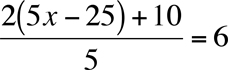
Today’s worksheet is worth posting. We’re learning entirely new skills. By the end of today’s class, students will go from outright befuddlement at this …

… to a tentative ability to solve beasts like theseEquations which took five minutes to attach to this post. My thanks to anyone who can explain how the hell LaTeX works in here..

We did it with four carefully selected problems, problems which I delivered on a worksheet, each problem eliminating units of mental scaffolding so precisely that most of my desk-help topped out at the question, “How is this problem different from the last one?”

My ongoing question for the 21st-century crowd is:

  1. how do I perform that same feat (again from scratch) using blogs, wikis, podcasts, Skitch, VoiceThread, or whatever, or alternately
  2. should a student’s compulsory education even include that knowledgeFrom experience, I don’t anticipate much response to the first question. Ex-blogger Chris Lehmann recently put some screws to that second question, though..

Related:

Careful now.

I saw this in a pile of forgotten masters while walking by the copier. It was love.

Check out the clear hierarchy. The single, legible font. The single style for emphasis. Margins tightly aligned. The second lines indenting just as they should. Spacing is evenly distributed. The kids know exactly where to look, where to go for their next question, and where to find important information.

I stood there, the clear design drawing me in, the world slowing to a crawl behind me. I took it, scanned it, and decided that, look, unless you know how to translate all these techniques from the handwritten page to the printed page, stand by your handwriting.

Computers make light work of worksheets for teachers, but whether they’re any good for students depends entirely on the skill of the designer.

Related:

Build Your Handouts

Thanks.

Shortly after the results were announced on some SecondLife island, a writer with The Guardian, Steve O’Hear, e-mailed all the winners (presumably) with the questions:

  1. Why did you start blogging?
  2. What does the award mean to you?

My answers, as well as the reasons why I’ve carpet-bombed this blog with “for your consideration” ads, have very little to do with egotism or self-validation. Since it’s as good a statement of purpose as anything I’ve written, here is my response:

I blog to make the long road shorter for new teachers. My four years teaching have been marked by a lot of failure and, only recently, some success. By writing about successful classroom management, lesson design, and general practice I hope others will find success sooner. Perhaps I’m trying to redeem my early failures in the process.

But these pieces I write are rather useless if no one reads them. Some find the award process and its politicking and lobbying irritating but for me it all serves one end โ€“ I can help more people if more people read. I care little for egotism and self-validation. I care about gathering a readership and building a richer conversation.

Thanks again.

“We are the salt on the slugs of innovation.”

TMAO is the Alfred Hitchcock of the Edublog Awards. Whatever your take on his pedagogy or policy, dude’s undeniably the best writer on the edubloc. ¶ His post, The Ledge, surfaced the merit pay issue (as someone must every two or three months) and now he’s written Rules for the Voyage: Merit Pay to contend with criticism. ¶ Pull quote: “In education circles, especially those composed of teachers, we routinely murder the Good in the name of the Perfect. Whether in terms of classroom practices, school structure and function, or large scale systematic improvements and alterations, if an idea or proposal fails to repel any hypothetical hurled its way, said proposal is immediately dismissed and chests are thumped accordingly.” ¶ TMAO, man, I’m taking your book on vacation. Gonna see if you do to the Florida punk scene what your blog does to inner-city education. Respect.

Are you hot or not?

Back in college I lived in a townhouse with seven other guys. We had a house website with bio pages for the eight of us, head shots, etcWhich I can’t believe is still alive on the Internet.. We feuded with another house of guys across town, driving over at any idle hour just to turn off their power, toss a few hundred uncooked tortillas on their lawn, etc, the usual. You probably heard about us.

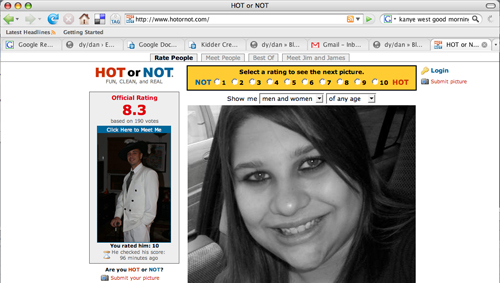
One day we threw all our headshots into some morphing software and got a snapshot of what our composite roommate would look like. We threw him onto a website called Hot Or Not where vanity- and charity-cases alike upload photos for others to rank on a ten-point scale. “We” pulled an eight and partied continuously for several weeks.

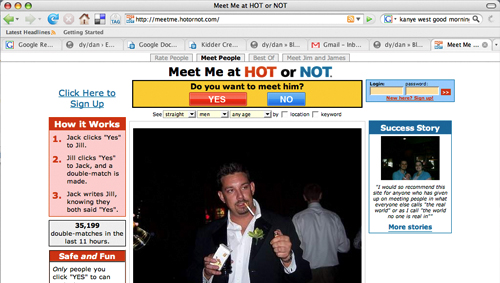
Until last week, I had no idea Hot Or Not was still around. It is and has drawn the attention of researchers from Columbia, Carnegie Mellon, and M.I.T. All these people feeding quantifiable preferences into Hot or Not’s servers, millions on the month, constitutes an ideal data set. Another apparent data set is Hot Or Not’s “Meet Me” service where you can meet someone but only if he or she wants to meet you also.

All that data and analysis, recently released, fascinated me for a 72-hour stretch last week. My job description, as I try to frame it these days, is to make some fraction of what excites me about life (and math, in particular) exciting to my kids. This one was difficult.

Mostly, it’s tough striking up a good conversation over questions which have already been answered. You’ve gotta tease them with clues without frustrating them, drifting just enough information past ’em without giving it all away.

Here’s how we built from nothing to something:

  • Discuss the question: “why do we date?” In my classes, answers ranged from the expected (someone’s fun to be around, cute, makes you feel happy) to the really expected (someone’s hot, horny, fertile, has money).
  • Focus for a bit on the “fertile” answer and how making babies is a biological imperative for every species.
  • Introduce hotornot.com. These people upload photos of themselves, you rank one, another photo appears, and then it’s three hours later.
  • Ask: “Who do you think hands out more ‘hot’ ratings? Guys or girls?” In my classes, both genders selected themselves. (Which confounds me still. Anyone know why?) Turns out it’s guys by 240%. (Which seems like a lay-up to me, but there ya go.)
  • Introduce the MeetMe service. If you want to meet this guy here, you click “meet,” at which point your photo is sent to him and then if he wants to meet you, your e-mail addresses are exchanged, love is found, babies are made.
  • Ask: “Who do you think clicks the ‘meet’ button more? Guys or girls?” Guys again.
  • Ask: “Who do you think clicks the ‘meet’ button more? People with low ratings or high ratings?” Low. Turns out, for each ranking you slip (from a 6 to a 5, for example) you become 25% more likely to accept a date.
  • You assign the class a hotornot ranking. You arbitrarily assign ’em a 7, setting them up for what happens next.
  • You say, “How do you decide which invitations to accept? Do you accept a 3?” Everyone says no. “Do you accept a 6?” Some would only date their level and above. Others recognized that the rankings came from a community that didn’t, e.g., share their affinity for baldness, and would consider a 6.
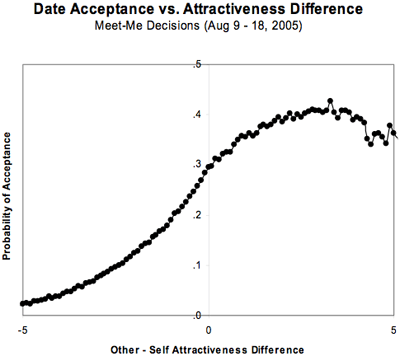
  • And finally, you show this chart-gem.
  • You talk about it. The x-axis is tricky. It’s the difference between you and the person asking you out. You point to the extreme left edge and say, “-5. How hot is that person?” Some will say “-5.” Others see that she’s a 2.
  • You gesture at the y-axis and say, “Is your probability of going out with this person low or high? Low. Obviously.
  • Ask: “What about this graph is expected?” You talk about how the graph rises, as you’d expect.
  • Ask: “What about this is unexpected?” And this is, of course, the kicker. Why does the graph take a dip at the end? Why would you decline to meet someone who was five ranks hotter than you? (Your thoughts are welcome in the comments.)

Total cost: ten minutes. In all, a really good way to kick off a period. If you’re feeling brave and you’ve got their trust, you can discuss the question, “how do 2’s find and maintain love?”